Department of Genetics and Plant Breeding, ChaudharyCharan Singh University (CCSU), Meerut, 250 004, India.
National Agri-Food Biotechnology Institute (NABI), Sector 81(Knowledge City), SahibzadaAjit Singh Nagar, Punjab, 140306, India.
BMC Genomics. 2021 Aug 5;22(1):597. doi: 10.1186/s12864-021-07834-5.
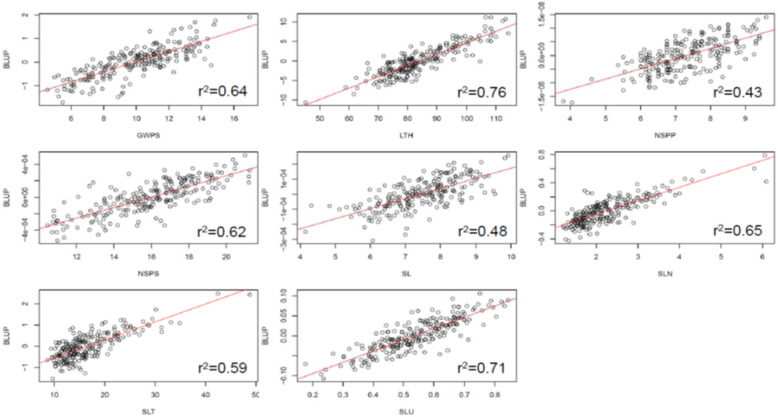
Bread wheat (Triticum aestivum L.) is one of the most important cereal food crops for the global population. Spike-layer uniformity (the consistency of the spike distribution in the vertical space)-related traits (SLURTs) are quantitative and have been shown to directly affect yield potential by modifying the plant architecture. Therefore, these parameters are important breeding targets for wheat improvement. The present study is the first genome-wide association study (GWAS) targeting SLURTs in wheat. In this study, a set of 225 diverse spring wheat accessions were used for multi-locus GWAS to evaluate SLURTs, including the number of spikes per plant (NSPP), spike length (SL), number of spikelets per spike (NSPS), grain weight per spike (GWPS), lowest tiller height (LTH), spike-layer thickness (SLT), spike-layer number (SLN) and spike-layer uniformity (SLU).
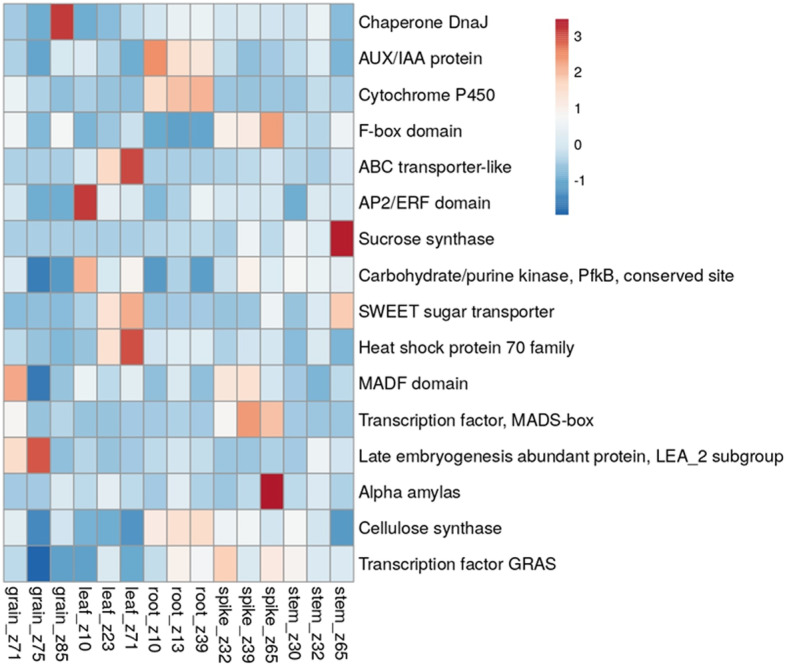
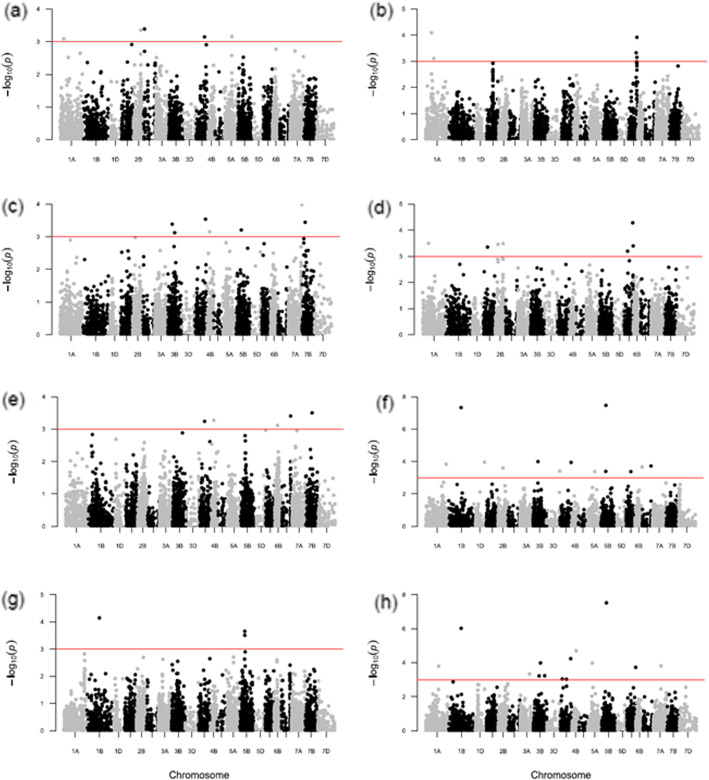
In total, 136 significant marker trait associations (MTAs) were identified when the analysis was both performed individually and combined for two environments. Twenty-nine MTAs were detected in environment one, 48 MTAs were discovered in environment two and 59 MTAs were detected using combined data from the two environments. Altogether, 15 significant MTAs were found for five traits in one of the two environments, and four significant MTAs were detected for the two traits, LTH and SLU, in both environments i.e. E1, E2 and also in combined data from the two environments. In total, 279 candidate genes (CGs) were identified, including Chaperone DnaJ, ABC transporter-like, AP2/ERF, SWEET sugar transporter, as well as genes that have previously been associated with wheat spike development, seed development and grain yield.
The MTAs detected through multi-locus GWAS will be useful for improving SLURTs and thus yield in wheat production through marker-assisted and genomic selection.
小麦(Triticum aestivum L.)是全球人口最重要的谷物食品作物之一。穗层均匀度(穗在垂直空间中的分布一致性)相关性状(SLURTs)是定量的,已被证明通过改变植物结构直接影响产量潜力。因此,这些参数是小麦改良的重要育种目标。本研究是针对小麦 SLURTs 的首次全基因组关联研究(GWAS)。在这项研究中,使用一组 225 个不同的春小麦品系进行多基因座 GWAS 来评估 SLURTs,包括每株穗数(NSPP)、穗长(SL)、每穗小穗数(NSPS)、穗粒重(GWPS)、最低分蘖高度(LTH)、穗层厚度(SLT)、穗层数(SLN)和穗层均匀度(SLU)。
当分别在两个环境中进行分析和组合分析时,共鉴定出 136 个显著的标记-性状关联(MTAs)。在环境 1 中检测到 29 个 MTAs,在环境 2 中检测到 48 个 MTAs,在两个环境的组合数据中检测到 59 个 MTAs。总共在两个环境中的一个环境中发现了五个性状的 15 个显著 MTAs,在两个环境中发现了两个性状,即 LTH 和 SLU 的四个显著 MTAs,即 E1、E2 以及两个环境的组合数据。总共鉴定出 279 个候选基因(CGs),包括分子伴侣 DnaJ、ABC 转运体样、AP2/ERF、SWEET 糖转运体,以及以前与小麦穗发育、种子发育和粒产量相关的基因。
通过多基因座 GWAS 检测到的 MTAs 将有助于通过标记辅助和基因组选择来提高小麦的 SLURTs 和产量。