Department of Family Medicine, Faculty of Medicine & Health Sciences, McGill University, Montréal, Canada.
Centre for Outcomes Research & Evaluation, Research Institute of the McGill University Health Centre, Montréal, Canada.
AIDS Patient Care STDS. 2021 Aug;35(8):288-307. doi: 10.1089/apc.2021.0079.
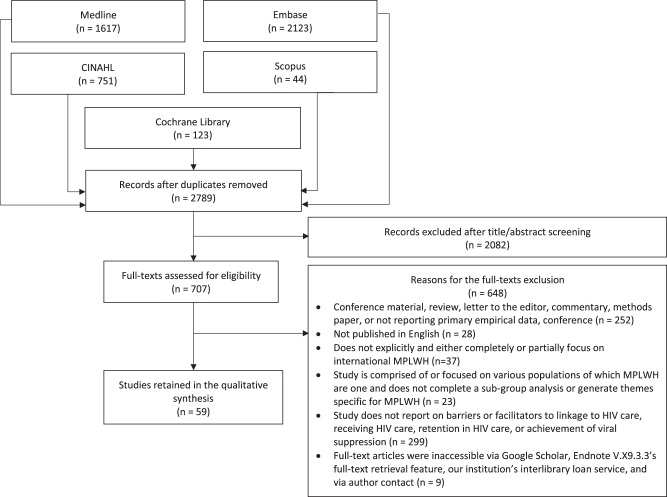
Migrants in countries affiliated with the Organization for Economic Co-operation and Development (OECD) have a higher risk of acquiring HIV, experience delayed HIV diagnosis, and have variable levels of engagement with HIV care and treatment when compared to native-born populations. A systematic mixed studies review was conducted to generate a multilevel understanding of the barriers and facilitators affecting HIV Care Cascade steps for migrant people living with HIV (MLWH) in OECD countries. Medline, Embase, Scopus, CINAHL, and the Cochrane Library were searched on March 25, 2020. Screening, critical appraisal, and analysis were conducted independently by two authors. We used qualitative content analysis and the five-level Socio-Ecological Model (i.e., individual, interpersonal, organizational, community, and policy) to categorize barriers and facilitators. Fifty-nine studies from 17 OECD countries were included. MLWH faced similar barriers and facilitators regardless of their host country, ethnic and geographic origins, or legal status. Most barriers and facilitators were associated with the individual and organizational levels and centered around retention in HIV care and treatment. Adapting clinical environments to better address MLWH's competing needs via multidisciplinary models would address retention issues across OECD countries.
在经济合作与发展组织(OECD)成员国中,移民感染艾滋病毒的风险更高,艾滋病毒诊断延迟,与本地出生的人群相比,他们接受艾滋病毒护理和治疗的程度也不同。为了从多层次了解影响移民艾滋病毒感染者(MLWH)接受艾滋病毒护理的障碍和促进因素,进行了一项系统的混合研究综述。于 2020 年 3 月 25 日在 Medline、Embase、Scopus、CINAHL 和 Cochrane Library 上进行了搜索。由两位作者独立进行筛选、批判性评估和分析。我们使用定性内容分析和五级社会生态模型(即个人、人际、组织、社区和政策)对障碍和促进因素进行分类。来自 17 个经合组织国家的 59 项研究被纳入。无论其所在国家、族裔和地理来源或法律地位如何,MLWH 都面临着类似的障碍和促进因素。大多数障碍和促进因素与个人和组织层面有关,主要集中在艾滋病毒护理和治疗的保留上。通过多学科模式调整临床环境,以更好地解决 MLWH 的竞争需求,将解决经合组织国家的保留问题。