Department of Population and Quantitative Health Sciences, Case Western Reserve University School of Medicine, Cleveland, Ohio, USA.
Case Western Reserve University School of Medicine, Cleveland, Ohio, USA.
Neuro Oncol. 2022 Feb 1;24(2):302-310. doi: 10.1093/neuonc/noab199.
Gliomas are the most common type of malignant brain and other CNS tumors, accounting for 80.8% of malignant primary brain and CNS tumors. They cause significant morbidity and mortality. This study investigates the intersection between age and sex to better understand variation of incidence and survival for glioma in the United States.
Incidence data from 2000 to 2017 were obtained from CBTRUS, which obtains data from the NPCR and SEER, and survival data from the CDC's NPCR. Age-adjusted incidence rate ratios (IRR) per 100 000 were generated to compare male-to-female incidence by age group. Cox proportional hazard models were performed by age group, generating hazard ratios to assess male-to-female survival differences.
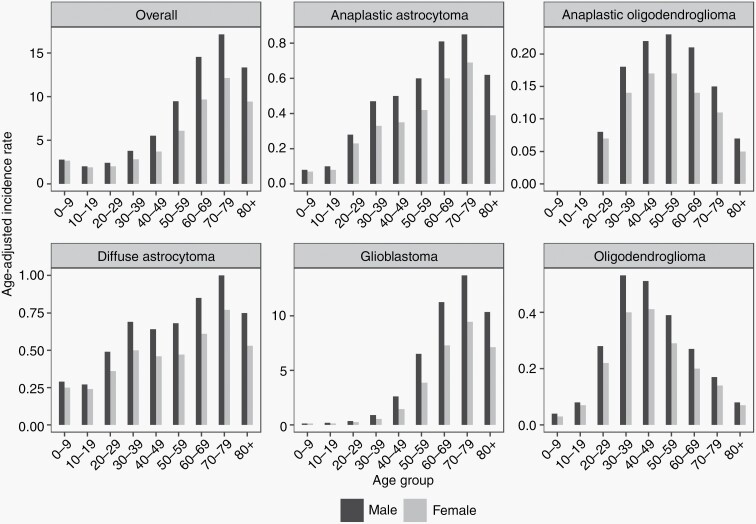
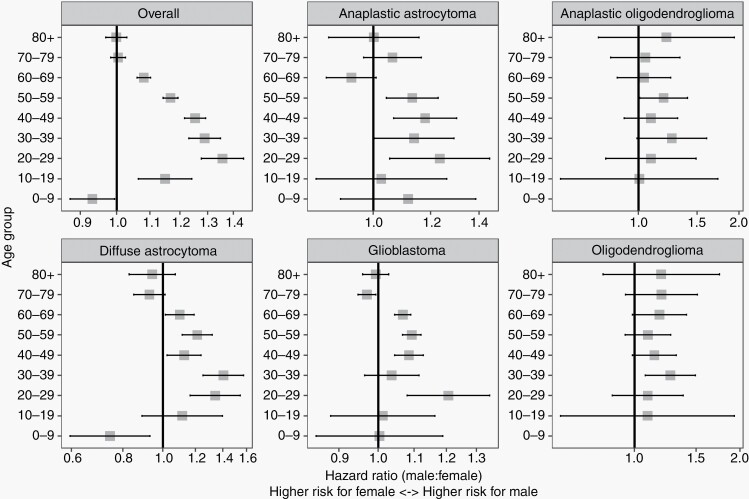
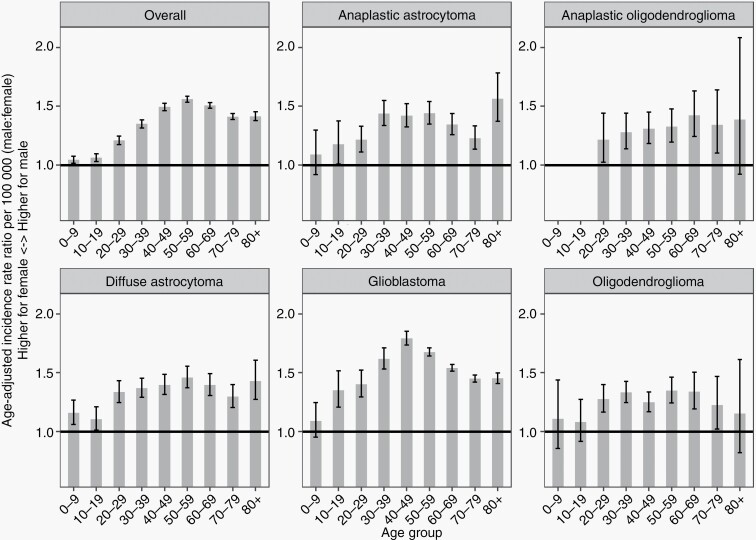
Overall, glioma incidence was higher in males. Male-to-female incidence was lowest in ages 0-9 years (IRR: 1.04, 95% CI: 1.01-1.07, P = .003), increasing with age, peaking at 50-59 years (IRR: 1.56, 95% CI: 1.53-1.59, P < .001). Females had worse survival for ages 0-9 (HR: 0.93, 95% CI: 0.87-0.99), though male survival was worse for all other age groups, with the difference highest in those 20-29 years (HR: 1.36, 95% CI: 1.28-1.44). Incidence and survival differences by age and sex also varied by histological subtype of glioma.
To better understand the variation in glioma incidence and survival, investigating the intersection of age and sex is key. The current work shows that the combined impact of these variables is dependent on glioma subtype. These results contribute to the growing understanding of sex and age differences that impact cancer incidence and survival.
神经胶质瘤是最常见的恶性脑和中枢神经系统肿瘤,占恶性原发性脑和中枢神经系统肿瘤的 80.8%。它们导致了高发病率和死亡率。本研究通过研究年龄和性别之间的关系,以更好地了解美国神经胶质瘤的发病和生存情况的变化。
从 CBTRUS 获取 2000 年至 2017 年的发病率数据,该组织从 NPCR 和 SEER 中获取数据,从疾病预防控制中心的 NPCR 中获取生存率数据。通过年龄组生成每 100000 人年龄调整发病率比(IRR),以比较男性与女性的发病率。通过年龄组进行 Cox 比例风险模型,生成风险比以评估男性与女性的生存差异。
总体而言,男性神经胶质瘤的发病率较高。男性与女性的发病率在 0-9 岁年龄组最低(IRR:1.04,95%CI:1.01-1.07,P =.003),随着年龄的增长而增加,在 50-59 岁年龄组达到峰值(IRR:1.56,95%CI:1.53-1.59,P <.001)。对于 0-9 岁年龄组的女性,生存率较差(HR:0.93,95%CI:0.87-0.99),而对于所有其他年龄组的男性,生存率较差,在 20-29 岁年龄组差异最高(HR:1.36,95%CI:1.28-1.44)。按年龄和性别划分的发病率和生存率差异也因神经胶质瘤的组织学亚型而异。
为了更好地了解神经胶质瘤发病率和生存率的变化,研究年龄和性别的交叉点是关键。目前的研究表明,这些变量的综合影响取决于神经胶质瘤的亚型。这些结果有助于加深对影响癌症发病率和生存率的性别和年龄差异的理解。