Al Husaini Mohammed Abdulla Salim, Habaebi Mohamed Hadi, Gunawan Teddy Surya, Islam Md Rafiqul, Elsheikh Elfatih A A, Suliman F M
IoT & Wireless Communication Protocols Lab, Department of Electrical Computer Engineering, International Islamic University, Selangor, Malaysia.
Department of Electrical Engineering, College of Engineering, King Khalid University, Abha, 61421 Saudi Arabia.
Neural Comput Appl. 2022;34(1):333-348. doi: 10.1007/s00521-021-06372-1. Epub 2021 Aug 7.
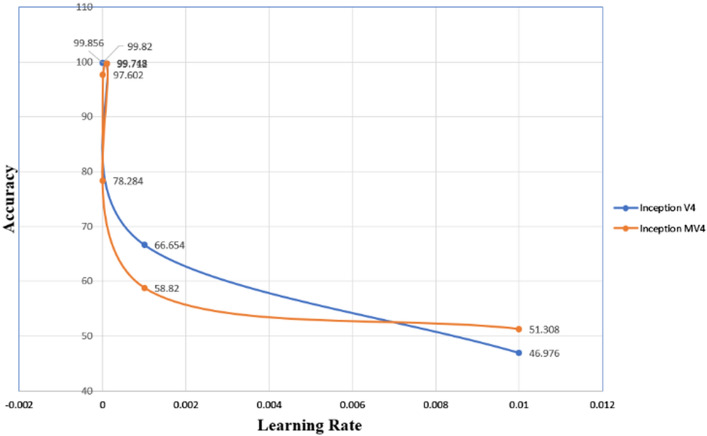
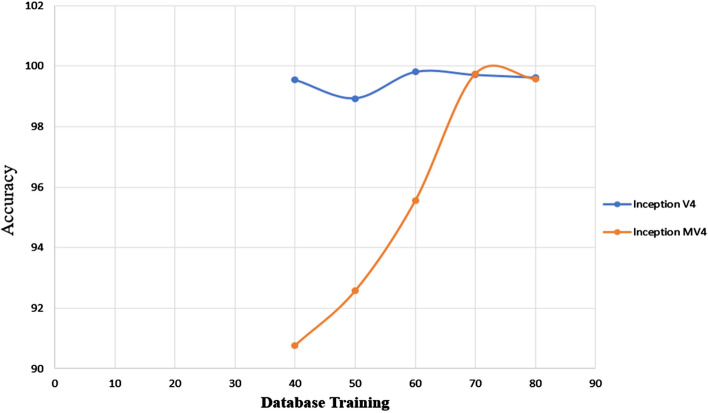
Breast cancer is one of the most significant causes of death for women around the world. Breast thermography supported by deep convolutional neural networks is expected to contribute significantly to early detection and facilitate treatment at an early stage. The goal of this study is to investigate the behavior of different recent deep learning methods for identifying breast disorders. To evaluate our proposal, we built classifiers based on deep convolutional neural networks modelling inception V3, inception V4, and a modified version of the latter called inception MV4. MV4 was introduced to maintain the computational cost across all layers by making the resultant number of features and the number of pixel positions equal. DMR database was used for these deep learning models in classifying thermal images of healthy and sick patients. A set of epochs 3-30 were used in conjunction with learning rates 1 × 10, 1 × 10 and 1 × 10, Minibatch 10 and different optimization methods. The training results showed that inception V4 and MV4 with color images, a learning rate of 1 × 10, and SGDM optimization method, reached very high accuracy, verified through several experimental repetitions. With grayscale images, inception V3 outperforms V4 and MV4 by a considerable accuracy margin, for any optimization methods. In fact, the inception V3 (grayscale) performance is almost comparable to inception V4 and MV4 (color) performance but only after 20-30 epochs. inception MV4 achieved 7% faster classification response time compared to V4. The use of MV4 model is found to contribute to saving energy consumed and fluidity in arithmetic operations for the graphic processor. The results also indicate that increasing the number of layers may not necessarily be useful in improving the performance.
乳腺癌是全球女性死亡的最重要原因之一。由深度卷积神经网络支持的乳腺热成像有望对早期检测做出重大贡献,并有助于早期治疗。本研究的目的是调查不同的近期深度学习方法在识别乳腺疾病方面的表现。为了评估我们的提议,我们基于深度卷积神经网络构建了分类器,对Inception V3、Inception V4以及后者的一个修改版本Inception MV4进行建模。引入Inception MV4是为了通过使最终的特征数量和像素位置数量相等来维持所有层的计算成本。DMR数据库被用于这些深度学习模型对健康和患病患者的热图像进行分类。一组3至30个轮次与学习率1×10、1×10和1×10、小批量10以及不同的优化方法一起使用。训练结果表明,使用彩色图像、学习率为1×10以及SGDM优化方法的Inception V4和MV4达到了非常高的准确率,这通过多次实验重复得到了验证。对于任何优化方法,使用灰度图像时,Inception V3在准确率上都明显优于V4和MV4。事实上,Inception V3(灰度)的性能几乎与Inception V4和MV4(彩色)的性能相当,但这仅在20至30个轮次之后。与V4相比,Inception MV4的分类响应时间快7%。发现使用MV4模型有助于节省图形处理器的能耗和算术运算的流畅性。结果还表明,增加层数不一定有助于提高性能。