Rihan F A, Alsakaji H J
Department of Mathematical Sciences, College of Science, UAE University, Al-Ain, 15551, United Arab Emirates.
Results Phys. 2021 Sep;28:104658. doi: 10.1016/j.rinp.2021.104658. Epub 2021 Aug 11.
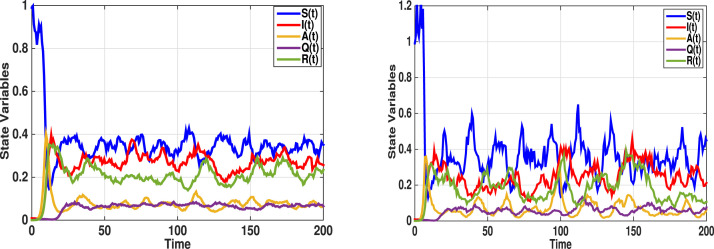
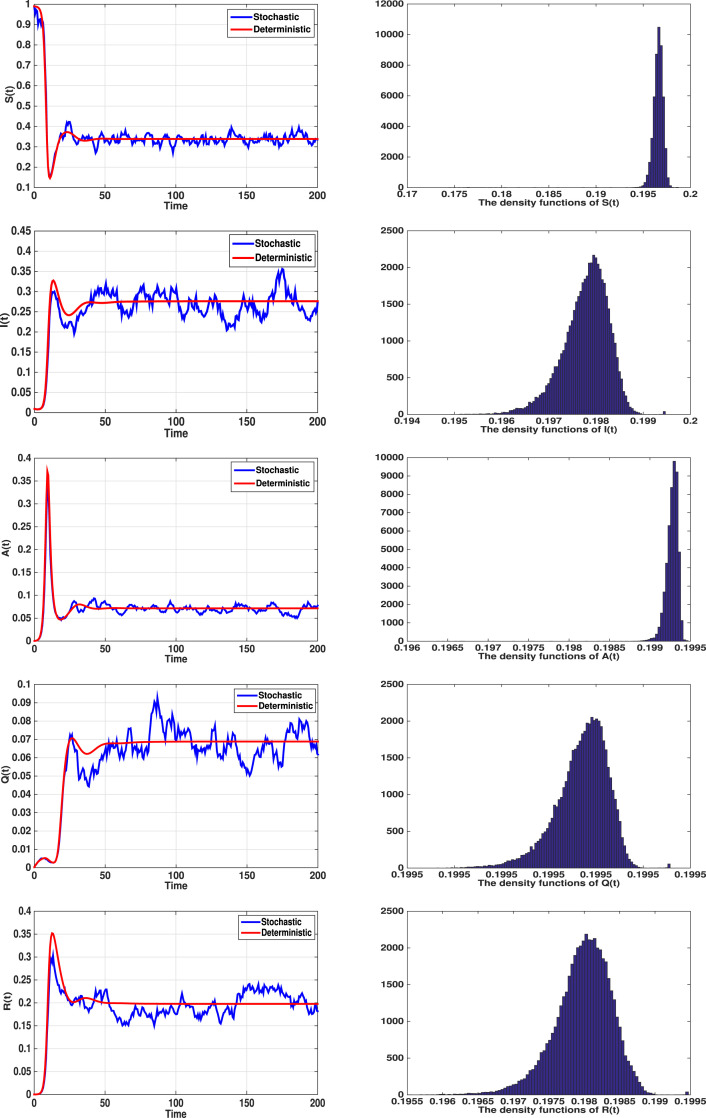
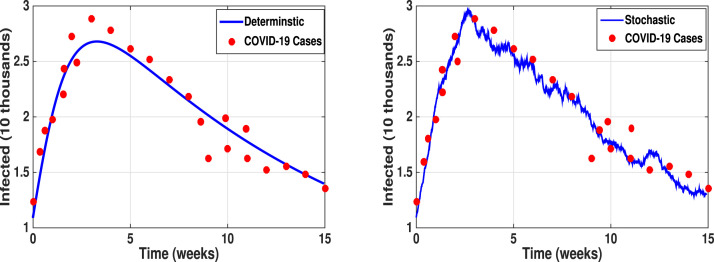
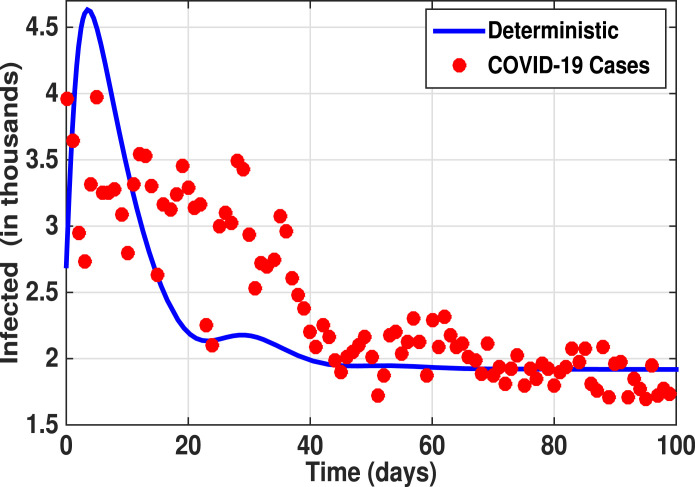
Public health science is increasingly focusing on understanding how COVID-19 spreads among humans. For the dynamics of COVID-19, we propose a stochastic epidemic model, with time-delays, Susceptible-Infected-Asymptomatic-Quarantined-Recovered (SIAQR). One global positive solution exists with probability one in the model. As a threshold condition of persistence and existence of an ergodic stationary distribution, we deduce a generalized stochastic threshold . To estimate the percentages of people who must be vaccinated to achieve herd immunity, least-squares approaches were used to estimate from real observations in the UAE. Our results suggest that when , a proportion of the population needs to be immunized/vaccinated during the pandemic wave. Numerical simulations show that the proposed stochastic delay differential model is consistent with the physical sensitivity and fluctuation of the real observations.
公共卫生科学越来越关注了解新冠病毒在人类中的传播方式。对于新冠病毒的动态传播,我们提出了一个具有时间延迟的随机流行病模型,即易感-感染-无症状-隔离-康复(SIAQR)模型。该模型以概率1存在一个全局正解。作为遍历平稳分布的持久性和存在性的阈值条件,我们推导出一个广义随机阈值。为了估计达到群体免疫所需接种疫苗的人群百分比,我们采用最小二乘法从阿联酋的实际观测数据中估计该阈值。我们的结果表明,当[此处缺失具体条件]时,在疫情期间需要有[此处缺失具体比例]的人口进行免疫接种。数值模拟表明,所提出的随机延迟微分模型与实际观测的物理敏感性和波动情况一致。