• 文献检索
  • 文档翻译
  • 深度研究
  • 学术资讯
  • Suppr Zotero 插件Zotero 插件
  • 邀请有礼
  • 套餐&价格
  • 历史记录
应用&插件
Suppr Zotero 插件Zotero 插件浏览器插件Mac 客户端Windows 客户端微信小程序
定价
高级版会员购买积分包购买API积分包
服务
文献检索文档翻译深度研究API 文档MCP 服务
关于我们
关于 Suppr公司介绍联系我们用户协议隐私条款
关注我们

Suppr 超能文献

核心技术专利:CN118964589B侵权必究
粤ICP备2023148730 号-1Suppr @ 2026

文献检索

告别复杂PubMed语法,用中文像聊天一样搜索,搜遍4000万医学文献。AI智能推荐,让科研检索更轻松。

立即免费搜索

文件翻译

保留排版,准确专业,支持PDF/Word/PPT等文件格式,支持 12+语言互译。

免费翻译文档

深度研究

AI帮你快速写综述,25分钟生成高质量综述,智能提取关键信息,辅助科研写作。

立即免费体验

利用地理空间分析应对全球蛇咬伤危机——最新进展与未来方向

Addressing the global snakebite crisis with geo-spatial analyses - Recent advances and future direction.

作者信息

Pintor Anna F V, Ray Nicolas, Longbottom Joshua, Bravo-Vega Carlos A, Yousefi Masoud, Murray Kris A, Ediriweera Dileepa S, Diggle Peter J

机构信息

Division of Data, Analytics and Delivery for Impact (DDI), World Health Organization, Geneva, Switzerland.

Australian Institute of Tropical Health and Medicine, Division of Tropical Health and Medicine, James Cook University, Cairns, Australia.

出版信息

Toxicon X. 2021 Jul 31;11:100076. doi: 10.1016/j.toxcx.2021.100076. eCollection 2021 Sep.

DOI:10.1016/j.toxcx.2021.100076
PMID:34401744
原文链接:https://pmc.ncbi.nlm.nih.gov/articles/PMC8350508/
Abstract

Venomous snakebite is a neglected tropical disease that annually leads to hundreds of thousands of deaths or long-term physical and mental ailments across the developing world. Insufficient data on spatial variation in snakebite risk, incidence, human vulnerability, and accessibility of medical treatment contribute substantially to ineffective on-ground management. There is an urgent need to collect data, fill knowledge gaps and address on-ground management problems. The use of novel, and transdisciplinary approaches that take advantage of recent advances in spatio-temporal models, 'big data', high performance computing, and fine-scale spatial information can add value to snakebite management by strategically improving our understanding and mitigation capacity of snakebite. We review the background and recent advances on the topic of snakebite related geospatial analyses and suggest avenues for priority research that will have practical on-ground applications for snakebite management and mitigation. These include streamlined, targeted data collection on snake distributions, snakebites, envenomings, venom composition, health infrastructure, and antivenom accessibility along with fine-scale models of spatio-temporal variation in snakebite risk and incidence, intraspecific venom variation, and environmental change modifying human exposure. These measures could improve and 'future-proof' antivenom production methods, antivenom distribution and stockpiling systems, and human-wildlife conflict management practices, while simultaneously feeding into research on venom evolution, snake taxonomy, ecology, biogeography, and conservation.

摘要

毒蛇咬伤是一种被忽视的热带疾病,在发展中世界每年导致成千上万的人死亡或长期身心疾病。关于蛇咬伤风险、发病率、人类易感性和医疗可及性的空间变异数据不足,这在很大程度上导致了实地管理的无效。迫切需要收集数据、填补知识空白并解决实地管理问题。利用时空模型、“大数据”、高性能计算和精细尺度空间信息等最新进展的新颖跨学科方法,通过从战略上提高我们对蛇咬伤的理解和缓解能力,可以为蛇咬伤管理增添价值。我们回顾了蛇咬伤相关地理空间分析主题的背景和最新进展,并提出了优先研究途径,这些途径将在蛇咬伤管理和缓解方面具有实际的实地应用。这些措施包括简化、有针对性地收集关于蛇分布、蛇咬伤、中毒、毒液成分、卫生基础设施和抗蛇毒血清可及性的数据,以及蛇咬伤风险和发病率、种内毒液变异以及改变人类接触的环境变化的精细尺度时空变异模型。这些措施可以改进抗蛇毒血清生产方法、抗蛇毒血清分发和储存系统以及人类与野生动物冲突管理实践,并使其“面向未来”,同时为毒液进化、蛇类分类学、生态学、生物地理学和保护研究提供信息。
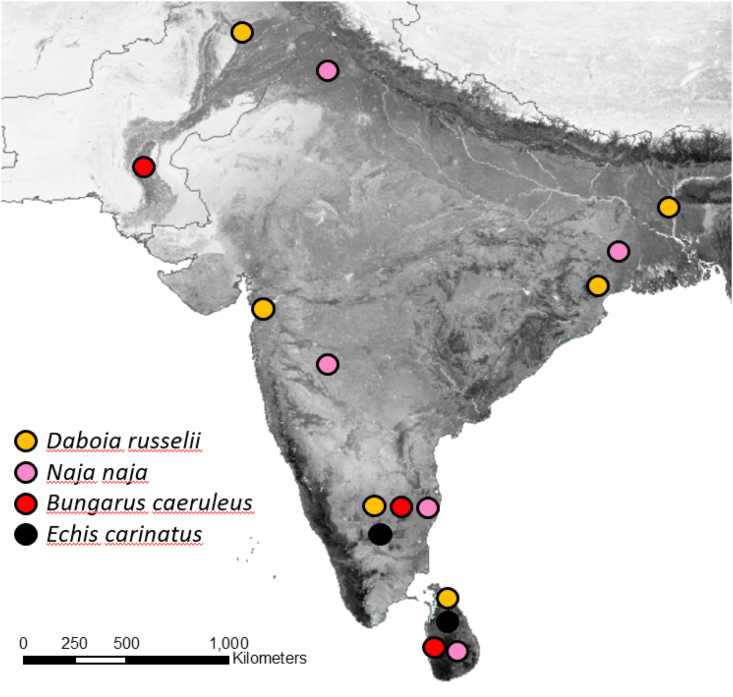
https://cdn.ncbi.nlm.nih.gov/pmc/blobs/f374/8350508/1daea398d2e7/gr7.jpg
https://cdn.ncbi.nlm.nih.gov/pmc/blobs/f374/8350508/7818ef37f3bc/gr1.jpg
https://cdn.ncbi.nlm.nih.gov/pmc/blobs/f374/8350508/58d611f8a049/gr2.jpg
https://cdn.ncbi.nlm.nih.gov/pmc/blobs/f374/8350508/55557dce68be/gr3.jpg
https://cdn.ncbi.nlm.nih.gov/pmc/blobs/f374/8350508/9460e4d07555/gr4.jpg
https://cdn.ncbi.nlm.nih.gov/pmc/blobs/f374/8350508/b0817c760313/gr5.jpg
https://cdn.ncbi.nlm.nih.gov/pmc/blobs/f374/8350508/56f880edc4fc/gr6.jpg
https://cdn.ncbi.nlm.nih.gov/pmc/blobs/f374/8350508/1daea398d2e7/gr7.jpg
https://cdn.ncbi.nlm.nih.gov/pmc/blobs/f374/8350508/7818ef37f3bc/gr1.jpg
https://cdn.ncbi.nlm.nih.gov/pmc/blobs/f374/8350508/58d611f8a049/gr2.jpg
https://cdn.ncbi.nlm.nih.gov/pmc/blobs/f374/8350508/55557dce68be/gr3.jpg
https://cdn.ncbi.nlm.nih.gov/pmc/blobs/f374/8350508/9460e4d07555/gr4.jpg
https://cdn.ncbi.nlm.nih.gov/pmc/blobs/f374/8350508/b0817c760313/gr5.jpg
https://cdn.ncbi.nlm.nih.gov/pmc/blobs/f374/8350508/56f880edc4fc/gr6.jpg
https://cdn.ncbi.nlm.nih.gov/pmc/blobs/f374/8350508/1daea398d2e7/gr7.jpg

相似文献

1
Addressing the global snakebite crisis with geo-spatial analyses - Recent advances and future direction.利用地理空间分析应对全球蛇咬伤危机——最新进展与未来方向
Toxicon X. 2021 Jul 31;11:100076. doi: 10.1016/j.toxcx.2021.100076. eCollection 2021 Sep.
2
A Review of the Proteomic Profiling of African Viperidae and Elapidae Snake Venoms and Their Antivenom Neutralisation.非洲蝰科和眼镜蛇科蛇毒的蛋白质组学分析及其抗蛇毒血清中和作用的综述
Toxins (Basel). 2022 Oct 22;14(11):723. doi: 10.3390/toxins14110723.
3
Promoting co-existence between humans and venomous snakes through increasing the herpetological knowledge base.通过增加爬行动物学知识库来促进人类与毒蛇的共存。
Toxicon X. 2021 Aug 26;12:100081. doi: 10.1016/j.toxcx.2021.100081. eCollection 2021 Nov.
4
Deciphering toxico-proteomics of Asiatic medically significant venomous snake species: A systematic review and interactive data dashboard.解析亚洲有医学重要意义的毒蛇的毒蛋白组学:系统综述和交互式数据仪表板。
Toxicon. 2024 Nov 6;250:108120. doi: 10.1016/j.toxicon.2024.108120. Epub 2024 Oct 10.
5
Vulnerability to snakebite envenoming: a global mapping of hotspots.蛇伤易感性:热点的全球映射。
Lancet. 2018 Aug 25;392(10148):673-684. doi: 10.1016/S0140-6736(18)31224-8. Epub 2018 Jul 17.
6
A mechanistic model of snakebite as a zoonosis: Envenoming incidence is driven by snake ecology, socioeconomics and its impacts on snakes.蛇伤作为一种人畜共患病的机制模型:蛇的生态学、社会经济学及其对蛇的影响决定了中毒发生率。
PLoS Negl Trop Dis. 2022 May 12;16(5):e0009867. doi: 10.1371/journal.pntd.0009867. eCollection 2022 May.
7
Use of geospatial analyses to address snakebite hotspots in mid-northern Brazil - A direction to health planning in shortfall biodiversity knowledge areas.利用地理空间分析方法解决巴西北部中地区的蛇伤热点问题——在生物多样性知识匮乏地区进行卫生规划的方向。
Toxicon. 2022 Jul 15;213:43-51. doi: 10.1016/j.toxicon.2022.03.012. Epub 2022 Apr 4.
8
Snakebite: When the Human Touch Becomes a Bad Touch.蛇咬伤:当人类的触摸变成糟糕的触摸。
Toxins (Basel). 2018 Apr 21;10(4):170. doi: 10.3390/toxins10040170.
9
VenomMaps: Updated species distribution maps and models for New World pitvipers (Viperidae: Crotalinae).毒液地图:更新的新世界响尾蛇(蝰蛇科:响尾蛇亚科)的物种分布地图和模型。
Sci Data. 2022 May 25;9(1):232. doi: 10.1038/s41597-022-01323-4.
10
The concept of Big Four: Road map from snakebite epidemiology to antivenom efficacy.四大要点:从蛇伤流行病学到抗蛇毒血清疗效的路线图。
Int J Biol Macromol. 2023 Jul 1;242(Pt 1):124771. doi: 10.1016/j.ijbiomac.2023.124771. Epub 2023 May 9.

引用本文的文献

1
Causal inference unveils how forest coverage mitigates excess snakebite cases during rainfall seasons in Colombia.因果推断揭示了哥伦比亚雨季森林覆盖率如何减轻蛇咬伤过量病例。
Sci Rep. 2025 Sep 10;15(1):32401. doi: 10.1038/s41598-025-17405-3.
2
Future of snakebite risk in India: Consequence of climate change and the shifting habitats of the big four species in next five decades.印度蛇咬伤风险的未来:气候变化的影响以及未来五十年内四大蛇类栖息地的变化
PLoS Negl Trop Dis. 2025 Sep 2;19(9):e0013464. doi: 10.1371/journal.pntd.0013464. eCollection 2025 Sep.
3
Venomics of the Arabian saw-scaled viper (Echis coloratus) through transcriptome-guided proteomics and in vitro functional profiling.

本文引用的文献

1
Epidemiology of snakebites in Colombia (2008-2016).哥伦比亚蛇咬伤的流行病学(2008-2016 年)。
Rev Salud Publica (Bogota). 2020 May 1;22(3):280-287. doi: 10.15446/rsap.V22n3.87005.
2
Predicting species distribution: offering more than simple habitat models.预测物种分布:提供的不仅仅是简单的栖息地模型。
Ecol Lett. 2005 Sep;8(9):993-1009. doi: 10.1111/j.1461-0248.2005.00792.x. Epub 2005 Jun 23.
3
Delays, fears and training needs: Perspectives of health workers on clinical management of snakebite revealed by a qualitative study in Kitui County, Kenya.
通过转录组引导的蛋白质组学和体外功能分析对阿拉伯锯鳞蝰(Echis coloratus)进行毒液组学研究。
PLoS Negl Trop Dis. 2025 Aug 14;19(8):e0013439. doi: 10.1371/journal.pntd.0013439. eCollection 2025 Aug.
4
Applying Ensemble Ecological Niche Modeling to Identify High Risk Areas for Scorpions' Sting.应用集成生态位建模来识别蝎子蜇伤的高风险区域。
Ecol Evol. 2025 Jul 4;15(7):e71713. doi: 10.1002/ece3.71713. eCollection 2025 Jul.
5
The biology and toxinology of blunt-nosed vipers.钝鼻蝰蛇的生物学与毒素学
NPJ Biodivers. 2025 Jun 3;4(1):21. doi: 10.1038/s44185-025-00090-w.
6
Glycopolymer-Functionalized Gold Nanoparticles for the Detection of Western Diamondback Rattlesnake () Venom.用于检测西部菱背响尾蛇毒液的糖聚合物功能化金纳米颗粒
Biomacromolecules. 2025 Jun 9;26(6):3514-3524. doi: 10.1021/acs.biomac.5c00125. Epub 2025 May 20.
7
The epidemiology of snakebites, treatment-seeking behaviour, and snakebite management in the department of Ogooué et des Lacs, Gabon, Central Africa: a cross-sectional community and health facility-based survey.中非加蓬奥果韦-拉克地区蛇咬伤的流行病学、就诊行为及蛇咬伤处理:一项基于社区和医疗机构的横断面调查
J Glob Health. 2025 Apr 25;15:04062. doi: 10.7189/jogh.15.04062.
8
Association Between Deforestation and the Incidence of Snakebites in South Korea.韩国森林砍伐与蛇咬伤发生率之间的关联
Animals (Basel). 2025 Jan 13;15(2):198. doi: 10.3390/ani15020198.
9
A systematic review of reports on aquatic envenomation: are there global hot spots and vulnerable populations?关于水生动物致伤报告的系统评价:是否存在全球热点地区和易感人群?
J Venom Anim Toxins Incl Trop Dis. 2024 Dec 20;30:e20240032. doi: 10.1590/1678-9199-JVATITD-2024-0032. eCollection 2024.
10
Conflict between sea snakes and humans on the coast of West Bengal and Odisha, India: perception, attitudes and incidents.印度西孟加拉邦和奥里萨邦沿海海蛇与人类的冲突:认知、态度及事件
Trans R Soc Trop Med Hyg. 2025 Jun 5;119(6):671-678. doi: 10.1093/trstmh/trae086.
延误、恐惧与培训需求:肯尼亚基图伊县一项定性研究揭示的卫生工作者对蛇咬伤临床管理的看法
Toxicon X. 2021 Jul 30;11:100078. doi: 10.1016/j.toxcx.2021.100078. eCollection 2021 Sep.
4
Pattern of crop raiding by wild large mammals and the resultant impacts vary with distances from forests in Southwest Ethiopia.埃塞俄比亚西南部野生大型哺乳动物的作物掠夺模式及其产生的影响因与森林的距离而异。
Ecol Evol. 2021 Feb 14;11(7):3203-3209. doi: 10.1002/ece3.7268. eCollection 2021 Apr.
5
Biogeographic venom variation in Russell's viper (Daboia russelii) and the preclinical inefficacy of antivenom therapy in snakebite hotspots.圆斑蝰(Daboia russelii)的生物地理毒液变异与蛇伤热点地区抗蛇毒血清治疗的临床前无效性。
PLoS Negl Trop Dis. 2021 Mar 25;15(3):e0009247. doi: 10.1371/journal.pntd.0009247. eCollection 2021 Mar.
6
Crowdsourcing snake identification with online communities of professional herpetologists and avocational snake enthusiasts.通过专业爬虫学家和业余蛇类爱好者的在线社区进行众包蛇类识别。
R Soc Open Sci. 2021 Jan 13;8(1):201273. doi: 10.1098/rsos.201273. eCollection 2021 Jan.
7
Biogeographical venom variation in the Indian spectacled cobra (Naja naja) underscores the pressing need for pan-India efficacious snakebite therapy.印度眼镜蛇(Naja naja)的生物地理毒液变异凸显了在全印度范围内提供有效蛇伤治疗的迫切需求。
PLoS Negl Trop Dis. 2021 Feb 18;15(2):e0009150. doi: 10.1371/journal.pntd.0009150. eCollection 2021 Feb.
8
Novel transdisciplinary methodology for cross-sectional analysis of snakebite epidemiology at national scale.用于全国范围内蛇咬伤流行病学横断面分析的新型跨学科方法。
PLoS Negl Trop Dis. 2021 Feb 12;15(2):e0009023. doi: 10.1371/journal.pntd.0009023. eCollection 2021 Feb.
9
Overview of snakebite in Brazil: Possible drivers and a tool for risk mapping.巴西蛇伤概述:可能的驱动因素及风险绘图工具。
PLoS Negl Trop Dis. 2021 Jan 29;15(1):e0009044. doi: 10.1371/journal.pntd.0009044. eCollection 2021 Jan.
10
Integrating human behavior and snake ecology with agent-based models to predict snakebite in high risk landscapes.将人类行为和蛇类生态学与基于主体的模型相结合,以预测高风险景观中的蛇咬伤。
PLoS Negl Trop Dis. 2021 Jan 22;15(1):e0009047. doi: 10.1371/journal.pntd.0009047. eCollection 2021 Jan.