Veneto Region Arbovirosis Task Force, Dorsoduro, 3493 - Rio Nuovo - 30123 Venezia, Italy.
Department of Molecular Medicine, University of Padova, via A. Gabelli 63, 35121 Padova, Italy.
J Travel Med. 2021 Dec 29;28(8). doi: 10.1093/jtm/taab130.
In August 2020, in the context of COVID-19 pandemics, an autochthonous dengue outbreak was identified for the first time in Italy.
Following the reporting of the index case of autochthonous dengue, epidemiological investigation, vector control and substances of human origin safety measures were immediately activated, according to the national arbovirus surveillance plan. Dengue cases were followed-up with weekly visits and laboratory tests until recovery and clearance of viral RNA from blood.
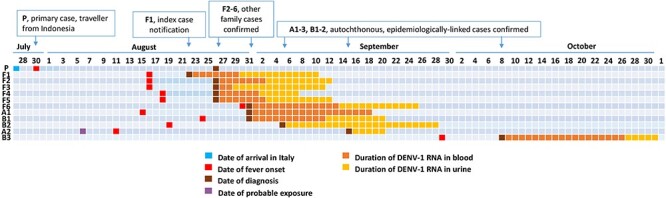
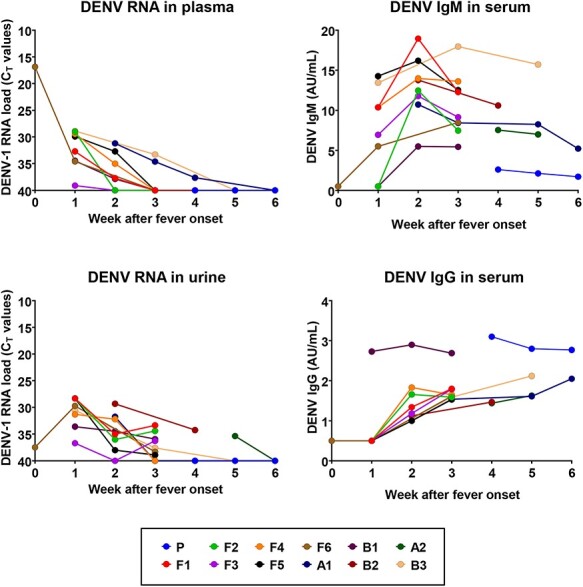
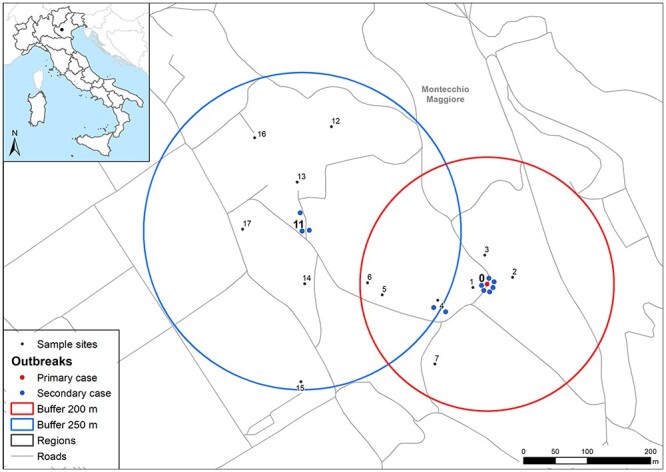
The primary dengue case was identified in a young woman, who developed fever after returning from Indonesia to northern Italy, on 27 July 2020. She spent the mandatory quarantine for COVID-19 at home with relatives, six of whom developed dengue within two weeks. Epidemiological investigation identified further five autochthonous dengue cases among people who lived or stayed near the residence of the primary case. The last case of the outbreak developed fever on 29 September 2020. Dengue cases had a mild febrile illness, except one with persistent asthenia and myalgia. DENV-1 RNA was detected in blood and/or urine in all autochthonous cases, up to 35 days after fever onset. All cases developed IgM and IgG antibodies which cross-reacted with West Nile virus (WNV) and other flaviviruses. Sequencing of the full viral genome from blood samples showed over 99% nucleotide identity with DENV-1 strains isolated in China in 2014-2015; phylogenetic analysis classified the virus within Genotype I. Entomological site inspection identified a high density of Aedes albopictus mosquitoes, which conceivably sustained local DENV-1 transmission. Aedes koreicus mosquitoes were also collected in the site.
Areas in Europe with high density of Aedes mosquitoes should be considered at risk for dengue transmission. The presence of endemic flaviviruses, such as WNV, might pose problems in the laboratory diagnosis.
2020 年 8 月,在 COVID-19 大流行的背景下,意大利首次发现了本土登革热疫情。
在报告首例本土登革热病例后,根据国家虫媒病毒监测计划,立即启动了流行病学调查、病媒控制和人体物质安全措施。对登革热病例进行了每周随访和实验室检查,直至病毒 RNA 从血液中清除。
首例登革热病例是一名年轻女性,她于 2020 年 7 月 27 日从印度尼西亚返回意大利北部后出现发热。她在家中与亲属一起接受 COVID-19 强制性隔离,其中 6 人在两周内感染了登革热。流行病学调查在首例病例居住地附近发现了另外 5 例本地登革热病例。疫情的最后一例病例于 2020 年 9 月 29 日出现发热。登革热病例均表现为轻度发热性疾病,除 1 例持续乏力和肌痛外。所有本地病例的血液和/或尿液中均检测到 DENV-1 RNA,发热后 35 天内仍可检测到。所有病例均产生了与西尼罗河病毒(WNV)和其他黄病毒交叉反应的 IgM 和 IgG 抗体。从血液样本中测序的全长病毒基因组与 2014-2015 年在中国分离的 DENV-1 株的核苷酸同源性超过 99%;系统进化分析将该病毒分类为 I 型。在蚊媒监测点发现了大量白纹伊蚊,这些蚊子可能在当地传播了 DENV-1。还在该地点采集到了韩国伊蚊。
蚊虫密度高的欧洲地区应被视为登革热传播的风险地区。WNV 等地方性黄病毒的存在可能会给实验室诊断带来问题。