Fatma Mehar, Iqbal Noushina, Sehar Zebus, Alyemeni Mohammed Nasser, Kaushik Prashant, Khan Nafees A, Ahmad Parvaiz
Plant Physiology and Biochemistry Laboratory, Department of Botany, Aligarh Muslim University, Aligarh 202002, India.
Department of Botany, School of Chemical and Life Sciences, Jamia Hamdard, New Delhi 110062, India.
Antioxidants (Basel). 2021 Jul 28;10(8):1216. doi: 10.3390/antiox10081216.
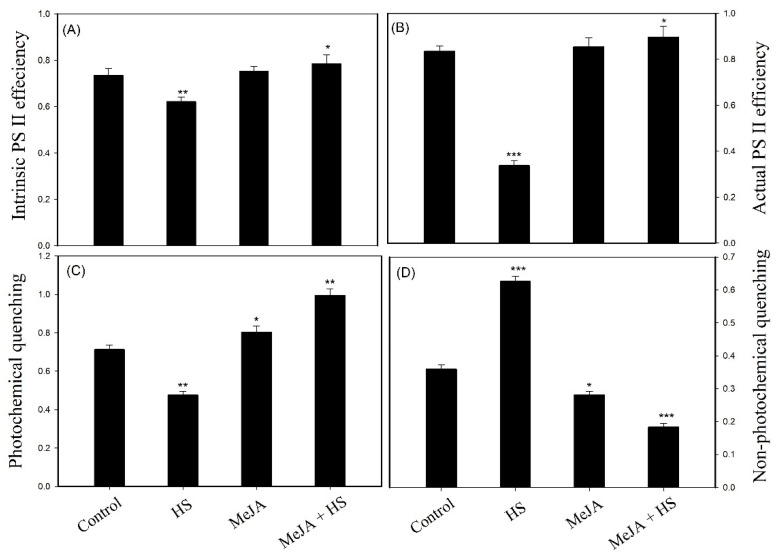
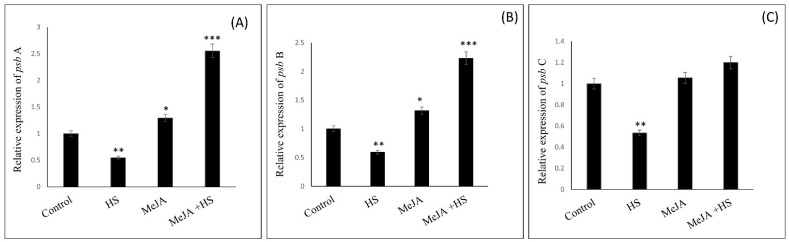
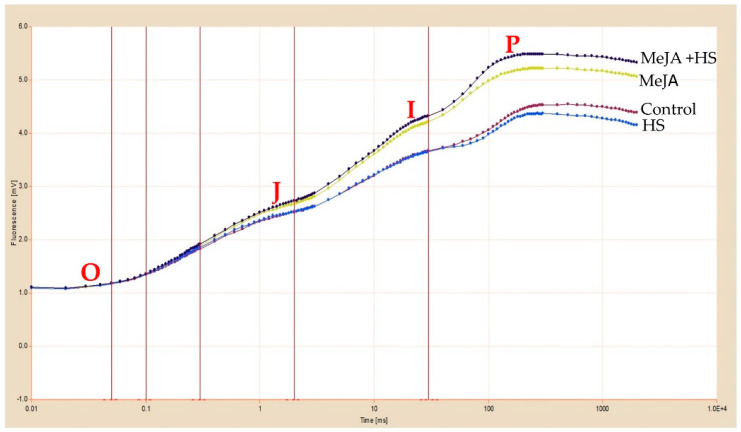
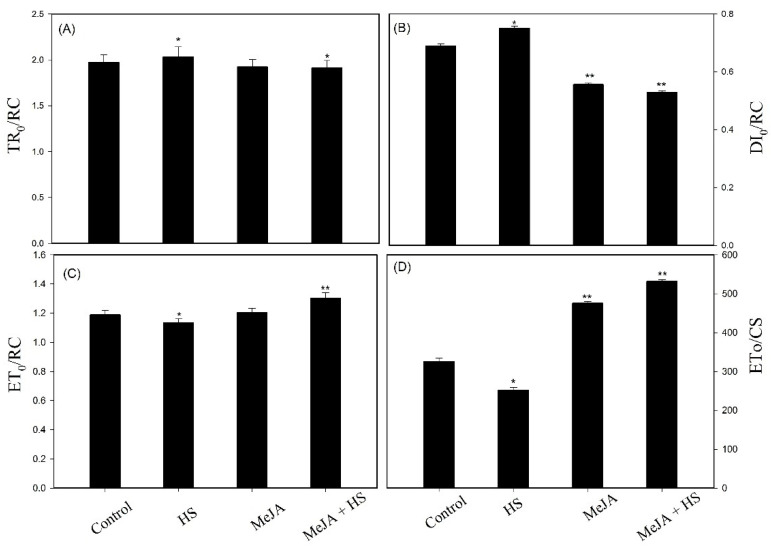
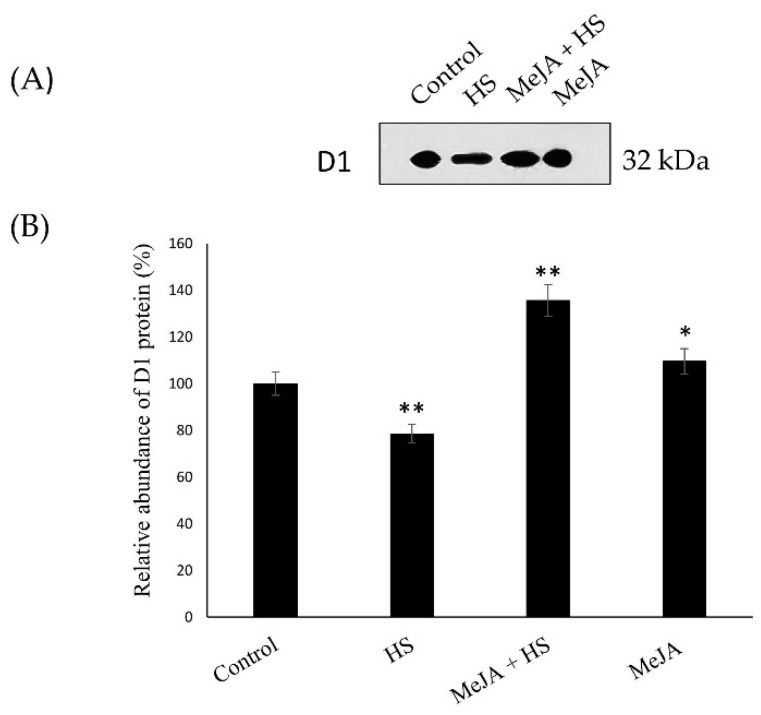
The application of 10 µM methyl jasmonate (MeJA) for the protection of wheat ( L.) photosystem II (PS II) against heat stress (HS) was studied. Heat stress was induced at 42 °C to established plants, which were then recovered at 25 °C and monitored during their growth for the study duration. Application of MeJA resulted in increased enzymatic antioxidant activity that reduced the content of hydrogen peroxide (HO) and thiobarbituric acid reactive substances (TBARS) and enhanced the photosynthetic efficiency. Exogenous MeJA had a beneficial effect on chlorophyll fluorescence under HS and enhanced the pigment system (PS) II system, as observed in a JIP-test, a new tool for chlorophyll fluorescence induction curve. Exogenous MeJA improved the quantum yield of electron transport (ET/CS) as well as electron transport flux for each reaction center (ET/RC). However, the specific energy fluxes per reaction center (RC), i.e., TR/RC (trapping) and DI/RC (dissipation), were reduced by MeJA. These results indicate that MeJA affects the efficiency of PS II by stabilizing the D1 protein, increasing its abundance, and enhancing the expression of the A and B genes under HS, which encode proteins of the PS II core RC complex. Thus, MeJA is a potential tool to protect PS II and D1 protein in wheat plants under HS and to accelerate the recovery of the photosynthetic capacity.
研究了10微摩尔茉莉酸甲酯(MeJA)对小麦(L.)光系统II(PS II)抗热胁迫(HS)的应用效果。对已定植的植株在42℃诱导热胁迫,然后在25℃恢复,并在其生长期间进行监测以完成研究时长。MeJA的应用导致酶促抗氧化活性增加,降低了过氧化氢(HO)和硫代巴比妥酸反应性物质(TBARS)的含量,并提高了光合效率。如在叶绿素荧光诱导曲线的新工具JIP测试中所观察到的,外源MeJA对热胁迫下的叶绿素荧光有有益影响,并增强了色素系统(PS)II系统。外源MeJA提高了电子传递量子产率(ET/CS)以及每个反应中心的电子传递通量(ET/RC)。然而,MeJA降低了每个反应中心的特定能量通量,即TR/RC(捕获)和DI/RC(耗散)。这些结果表明,MeJA通过在热胁迫下稳定D1蛋白、增加其丰度并增强编码PS II核心RC复合物蛋白的A和B基因的表达来影响PS II的效率。因此,MeJA是保护热胁迫下小麦植株中PS II和D1蛋白并加速光合能力恢复的潜在工具。