Lucero García Rojas Emilio Y, Villanueva Cleva, Bond Richard A
Department of Pharmacology and Pharmaceutical Sciences, University of Houston, Houston, TX, United States.
Instituto Politecnico Nacional, Escuela Superior de Medicina, Mexico City, Mexico.
Front Cardiovasc Med. 2021 Aug 10;8:709509. doi: 10.3389/fcvm.2021.709509. eCollection 2021.
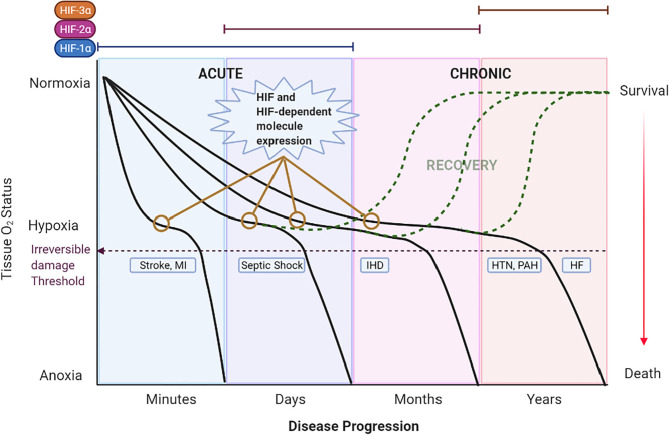
Cardiovascular (CV) diseases are the major cause of death in industrialized countries. The main function of the CV system is to deliver nutrients and oxygen to all tissues. During most CV pathologies, oxygen and nutrient delivery is decreased or completely halted. Several mechanisms, including increased oxygen transport and delivery, as well as increased blood flow are triggered to compensate for the hypoxic state. If the compensatory mechanisms fail to sufficiently correct the hypoxia, irreversible damage can occur. Thus, hypoxia plays a central role in the pathogenesis and pathophysiology of CV diseases. Hypoxia inducible factors (HIFs) orchestrate the gene transcription for hundreds of proteins involved in erythropoiesis, glucose transport, angiogenesis, glycolytic metabolism, reactive oxygen species (ROS) handling, cell proliferation and survival, among others. The overall regulation of the expression of HIF-dependent genes depends on the severity, duration, and location of hypoxia. In the present review, common CV diseases were selected to illustrate that HIFs, and proteins derived directly or indirectly from their stabilization and activation, are related to the development and perpetuation of hypoxia in these pathologies. We further classify CV diseases into acute and chronic hypoxic states to better understand the temporal relevance of HIFs in the pathogenesis, disease progression and clinical outcomes of these diseases. We conclude that HIFs and their derived factors are fundamental in the genesis and progression of CV diseases. Understanding these mechanisms will lead to more effective treatment strategies leading to reduced morbidity and mortality.
心血管(CV)疾病是工业化国家的主要死因。CV系统的主要功能是向所有组织输送营养物质和氧气。在大多数CV病理过程中,氧气和营养物质的输送会减少或完全停止。机体触发了多种机制,包括增加氧气运输和输送以及增加血流量,以补偿缺氧状态。如果代偿机制未能充分纠正缺氧,就可能发生不可逆的损伤。因此,缺氧在CV疾病的发病机制和病理生理学中起着核心作用。缺氧诱导因子(HIFs)协调数百种参与红细胞生成、葡萄糖转运、血管生成、糖酵解代谢、活性氧(ROS)处理、细胞增殖和存活等过程的蛋白质的基因转录。HIF依赖基因表达的整体调控取决于缺氧的严重程度、持续时间和位置。在本综述中,选择了常见的CV疾病来说明HIFs以及直接或间接源于其稳定和激活的蛋白质与这些病理过程中缺氧的发生和持续存在有关。我们进一步将CV疾病分为急性和慢性缺氧状态,以更好地理解HIFs在这些疾病的发病机制、疾病进展和临床结果中的时间相关性。我们得出结论,HIFs及其衍生因子在CV疾病的发生和发展中至关重要。了解这些机制将带来更有效的治疗策略,从而降低发病率和死亡率。