Australian National Centre for the Public Awareness of Science, Australian National University, Canberra, Australia.
Department of Psychology, Macquarie University, Sydney, Australia.
Mem Cognit. 2022 Feb;50(2):425-434. doi: 10.3758/s13421-021-01219-5. Epub 2021 Aug 27.
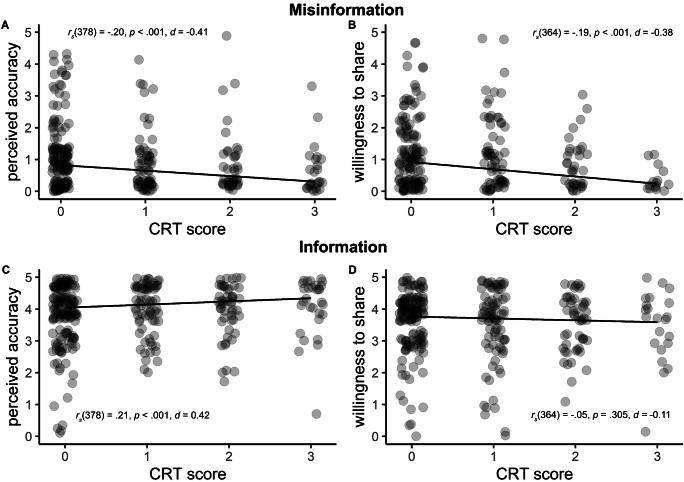
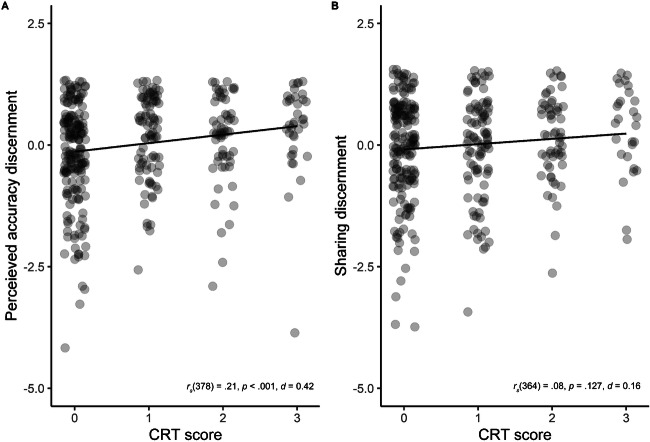
The classical account of reasoning posits that analytic thinking weakens belief in COVID-19 misinformation. We tested this account in a demographically representative sample of 742 Australians. Participants completed a performance-based measure of analytic thinking (the Cognitive Reflection Test) and were randomized to groups in which they either rated the perceived accuracy of claims about COVID-19 or indicated whether they would be willing to share these claims. Half of these claims were previously debunked misinformation, and half were statements endorsed by public health agencies. We found that participants with higher analytic thinking levels were less likely to rate COVID-19 misinformation as accurate and were less likely to be willing to share COVID-19 misinformation. These results support the classical account of reasoning for the topic of COVID-19 misinformation and extend it to the Australian context.
经典的推理理论认为,分析思维会削弱对新冠病毒错误信息的信任。我们在一个具有代表性的 742 名澳大利亚人样本中测试了这一理论。参与者完成了一项基于表现的分析思维测试(认知反射测试),并被随机分配到两组,一组评估有关新冠病毒的说法的感知准确性,另一组则表示是否愿意分享这些说法。这些说法中有一半是之前揭穿的错误信息,另一半则是公共卫生机构认可的声明。我们发现,分析思维水平较高的参与者不太可能认为新冠病毒错误信息是准确的,也不太可能愿意分享新冠病毒错误信息。这些结果支持了有关新冠病毒错误信息的经典推理理论,并将其扩展到澳大利亚的背景下。