PhD Programme in Experimental Biology and Biomedicine, Institute for Interdisciplinary Research (IIIUC), University of Coimbra, Coimbra, Portugal.
Center for Neuroscience and Cell Biology, University of Coimbra, Coimbra, Portugal.
Oxid Med Cell Longev. 2021 Aug 17;2021:2207125. doi: 10.1155/2021/2207125. eCollection 2021.
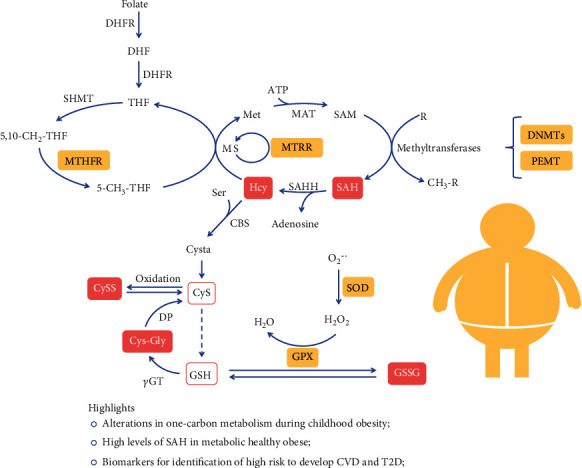
Obesity is increasing worldwide in prepubertal children, reducing the age of onset of associated comorbidities, including type 2 diabetes. Sulfur-containing amino acids, methionine, cysteine, and their derivatives play important roles in the transmethylation and transsulfuration pathways. Dysregulation of these pathways leads to alterations in the cellular methylation patterns and an imbalanced redox state. Therefore, we tested the hypothesis that one-carbon metabolism is already dysregulated in prepubertal children with obesity. Peripheral blood was collected from 64 children, and the plasma metabolites from transmethylation and transsulfuration pathways were quantified by HPLC. The cohort was stratified by BMI z-scores and HOMA-IR indices into healthy lean (HL), healthy obese (HO), and unhealthy obese (UHO). Fasting insulin levels were higher in the HO group compared to the HL, while the UHO had the highest. All groups presented normal fasting glycemia. Furthermore, high-density lipoprotein (HDL) was lower while triglycerides and lactate levels were higher in the UHO compared to HO subjects. S-adenosylhomocysteine (SAH) and total homocysteine levels were increased in the HO group compared to HL. Additionally, glutathione metabolism was also altered. Free cystine and oxidized glutathione (GSSG) were increased in the HO as compared to HL subjects. Importantly, the adipocyte secretory function was already compromised at this young age. Elevated circulating leptin and decreased adiponectin levels were observed in the UHO as compared to the HO subjects. Some of these alterations were concomitant with alterations in the DNA methylation patterns in the obese group, independent of the impaired insulin levels. In conclusion, our study informs on novel and important metabolic alterations in the transmethylation and the transsulfuration pathways in the early stages of obesity. Moreover, the altered secretory function of the adipocyte very early in life may be relevant in identifying early metabolic markers of disease that may inform on the increased risk for specific future comorbidities in this population.
肥胖在青春期前儿童中在全球范围内不断增加,降低了相关合并症(包括 2 型糖尿病)的发病年龄。含硫氨基酸蛋氨酸、半胱氨酸及其衍生物在转甲基和转硫途径中发挥重要作用。这些途径的失调导致细胞甲基化模式的改变和不平衡的氧化还原状态。因此,我们测试了这样一个假设,即在肥胖的青春期前儿童中,一碳代谢已经失调。从 64 名儿童中采集外周血,并通过 HPLC 定量测定转甲基和转硫途径的血浆代谢物。该队列根据 BMI z 分数和 HOMA-IR 指数分为健康瘦(HL)、健康胖(HO)和不健康胖(UHO)。与 HL 相比,HO 组的空腹胰岛素水平较高,而 UHO 组的空腹胰岛素水平最高。所有组的空腹血糖均正常。此外,与 HO 组相比,UHO 组的高密度脂蛋白(HDL)较低,而甘油三酯和乳酸水平较高。与 HL 相比,HO 组的 S-腺苷同型半胱氨酸(SAH)和总同型半胱氨酸水平升高。此外,谷胱甘肽代谢也发生改变。与 HL 相比,HO 组的游离胱氨酸和氧化型谷胱甘肽(GSSG)增加。重要的是,在这个年轻的年龄,脂肪细胞的分泌功能已经受损。与 HO 组相比,UHO 组的循环瘦素水平升高,脂联素水平降低。这些改变中的一些与肥胖组的 DNA 甲基化模式的改变有关,与胰岛素水平受损无关。总之,我们的研究表明,肥胖早期转甲基和转硫途径中存在新的和重要的代谢改变。此外,脂肪细胞早期改变的分泌功能可能与识别疾病的早期代谢标志物有关,这些标志物可能提示该人群未来特定合并症的风险增加。