Tai'an City Central Hospital, Taian, China.
College of Animal Science and Veterinary Medicine, Sino-German Cooperative Research Centre for Zoonosis of Animal Origin Shandong, Shandong Provincial Key Laboratory of Animal Biotechnology and Disease Control and Prevention, Shandong Provincial Engineering Technology Research Center of Animal Disease Control and Prevention, Shandong Agricultural University, Taian, China.
Front Public Health. 2021 Aug 12;9:707435. doi: 10.3389/fpubh.2021.707435. eCollection 2021.
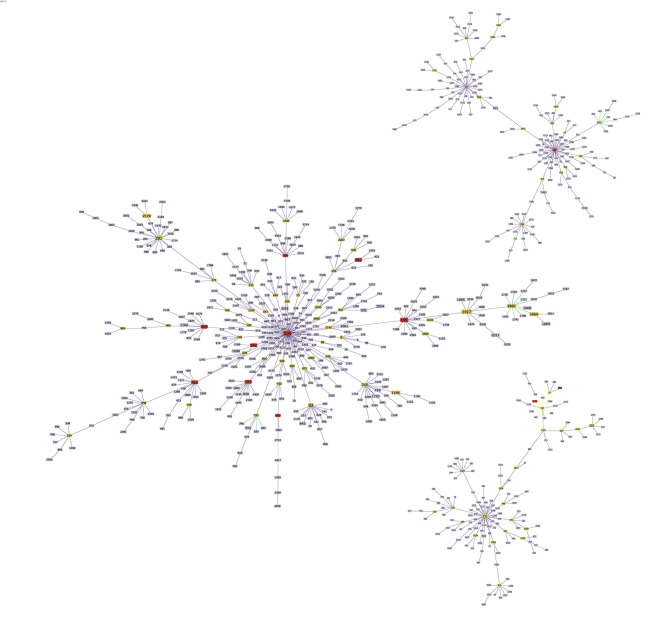
is an important nosocomial pathogen, which is multidrug resistant (MDR). has become a major threat to public health worldwide due to its ability to easily acquire resistant genes. In order to analyze its epidemiology characteristics and the genetic evolution, isolates obtained from a Chinese tertiary hospital in the past 12 years (2008-2019), 295 isolates of non-repetitive , were recovered from patients and wards environments. The resistance genes were analyzed using antimicrobial susceptibility testing. The genetic relatedness of 295 isolates was identified by multilocus sequence typing (MLST) and eBURST analysis. It was found that the antibiotic-resistant and carbapenemase-resistant genes of all the 295 MDR in the hospital have not changed significantly over the past 12 years; all of them were resistant to multiple antibiotics except the polymyxin E and tigecycline. The results of drug-resistant genes showed that the detection rates of carbapenemase-resistant genes , , and were 97.6, 75.3, and 71.9%, respectively, which were detected almost every year from 2008 to 2019. Additionally, 16s rRNA methylation enzyme gene , aminoglycoside-resistant gene , and class I integrase gene could also have a high positive rate. By MLST, these isolates were assigned to 12 sequence types (STs), including ST369, ST208, ST195, ST191, ST368, ST530, ST469, ST451, ST229, ST381, ST543, and ST1176. eBURST analysis showed that 9 STs with ST208 as the founder genotype belonged to Group 1 except for ST229, ST530, and ST1176. Therefore, most MDR isolates had a relatively close genetic relationship. Notably, the predominant ST208 and ST369 at the early stage changed to ST451 in 2019, indicating that the complex and diverse genetic background of the prevalence of isolates in the hospital. Overall, further epidemiological surveillance and genetic evolution analysis of are required, which can provide new strategies for the prevention and control of infections.
是一种重要的医院获得性病原体,具有多重耐药性(MDR)。由于其容易获得耐药基因,已成为全球公共卫生的主要威胁。为了分析其流行病学特征和遗传进化,我们从过去 12 年(2008-2019 年)中国一家三级医院的患者和病房环境中分离出 295 株非重复的 ,并使用抗菌药物敏感性试验分析了耐药基因。通过多位点序列分型(MLST)和 eBURST 分析鉴定了 295 株 的遗传相关性。结果发现,过去 12 年来,医院所有 295 株 MDR 的抗生素耐药和碳青霉烯酶耐药基因没有明显变化;除多粘菌素 E 和替加环素外,它们均对多种抗生素耐药。耐药基因检测结果表明,碳青霉烯酶耐药基因 、 、 的检出率分别为 97.6%、75.3%和 71.9%,从 2008 年到 2019 年几乎每年都有检出。此外,16s rRNA 甲基化酶基因、氨基糖苷类耐药基因和 I 类整合酶基因也具有较高的阳性率。通过 MLST,这些分离株被分为 12 种序列型(STs),包括 ST369、ST208、ST195、ST191、ST368、ST530、ST469、ST451、ST229、ST381、ST543 和 ST1176。eBURST 分析表明,除 ST229、ST530 和 ST1176 外,以 ST208 为创始基因型的 9 个 ST 属于第 1 组。因此,大多数 MDR 分离株具有相对密切的遗传关系。值得注意的是,早期主要流行的 ST208 和 ST369 在 2019 年转变为 ST451,表明医院 分离株流行的复杂多样的遗传背景。总体而言,需要进一步进行 的流行病学监测和遗传进化分析,为 感染的预防和控制提供新的策略。