Magalhães Nathalia Santos, Savino Wilson, Silva Patrícia Machado Rodrigues, Martins Marco Aurélio, Carvalho Vinicius Frias
Laboratory of Inflammation, Oswaldo Cruz Institute, Oswaldo Cruz Foundation (Fiocruz), Rio de Janeiro, Brazil.
Laboratory on Thymus Research, Oswaldo Cruz Institute, Oswaldo Cruz Foundation (Fiocruz), Rio de Janeiro, Brazil.
Front Med (Lausanne). 2021 Aug 11;8:644751. doi: 10.3389/fmed.2021.644751. eCollection 2021.
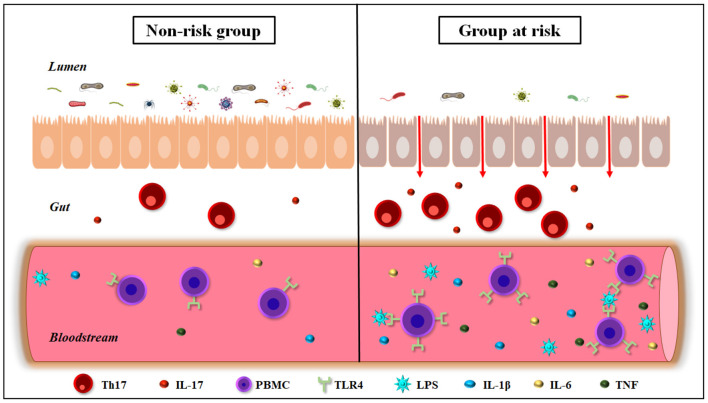
A new infectious disease, named COVID-19, caused by the coronavirus associated to severe acute respiratory syndrome (SARS-CoV-2) has become pandemic in 2020. The three most common pre-existing comorbidities associated with COVID-19-related death are elderly, diabetic, and hypertensive people. A common factor among these risk groups for the outcome of death in patients infected with SARS-CoV-2 is dysbiosis, with an increase in the proportion of bacteria with a pro-inflammatory profile. Due to this dysbiosis, elderly, diabetic, and hypertensive people present a higher propensity to mount an inflammatory environment in the gut with poor immune editing, culminating in a weakness of the intestinal permeability barrier and high bacterial product translocation to the bloodstream. This scenario culminates in a low-grade, persistent, and systemic inflammation. In this context, we propose here that high circulating levels of bacterial products, like lipopolysaccharide (LPS), can potentiate the SARS-CoV-2-induced cytokines, including IL-6, being crucial for development of the cytokine storm in the severe form of the disease. A better understanding on the possible correlation between gut dysbiosis and poor outcomes observed in elderly, diabetic, and hypertensive people can be useful for the development of new therapeutic strategies based on modulation of the gut microbiota.
一种由与严重急性呼吸综合征相关的冠状病毒(SARS-CoV-2)引起的新型传染病——COVID-19,于2020年大流行。与COVID-19相关死亡相关的三种最常见的基础合并症是老年人、糖尿病患者和高血压患者。在感染SARS-CoV-2的患者中,这些死亡风险人群的一个共同因素是肠道菌群失调,促炎型细菌的比例增加。由于这种肠道菌群失调,老年人、糖尿病患者和高血压患者在肠道中更易形成炎症环境,免疫编辑功能较差,最终导致肠道通透性屏障减弱,细菌产物大量易位至血液中。这种情况最终会导致低度、持续性的全身炎症。在此背景下,我们在此提出,高循环水平的细菌产物,如脂多糖(LPS),可增强SARS-CoV-2诱导的细胞因子,包括IL-6,这对疾病严重形式下细胞因子风暴的发展至关重要。更好地理解肠道菌群失调与老年人、糖尿病患者和高血压患者不良预后之间的可能关联,有助于开发基于调节肠道微生物群的新治疗策略。