de Jong Heleen, Bonger Kimberly M, Löwik Dennis W P M
Department of Synthetic Organic Chemistry, Institute for Molecules and Materials, Radboud University Nijmegen The Netherlands
RSC Chem Biol. 2020 Aug 26;1(4):192-203. doi: 10.1039/d0cb00114g. eCollection 2020 Oct 1.
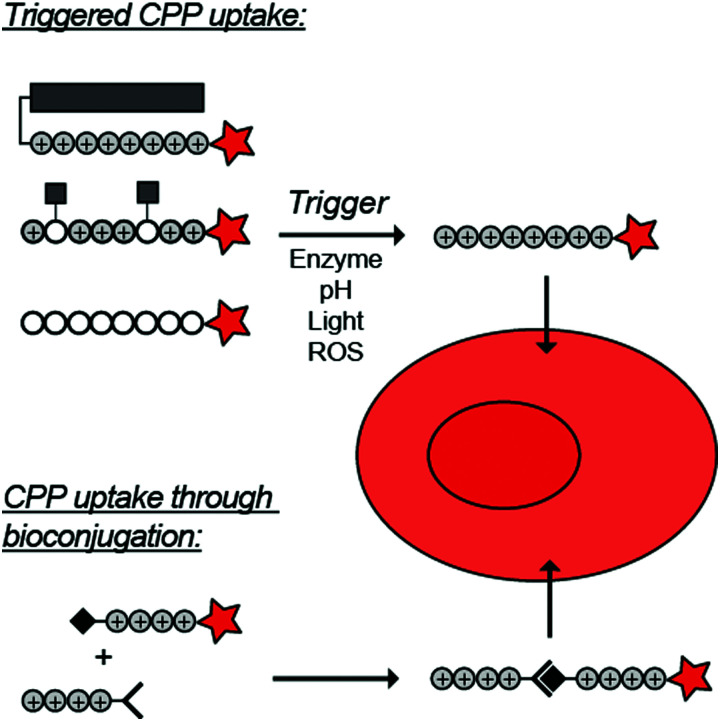
An important hurdle for the intracellular delivery of large cargo is the cellular membrane, which protects the cell from exogenous substances. Cell-penetrating peptides (CPPs) can cross this barrier but their use as drug delivery vehicles is hampered by their lack of cell type specificity. Over the past years, several approaches have been explored to control the activity of CPPs that can be primed for cellular uptake. Since the first report on such activatable CPPs (ACPPs) in 2004, various methods of activation have been developed. Here, we provide an overview of the different ACPPs strategies known to date and summarize the benefits, drawbacks, and future directions.
大分子货物进行细胞内递送的一个重要障碍是细胞膜,它保护细胞免受外源物质的侵害。细胞穿透肽(CPP)可以跨越这一屏障,但其作为药物递送载体的应用却因缺乏细胞类型特异性而受到阻碍。在过去几年中,人们探索了几种方法来控制CPP的活性,使其能够被引发进行细胞摄取。自2004年首次报道此类可激活细胞穿透肽(ACPP)以来,已开发出各种激活方法。在此,我们概述了迄今为止已知的不同ACPP策略,并总结了其优点、缺点和未来方向。