Luo Yian, Fan Lei, Liu Can, Wen Huiquan, Wang Shihuan, Guan Pengfei, Chen Dafu, Ning Chengyun, Zhou Lei, Tan Guoxin
School of Chemical Engineering and Light Industry, Guangdong University of Technology, Guangzhou, 510006, China.
School of Materials Science and Engineering, National Engineering Research Center for Tissue Restoration and Reconstruction, South China University of Technology, Guangzhou, 510641, China.
Bioact Mater. 2021 Jun 1;7:98-111. doi: 10.1016/j.bioactmat.2021.05.039. eCollection 2022 Jan.
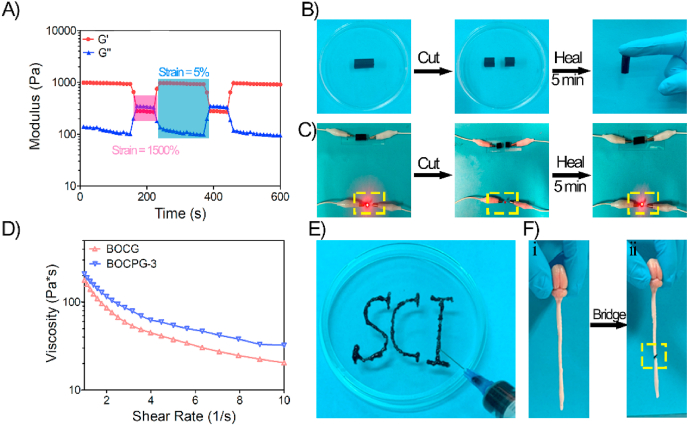
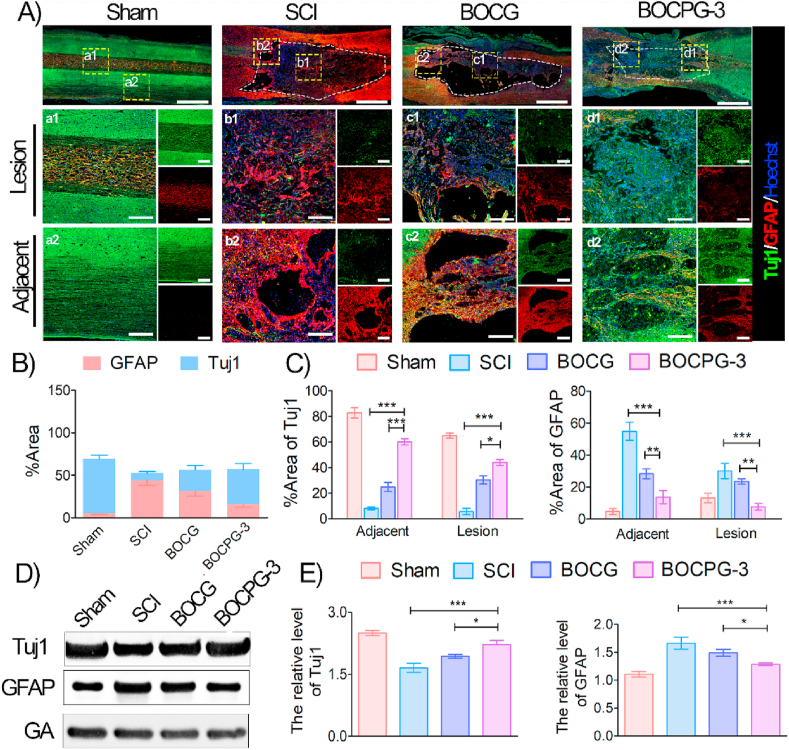
Injectable biomaterial-based treatment is a promising strategy to enhance tissue repair after traumatic spinal cord injury (SCI) by bridging cavity spaces. However, there are limited reports of injectable, electroconductive hydrogels with self-healing properties being employed for the treatment of traumatic SCI. Hence, a natural extracellular matrix (ECM) biopolymer (chondroitin sulphate and gelatin)-based hydrogel containing polypyrrole, which imparted electroconductive properties, is developed for traumatic SCI repair. The resulting hydrogels showed mechanical (~928 Pa) and conductive properties (4.49 mS/cm) similar to natural spinal cord tissues. Moreover, the hydrogels exhibited shear-thinning and self-healing abilities, which allows it to be effectively injected into the injury site and to fill the lesion cavity to accelerate the tissue repair of traumatic SCI. electroconductive ECM hydrogels promoted neuronal differentiation, enhanced axon outgrowth, and inhibited astrocyte differentiation. The electroconductive ECM hydrogel activated endogenous neural stem cell neurogenesis (n = 6), and induced myelinated axon regeneration into the lesion site via activation of the PI3K/AKT and MEK/ERK pathways, thereby achieving significant locomotor function restoration in rats with spinal cord injury (p < 0.001, compared to SCI group). Overall, the injectable self-healing electroconductive ECM-based hydrogels developed in this study are ideal biomaterials for treatment of traumatic SCI.
基于可注射生物材料的治疗是一种很有前景的策略,可通过桥接腔隙来促进创伤性脊髓损伤(SCI)后的组织修复。然而,关于具有自愈特性的可注射导电水凝胶用于治疗创伤性SCI的报道有限。因此,开发了一种基于天然细胞外基质(ECM)生物聚合物(硫酸软骨素和明胶)并含有聚吡咯以赋予导电性能的水凝胶,用于创伤性SCI修复。所得水凝胶显示出与天然脊髓组织相似的力学性能(约928帕)和导电性能(4.49毫西门子/厘米)。此外,水凝胶表现出剪切变稀和自愈能力,这使其能够有效地注入损伤部位并填充损伤腔,以加速创伤性SCI的组织修复。导电ECM水凝胶促进神经元分化,增强轴突生长,并抑制星形胶质细胞分化。导电ECM水凝胶激活内源性神经干细胞神经发生(n = 6),并通过激活PI3K/AKT和MEK/ERK途径诱导有髓轴突再生进入损伤部位,从而在脊髓损伤大鼠中实现显著的运动功能恢复(与SCI组相比,p < 0.001)。总体而言,本研究中开发的可注射自愈导电ECM基水凝胶是治疗创伤性SCI的理想生物材料。