Laboratoire MIVEGEC, Université de Montpellier, Centre national de la recherche scientifique, Institut de recherche pour le développement, Montpellier, France.
PLoS Comput Biol. 2021 Sep 7;17(9):e1009352. doi: 10.1371/journal.pcbi.1009352. eCollection 2021 Sep.
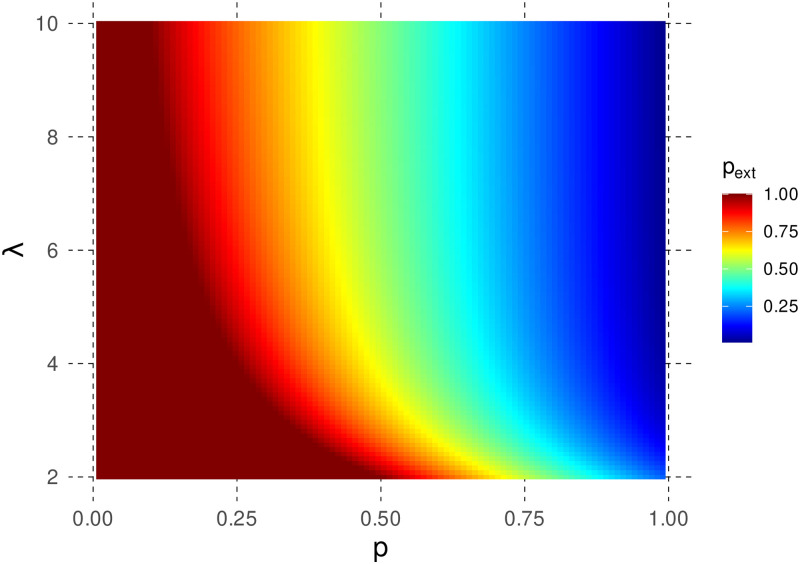
Human Papillomaviruses (HPV) are one of the most prevalent sexually transmitted infections (STI) and the most oncogenic viruses known to humans. The vast majority of HPV infections clear in less than 3 years, but the underlying mechanisms, especially the involvement of the immune response, are still poorly known. Building on earlier work stressing the importance of randomness in the type of cell divisions in the clearance of HPV infection, we develop a stochastic mathematical model of HPV dynamics that combines the previous aspect with an explicit description of the intracellular level. We show that the random partitioning of virus episomes upon stem cell division and the occurrence of symmetric divisions dramatically affect viral persistence. These results call for more detailed within-host studies to better understand the relative importance of stochasticity and immunity in HPV infection clearance.
人乳头瘤病毒 (HPV) 是最常见的性传播感染 (STI) 之一,也是已知对人类致癌性最强的病毒。绝大多数 HPV 感染在 3 年内清除,但潜在机制,特别是免疫反应的参与,仍知之甚少。基于早期强调 HPV 感染清除中细胞分裂随机性重要性的工作,我们开发了一个 HPV 动力学的随机数学模型,该模型将之前的方面与细胞内水平的明确描述结合起来。我们表明,干细胞分裂时病毒外显子的随机分配和对称分裂的发生会极大地影响病毒的持续存在。这些结果呼吁进行更详细的宿主内研究,以更好地了解 HPV 感染清除中随机性和免疫性的相对重要性。