Mishra Gyan P, Dikshit Harsh K, T Vinutha, Tontang M Tomuilim, Stobdan Tsering, Sangwan Seema, Aski Muraleedhar, Singh Ajeet, Kumar Ranjeet R, Tripathi Kuldeep, Kumar Shiv, Nair Ramakrishnan M, Praveen Shelly
Division of Genetics, Indian Council of Agricultural Research-Indian Agricultural Research Institute, New Delhi, India.
Division of Biochemistry, Indian Council of Agricultural Research-Indian Agricultural Research Institute, New Delhi, India.
Front Plant Sci. 2021 Jul 30;12:710812. doi: 10.3389/fpls.2021.710812. eCollection 2021.
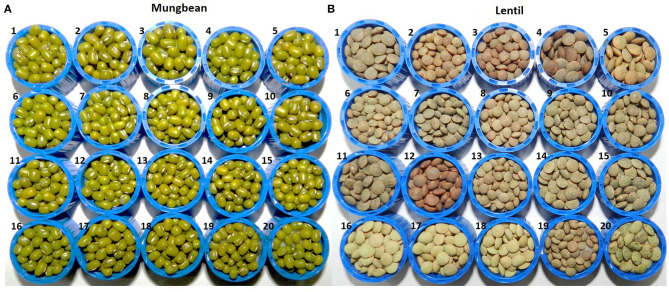
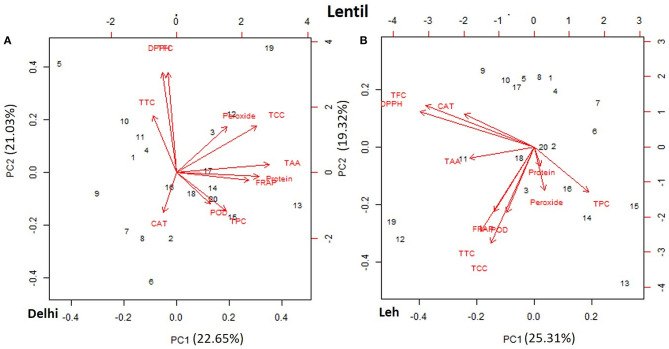
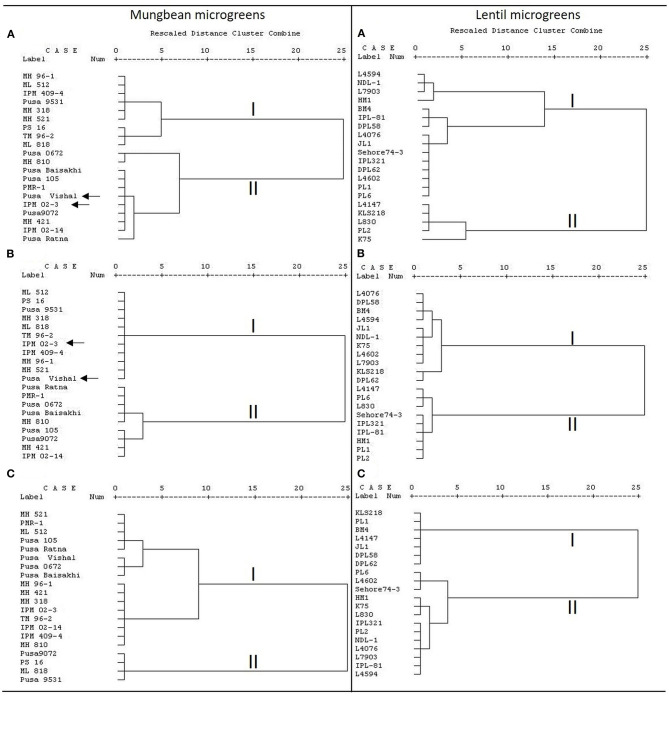
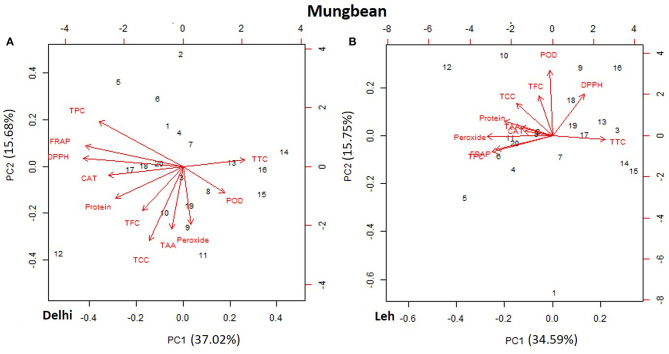
Mungbeans and lentils are relatively easily grown and cheaper sources of microgreens, but their phytonutrient diversity is not yet deeply explored. In this study, 20 diverse genotypes each of mungbean and lentil were grown as microgreens under plain-altitude (Delhi) and high-altitude (Leh) conditions, which showed significant genotypic variations for ascorbic acid, tocopherol, carotenoids, flavonoid, total phenolics, DPPH (1, 1-diphenyl-2-picrylhydrazyl), FRAP (ferric-reducing antioxidant power), peroxide activity, proteins, enzymes (peroxidase and catalase), micronutrients, and macronutrients contents. The lentil and mungbean genotypes L830 and MH810, respectively, were found superior for most of the studied parameters over other studied genotypes. Interestingly, for most of the studied parameters, Leh-grown microgreens were found superior to the Delhi-grown microgreens, which could be due to unique environmental conditions of Leh, especially wide temperature amplitude, photosynthetically active radiation (PAR), and UV-B content. In mungbean microgreens, total phenolics content (TPC) was found positively correlated with FRAP and DPPH, while in lentil microgreens, total flavonoid content (TFC) was found positively correlated with DPPH. The most abundant elements recorded were in the order of K, P, and Ca in mungbean microgreens; and K, Ca, and P in the lentil microgreens. In addition, these Fabaceae microgreens may help in the nutritional security of the population residing in the high-altitude regions of Ladakh, especially during winter months when this region remains landlocked due to heavy snowfall.
绿豆和小扁豆是相对容易种植且价格较低的芽苗菜来源,但它们的植物营养素多样性尚未得到深入研究。在本研究中,20种不同基因型的绿豆和小扁豆均作为芽苗菜在平原海拔(德里)和高海拔(列城)条件下种植,结果显示,在抗坏血酸、生育酚、类胡萝卜素、黄酮类化合物、总酚、DPPH(1,1 - 二苯基 - 2 - 苦基肼)、FRAP(铁还原抗氧化能力)、过氧化物活性、蛋白质、酶(过氧化物酶和过氧化氢酶)、微量营养素和大量营养素含量方面存在显著的基因型差异。在大多数研究参数方面,分别发现小扁豆基因型L830和绿豆基因型MH810优于其他研究的基因型。有趣的是,在大多数研究参数方面,发现列城种植的芽苗菜优于德里种植的芽苗菜,这可能是由于列城独特的环境条件,特别是较大的温度幅度、光合有效辐射(PAR)和UV - B含量。在绿豆芽苗菜中,发现总酚含量(TPC)与FRAP和DPPH呈正相关,而在小扁豆芽苗菜中,发现总黄酮含量(TFC)与DPPH呈正相关。记录到的最丰富元素在绿豆芽苗菜中按钾、磷、钙的顺序排列;在小扁豆芽苗菜中按钾、钙、磷的顺序排列。此外,这些豆科芽苗菜可能有助于拉达克高海拔地区居民的营养安全,特别是在冬季,该地区因大雪而处于内陆状态的时候。