Department of Pediatrics, Baylor College of Medicine, Houston, TX 77030, USA.
Texas Children's Cancer and Hematology Centers, Texas Children's Hospital, Houston, TX 77030, USA.
Int J Environ Res Public Health. 2021 Sep 2;18(17):9273. doi: 10.3390/ijerph18179273.
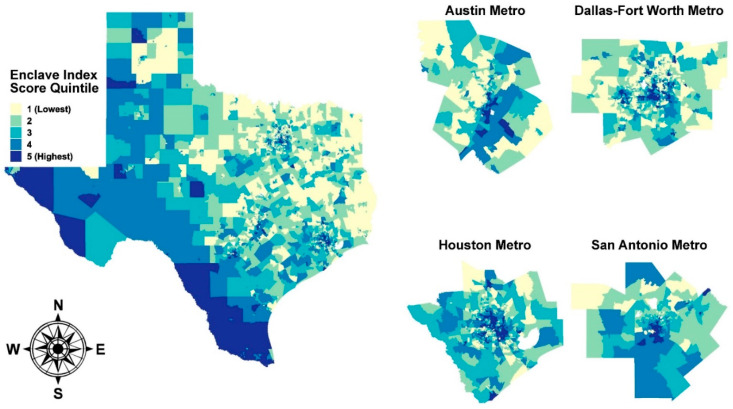
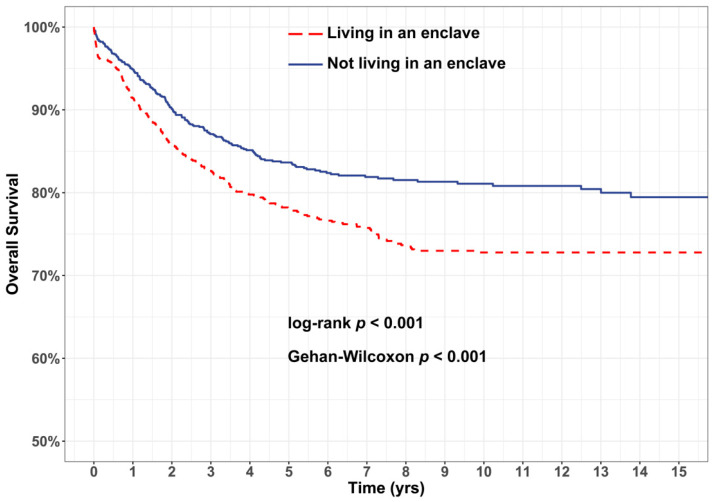
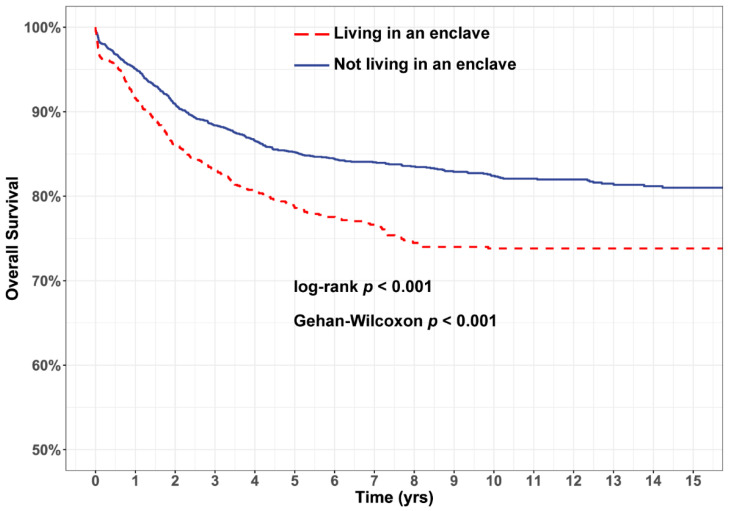
Hispanic children with acute lymphoblastic leukemia (ALL) experience poorer overall survival (OS) than non-Hispanic White children; however, few studies have investigated the social determinants of this disparity. In Texas, many Hispanic individuals reside in ethnic enclaves-areas with high concentrations of immigrants, ethnic-specific businesses, and language isolation, which are often socioeconomically deprived. We determined whether enclave residence was associated with ALL survival, overall and among Hispanic children. We computed Hispanic enclave index scores for Texas census tracts, and classified children ( = 4083) as residing in enclaves if their residential tracts scored in the highest statewide quintile. We used Cox regression to evaluate the association between enclave residence and OS. Five-year OS was 78.6% for children in enclaves, and 77.8% for Hispanic children in enclaves, both significantly lower ( < 0.05) than the 85.8% observed among children not in enclaves. Children in enclaves had increased risk of death (hazard ratio (HR) 1.20, 95% confidence interval (CI) 1.01-1.49) after adjustment for sex, age at diagnosis, year of diagnosis, metropolitan residence and neighborhood socioeconomic deprivation and after further adjustment for child race/ethnicity (HR 1.19, 95% CI 0.97-1.45). We observed increased risk of death when analyses were restricted to Hispanic children specifically (HR 1.30, 95% CI 1.03-1.65). Observations suggest that children with ALL residing in Hispanic enclaves experience inferior OS.
西班牙裔儿童患有急性淋巴细胞白血病 (ALL) 的总生存率 (OS) 不如非西班牙裔白种人儿童;然而,很少有研究调查这种差异的社会决定因素。在德克萨斯州,许多西班牙裔人居住在少数民族聚居区——这些地区移民、特定族裔的企业和语言隔离程度高,往往经济上处于贫困状态。我们确定了聚居区的居住是否与 ALL 存活有关,包括整体和西班牙裔儿童的存活。我们计算了德克萨斯州普查区的西班牙裔聚居区指数得分,并将居住在聚居区的儿童(=4083)分类为如果其居住的街区得分在全州最高的五分之一。我们使用 Cox 回归评估聚居区居住与 OS 的关系。聚居区儿童的 5 年 OS 为 78.6%,西班牙裔聚居区儿童的 5 年 OS 为 77.8%,均明显低于非聚居区儿童的 85.8%(<0.05)。调整性别、诊断时的年龄、诊断年份、大都市居住和社区社会经济剥夺后,聚居区儿童的死亡风险增加(风险比 (HR) 1.20,95%置信区间 (CI) 1.01-1.49),并进一步调整儿童种族/族裔后(HR 1.19,95% CI 0.97-1.45)。当分析仅限于西班牙裔儿童时,我们观察到死亡风险增加(HR 1.30,95% CI 1.03-1.65)。这些观察结果表明,居住在西班牙裔聚居区的 ALL 儿童的 OS 较差。