Cyll Karolina, Kleppe Andreas, Kalsnes Joakim, Vlatkovic Ljiljana, Pradhan Manohar, Kildal Wanja, Tobin Kari Anne R, Reine Trine M, Wæhre Håkon, Brennhovd Bjørn, Askautrud Hanne A, Skaaheim Haug Erik, Hveem Tarjei S, Danielsen Håvard E
Institute for Cancer Genetics and Informatics, Oslo University Hospital, NO-0424 Oslo, Norway.
Department of Informatics, University of Oslo, NO-0316 Oslo, Norway.
Cancers (Basel). 2021 Aug 26;13(17):4291. doi: 10.3390/cancers13174291.
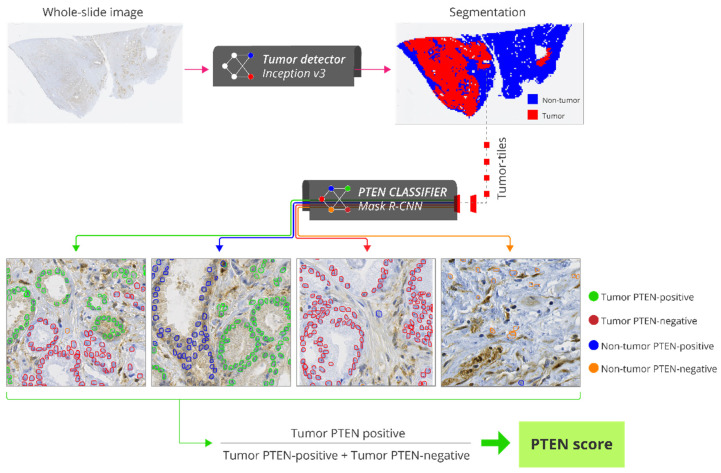
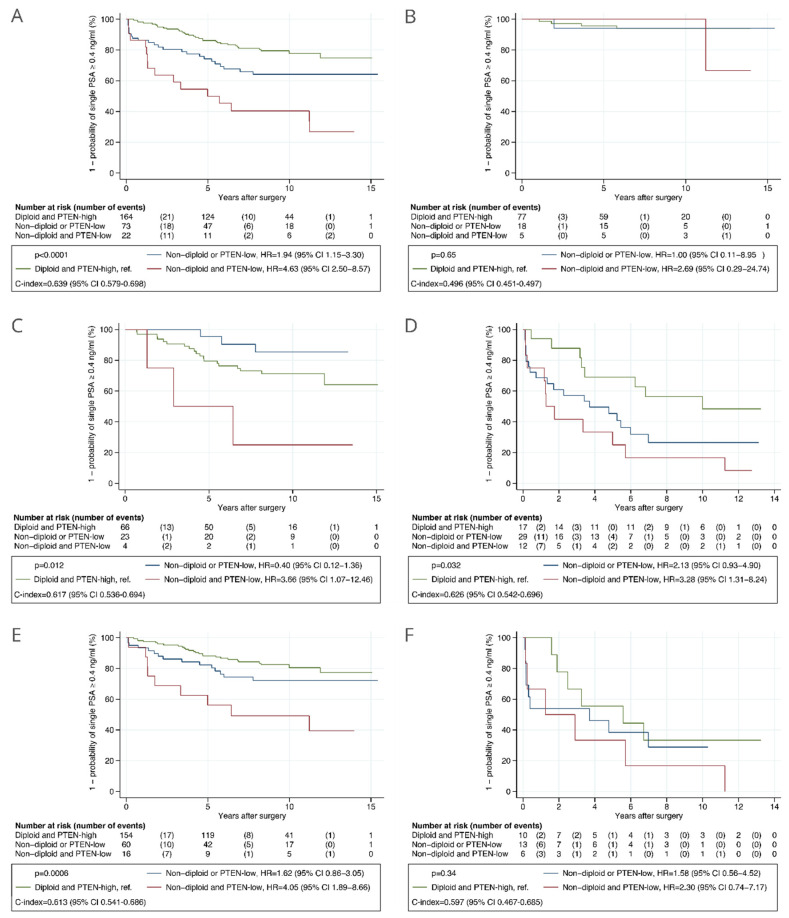
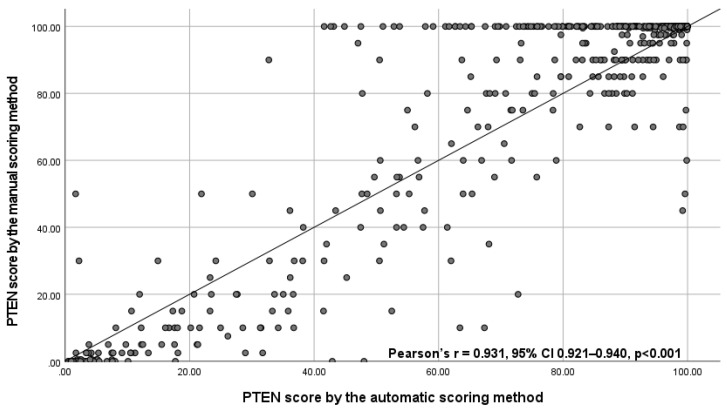
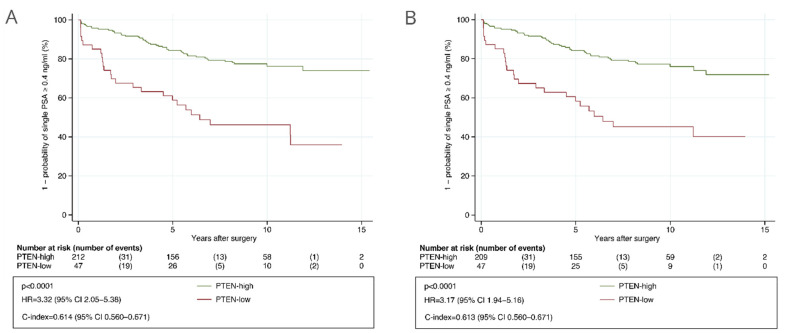
Machine learning (ML) is expected to improve biomarker assessment. Using convolution neural networks, we developed a fully-automated method for assessing PTEN protein status in immunohistochemically-stained slides using a radical prostatectomy (RP) cohort ( = 253). It was validated according to a predefined protocol in an independent RP cohort ( = 259), alone and by measuring its prognostic value in combination with DNA ploidy status determined by ML-based image cytometry. In the primary analysis, automatically assessed dichotomized PTEN status was associated with time to biochemical recurrence (TTBCR) (hazard ratio (HR) = 3.32, 95% CI 2.05 to 5.38). Patients with both non-diploid tumors and PTEN-low had an HR of 4.63 (95% CI 2.50 to 8.57), while patients with one of these characteristics had an HR of 1.94 (95% CI 1.15 to 3.30), compared to patients with diploid tumors and PTEN-high, in univariable analysis of TTBCR in the validation cohort. Automatic PTEN scoring was strongly predictive of the PTEN status assessed by human experts (area under the curve 0.987 (95% CI 0.968 to 0.994)). This suggests that PTEN status can be accurately assessed using ML, and that the combined marker of automatically assessed PTEN and DNA ploidy status may provide an objective supplement to the existing risk stratification factors in prostate cancer.
机器学习(ML)有望改善生物标志物评估。我们使用卷积神经网络,开发了一种全自动方法,用于在根治性前列腺切除术(RP)队列(n = 253)的免疫组织化学染色切片中评估PTEN蛋白状态。根据预定义方案,在一个独立的RP队列(n = 259)中对其进行了验证,单独验证以及通过结合基于ML的图像细胞术确定的DNA倍体状态测量其预后价值。在初步分析中,自动评估的二分法PTEN状态与生化复发时间(TTBCR)相关(风险比(HR)= 3.32,95%置信区间2.05至5.38)。在验证队列中对TTBCR进行单变量分析时,与二倍体肿瘤且PTEN高表达的患者相比,非二倍体肿瘤且PTEN低表达的患者HR为4.63(95%置信区间2.50至8.57),而具有这些特征之一的患者HR为1.94(95%置信区间1.15至3.30)。自动PTEN评分对人类专家评估的PTEN状态具有强烈预测性(曲线下面积为0.987(95%置信区间0.968至0.994))。这表明可以使用ML准确评估PTEN状态,并且自动评估的PTEN和DNA倍体状态的联合标志物可能为前列腺癌现有的风险分层因素提供客观补充。