Yamauchi Takuro, Fujishima Fumiyoshi, Hashimoto Masatoshi, Tsunokake Junichi, Akaishi Ryujiro, Gokon Yusuke, Ueki Shunsuke, Ozawa Yohei, Fukutomi Toshiaki, Okamoto Hiroshi, Sato Chiaki, Taniyama Yusuke, Nakamura Tomohiro, Nakaya Naoki, Kamei Takashi, Sasano Hironobu
Department of Surgery, Tohoku University Graduate School of Medicine, 1-1 Seiryo-machi, Aoba-ku, Sendai 980-8574, Japan.
Department of Pathology, Tohoku University Hospital, 1-1 Seiryo-machi, Aoba-ku, Sendai 980-8574, Japan.
Cancers (Basel). 2021 Sep 5;13(17):4473. doi: 10.3390/cancers13174473.
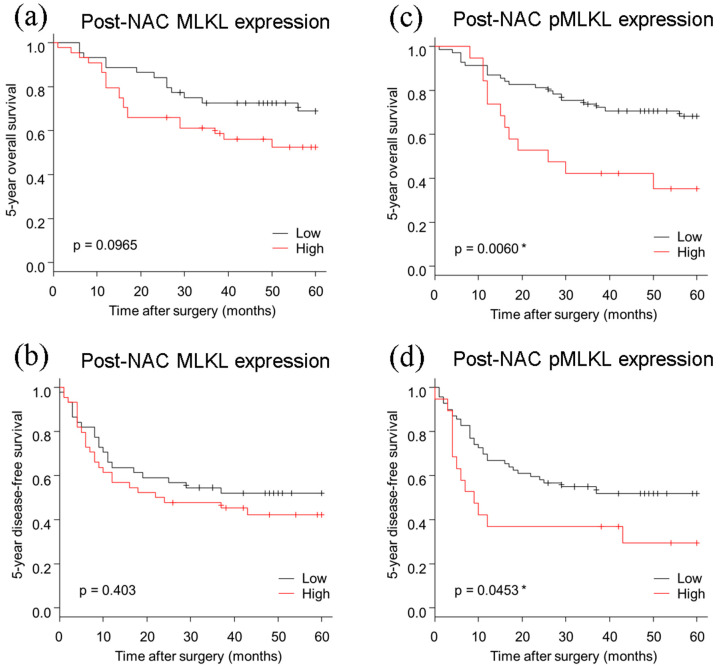
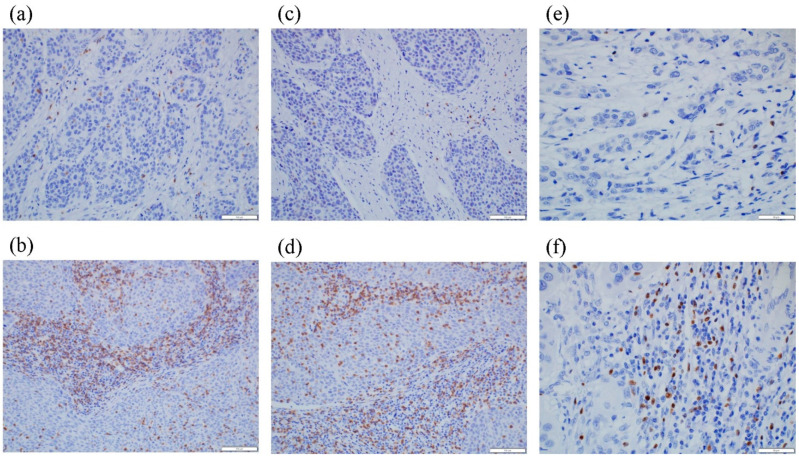
Necroptosis is a pivotal process in cancer biology; however, the clinical significance of necroptosis in esophageal squamous cell carcinoma (ESCC) has remained unknown. Therefore, in this study, we aimed to verify the potential involvement of necroptosis in the clinical outcome, chemotherapeutic resistance, and tumor microenvironment of ESCC. Mixed lineage kinase domain-like protein (MLKL) and phosphorylated MLKL (pMLKL) were immunohistochemically examined in 88 surgically resected specimens following neoadjuvant chemotherapy (NAC) and 53 pre-therapeutic biopsy specimens, respectively. Tumor-infiltrating lymphocytes (TILs) were also evaluated by immunolocalizing CD3, CD8, and forkhead box protein 3 (FOXP3) in the residual tumors after NAC. High pMLKL status in the post-NAC resected specimens was significantly correlated with worse prognosis in ESCC patients. Multivariate analysis demonstrated that a high pMLKL status was an independent prognostic factor. In pre-NAC biopsy specimens, a high pMLKL status was significantly associated with a lower therapeutic efficacy. CD8+ TILs were significantly lower in the high-pMLKL group. FOXP3+ TILs were significantly higher in both high-MLKL and high-pMLKL groups. We first demonstrated pMLKL status as an independent prognostic factor in ESCC patients. Our study revealed the possible involvement of necroptosis in the immunosuppressive microenvironment, resulting in the attenuated therapeutic efficacy of NAC and eventual adverse clinical outcomes in ESCC.
坏死性凋亡是癌症生物学中的一个关键过程;然而,坏死性凋亡在食管鳞状细胞癌(ESCC)中的临床意义尚不清楚。因此,在本研究中,我们旨在验证坏死性凋亡在ESCC临床结局、化疗耐药性和肿瘤微环境中的潜在作用。分别对88例新辅助化疗(NAC)后手术切除的标本和53例治疗前活检标本进行免疫组织化学检测,观察混合谱系激酶样蛋白(MLKL)和磷酸化MLKL(pMLKL)。通过对NAC后残留肿瘤中的CD3、CD8和叉头框蛋白3(FOXP3)进行免疫定位,评估肿瘤浸润淋巴细胞(TILs)。NAC后切除标本中高pMLKL状态与ESCC患者预后较差显著相关。多因素分析表明,高pMLKL状态是一个独立的预后因素。在NAC前活检标本中,高pMLKL状态与较低的治疗效果显著相关。高pMLKL组的CD8 + TILs显著降低。在高MLKL组和高pMLKL组中,FOXP3 + TILs均显著升高。我们首次证明pMLKL状态是ESCC患者的独立预后因素。我们的研究揭示了坏死性凋亡可能参与免疫抑制微环境,导致NAC治疗效果减弱,并最终导致ESCC患者出现不良临床结局。