Bortolini Silveira Amanda, Bidard François-Clément, Tanguy Marie-Laure, Girard Elodie, Trédan Olivier, Dubot Coraline, Jacot William, Goncalves Anthony, Debled Marc, Levy Christelle, Ferrero Jean-Marc, Jouannaud Christelle, Rios Maria, Mouret-Reynier Marie-Ange, Dalenc Florence, Hego Caroline, Rampanou Aurore, Albaud Benoit, Baulande Sylvain, Berger Frédérique, Lemonnier Jérôme, Renault Shufang, Desmoulins Isabelle, Proudhon Charlotte, Pierga Jean-Yves
Circulating Tumor Biomarkers laboratory, INSERM CIC BT-1428, Institut Curie, Paris, France.
Department of Medical Oncology, Institut Curie, Paris and Saint Cloud, Paris, France.
NPJ Breast Cancer. 2021 Sep 9;7(1):115. doi: 10.1038/s41523-021-00319-4.
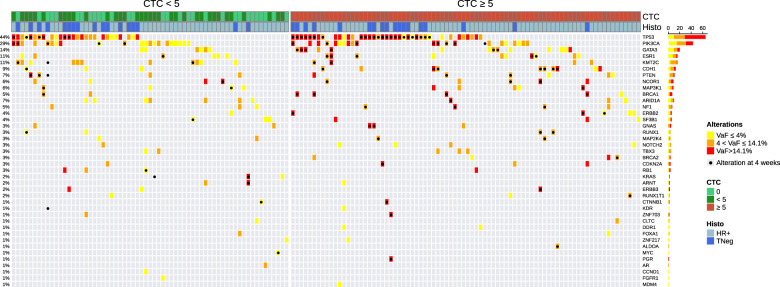
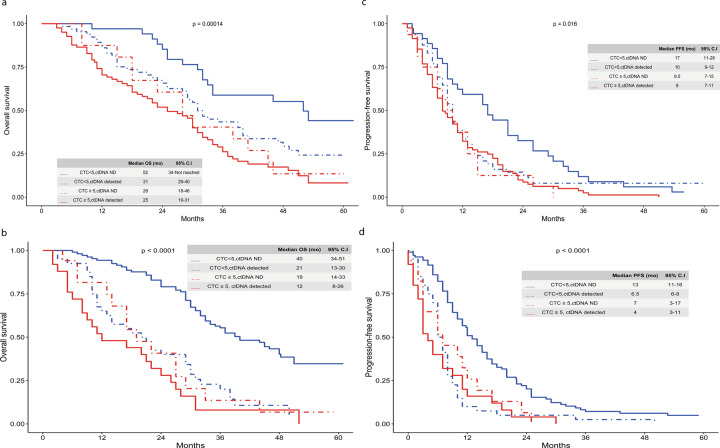
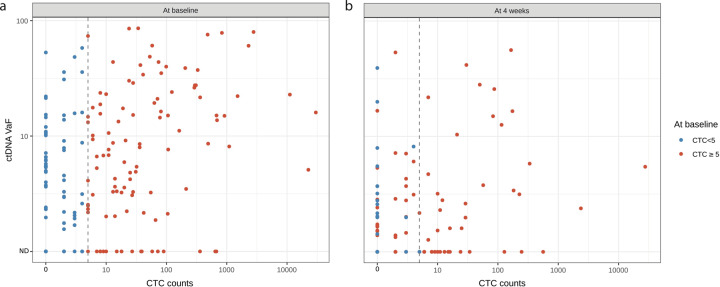
Circulating tumor cells (CTCs) and circulating tumor DNA (ctDNA) are two cancer-derived blood biomarkers that inform on patient prognosis and treatment efficacy in breast cancer. We prospectively evaluated the clinical validity of quantifying both CTCs (CellSearch) and ctDNA (targeted next-generation sequencing). Their combined value as prognostic and early monitoring markers was assessed in 198 HER2-negative metastatic breast cancer patients. All patients were included in the prospective multicenter UCBG study COMET (NCT01745757) and treated by first-line chemotherapy with weekly paclitaxel and bevacizumab. Blood samples were obtained at baseline and before the second cycle of chemotherapy. At baseline, CTCs and ctDNA were respectively detected in 72 and 74% of patients and were moderately correlated (Kendall's τ = 0.3). Only 26 (13%) patients had neither detectable ctDNA nor CTCs. Variants were most frequently observed in TP53 and PIK3CA genes. KMT2C/MLL3 variants detected in ctDNA were significantly associated with a lower CTC count, while the opposite trend was seen with GATA3 alterations. Both CTC and ctDNA levels at baseline and after four weeks of treatment were correlated with survival. For progression-free and overall survival, the best multivariate prognostic model included tumor subtype (triple negative vs other), grade (grade 3 vs other), ctDNA variant allele frequency (VAF) at baseline (per 10% increase), and CTC count at four weeks (≥5CTC/7.5 mL). Overall, this study demonstrates that CTCs and ctDNA have nonoverlapping detection profiles and complementary prognostic values in metastatic breast cancer patients. A comprehensive liquid-biopsy approach may involve simultaneous detection of ctDNA and CTCs.
循环肿瘤细胞(CTCs)和循环肿瘤DNA(ctDNA)是两种源自癌症的血液生物标志物,可用于评估乳腺癌患者的预后和治疗效果。我们前瞻性地评估了定量检测CTCs(CellSearch)和ctDNA(靶向新一代测序)的临床有效性。在198例HER2阴性转移性乳腺癌患者中评估了它们作为预后和早期监测标志物的联合价值。所有患者均纳入前瞻性多中心UCBG研究COMET(NCT01745757),并接受每周一次紫杉醇和贝伐单抗的一线化疗。在基线和化疗第二周期前采集血样。基线时,分别在72%和74%的患者中检测到CTCs和ctDNA,二者呈中度相关(肯德尔τ=0.3)。只有26例(13%)患者既未检测到ctDNA也未检测到CTCs。变异最常出现在TP53和PIK3CA基因中。在ctDNA中检测到的KMT2C/MLL3变异与较低的CTCs计数显著相关,而GATA3改变则呈现相反趋势。基线时以及治疗四周后的CTCs和ctDNA水平均与生存相关。对于无进展生存期和总生存期,最佳多变量预后模型包括肿瘤亚型(三阴性与其他亚型)、分级(3级与其他分级)、基线时ctDNA变异等位基因频率(VAF,每增加10%)以及四周时的CTCs计数(≥5个CTCs/7.5 mL)。总体而言,本研究表明CTCs和ctDNA在转移性乳腺癌患者中具有不重叠的检测谱和互补的预后价值。全面的液体活检方法可能涉及同时检测ctDNA和CTCs。