Sharafeddin Farahnaz, Jowkar Zahra, Bahrani Somaye
Professor, Biomaterials Research Center, Department of Operative Dentistry, School of Dentistry, Shiraz University of Medical Sciences, Shiraz, Iran.
Assistant professor, Oral and Dental Disease Research Center, Department of Operative Dentistry, School of Dentistry, Shiraz University of Medical Sciences, Shiraz, Iran.
J Clin Exp Dent. 2021 Aug 1;13(8):e737-e744. doi: 10.4317/jced.55996. eCollection 2021 Aug.
This study aimed to compare the effect of chitosan (CH) and hydroxyapatite (HP) on the surface roughness and microhardness of a conventional glass ionomer cement (CGIC) and a resin modified glass ionomer cement (RMGIC).
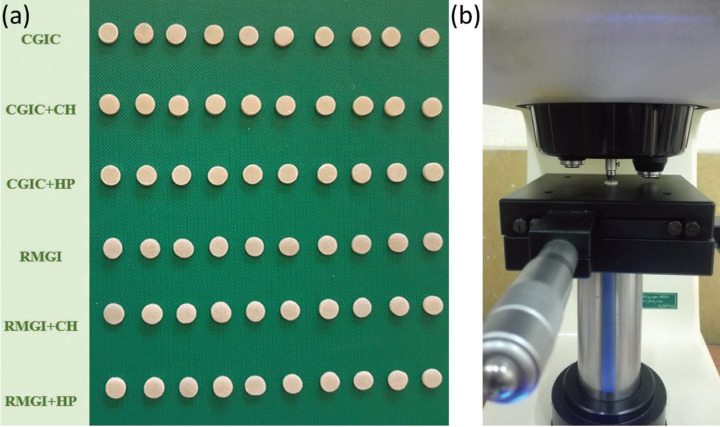
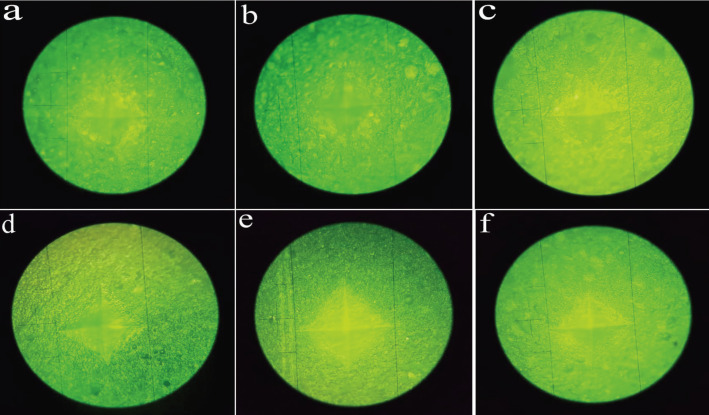
60 disk-shaped specimens (2mm x 6mm) were prepared in 6 groups; group I: CGIC, group II: RMGIC, group III: CGIC + 15% volume CH solution in liquid, group IV: CGIC +10% weight micro-HP in powder, group V: RMGIC + 15% volume CH, group VI: RMGIC + 10% weight micro-HP. After storage in deionized water at room temperature for 24 hours, the surface roughness and microhardness of the specimens were measured using a surface profilometer and Vickers microhardness (VHN) tester, respectively. Data were analyzed using two-way ANOVA, Tukey HSD test and paired t-test (<0.05).
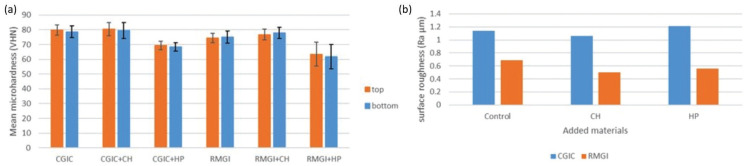
The microhardness values of RMGIC and CGIC decreased significantly with the addition of micro-HP (<0.001). None of the CH-containing GICs showed significant changes in microhardness ( = 0.552). The VHN values of CGIC were higher than RMGIC, regardless of the added substance (<0.001). The surface roughness (Ra) values (μm) of both RMGIC and CGIC decreased significantly with the addition of CH ( = 0.004). The incorporation of micro-HP into GICs did not have a significant effect on surface roughness values ( = 0.700). The RMGIC showed less Ra values compared to the CGIC regardless of the added substance (<0.001). The lowest and highest Ra values were observed in RMGIC + CH and CGIC + micro-HP groups, respectively.
The addition of CH to GIC and RMGIC reduced the surface roughness and did not have an adverse effect on the microhardness. Mixing GIC and RMGIC with micro-HP resulted in microhardness reduction and did not affect the surface roughness. Glass ionomer, hydroxyapatite, chitosan, hardness, surface roughness.
本研究旨在比较壳聚糖(CH)和羟基磷灰石(HP)对传统玻璃离子水门汀(CGIC)和树脂改性玻璃离子水门汀(RMGIC)表面粗糙度和显微硬度的影响。
制备6组共60个圆盘形试件(2mm×6mm);第一组:CGIC,第二组:RMGIC,第三组:CGIC + 液体中15%体积的CH溶液,第四组:CGIC + 粉末中10%重量的微粉HP,第五组:RMGIC + 15%体积的CH,第六组:RMGIC + 10%重量的微粉HP。在室温下于去离子水中储存24小时后,分别使用表面轮廓仪和维氏显微硬度(VHN)测试仪测量试件的表面粗糙度和显微硬度。数据采用双向方差分析、Tukey HSD检验和配对t检验进行分析(<0.05)。
添加微粉HP后,RMGIC和CGIC的显微硬度值显著降低(<0.001)。含CH的玻璃离子水门汀中均未观察到显微硬度有显著变化(P = 0.552)。无论添加何种物质,CGIC的VHN值均高于RMGIC(<0.001)。添加CH后,RMGIC和CGIC的表面粗糙度(Ra)值(μm)均显著降低(P = 0.004)。向玻璃离子水门汀中加入微粉HP对表面粗糙度值没有显著影响(P = 0.700)。无论添加何种物质,RMGIC的Ra值均低于CGIC(<0.001)。最低和最高的Ra值分别出现在RMGIC + CH组和CGIC + 微粉HP组。
向玻璃离子水门汀和树脂改性玻璃离子水门汀中添加CH可降低表面粗糙度,且对显微硬度无不利影响。将玻璃离子水门汀和树脂改性玻璃离子水门汀与微粉HP混合会导致显微硬度降低,但不影响表面粗糙度。玻璃离子水门汀、羟基磷灰石、壳聚糖、硬度、表面粗糙度。