Hamilton Jessica Leigh, Lee Woanjun
Department of Psychology, Rutgers University, Piscataway, NJ, United States.
JMIR Ment Health. 2021 Sep 15;8(9):e26273. doi: 10.2196/26273.
Social media use is associated with poor sleep among adolescents, including daytime sleepiness, which affects adolescents' mental health. Few studies have examined the associations among specific aspects of social media, such as frequency of checking and posting, perceived importance of social media for social belonging, and daytime sleepiness. Identifying whether certain adolescents are more at risk or protected from the effects of social media on sleepiness may inform future interventions for social media, sleep, and mental health.
This study aims to examine the association between social media use frequency and importance, daytime sleepiness, and whether the perceived importance of social media for social interactions and parental rules around bedtime technology moderated these relationships.
This cross-sectional survey study was conducted with a sample of 4153 adolescents from across the United States. Qualtrics was used to collect data via panel recruitment from a national sample representing the US demographics of teens aged 12 to 17 years. Participants completed measures of daytime sleepiness, frequency of social media checking and posting, and the importance of social media for social interactions. Parents reported whether they had a household rule around bedtime media and screen use. Hierarchical regressions and moderation analyses were conducted, covarying for age, gender, and age at first smartphone use.
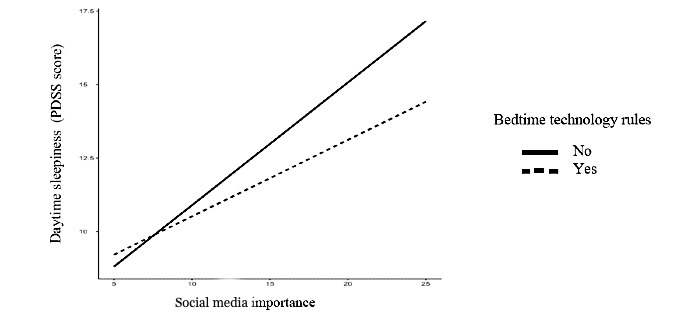
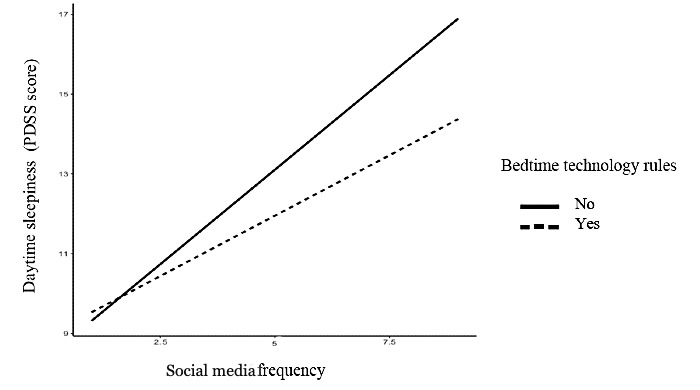
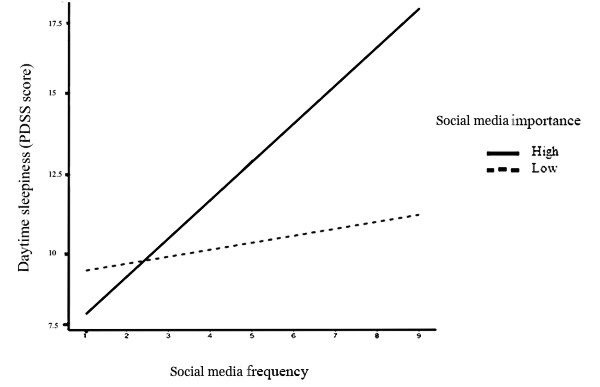
Participants had a mean age of 14.64 (SD 1.66) years in grades 6 to 12, 46.45% (1929/4153) identified as female, and 67.93% (2821/4153) identified as White. The results indicated that adolescents who posted (B=0.70, SE 0.04; P<.001) or checked (B=0.76, SE 0.04; P<.001) social media more frequently or who perceived social media to be more important for social belonging (B=0.36, SE 0.02; P<.001) had higher levels of daytime sleepiness. Moderation analyses indicated that the relationship between social media use frequency and daytime sleepiness was exacerbated by higher levels of perceived social media importance (B=0.04, SE 0.01; P<.001). Adolescents without household rules around bedtime technology use were more likely to be affected by social media checking (B=-0.34, SE 0.09; P<.001) and importance (B=-0.16, SE 0.04; P<.001) on daytime sleepiness.
The findings suggest that social media use frequency and perceived importance of social interactions are associated with daytime sleepiness among adolescents. It is important to consider youth's perceptions of social media when assessing the potential effects of social media use frequency on youth well-being. Furthermore, youth who did not have parental rules around bedtime technology use were most likely to be affected by social media use and perceived importance. The findings may extend to other mental health outcomes and may guide future prevention and intervention programs designed to improve social media use, sleep, and mental health.
青少年使用社交媒体与睡眠质量差有关,包括日间嗜睡,这会影响青少年的心理健康。很少有研究探讨社交媒体的具体方面之间的关联,如查看和发布的频率、社交媒体对社会归属感的感知重要性以及日间嗜睡。确定某些青少年是否更容易受到社交媒体对嗜睡影响的风险或保护,可能为未来针对社交媒体、睡眠和心理健康的干预措施提供参考。
本研究旨在探讨社交媒体使用频率与重要性、日间嗜睡之间的关联,以及社交媒体对社交互动的感知重要性和睡前使用电子设备的家长规定是否会调节这些关系。
这项横断面调查研究对来自美国各地的4153名青少年进行了抽样。通过从代表美国12至17岁青少年人口统计学特征的全国样本中进行小组招募,使用Qualtrics收集数据。参与者完成了日间嗜睡、社交媒体查看和发布频率以及社交媒体对社交互动重要性的测量。家长报告他们是否有关于睡前使用媒体和屏幕的家庭规定。进行了分层回归和调节分析,并对年龄、性别和首次使用智能手机的年龄进行了协变量调整。
参与者的平均年龄为14.64(标准差1.66)岁,处于6至12年级,46.45%(1929/4,153)为女性,67.93%(2,821/4,153)为白人。结果表明,更频繁发布(B = 0.70,标准误0.04;P <.001)或查看(B = 0.76,标准误0.04;P <.001)社交媒体,或认为社交媒体对社会归属感更重要(B = 0.36,标准误0.02;P <.001)的青少年,日间嗜睡程度更高。调节分析表明,社交媒体使用频率与日间嗜睡之间的关系因更高水平的社交媒体重要性感知而加剧(B = 0.04,标准误0.01;P <.001)。没有关于睡前使用电子设备家庭规定的青少年更容易受到社交媒体查看(B = -0.34,标准误0.09;P <.001)和重要性(B = -0.16,标准误0.04;P <.001)对日间嗜睡的影响。
研究结果表明,社交媒体使用频率和社交互动的感知重要性与青少年日间嗜睡有关。在评估社交媒体使用频率对青少年幸福感的潜在影响时,考虑青少年对社交媒体的看法很重要。此外,没有关于睡前使用电子设备家长规定的青少年最容易受到社交媒体使用及其感知重要性的影响。这些发现可能扩展到其他心理健康结果,并可能指导未来旨在改善社交媒体使用、睡眠和心理健康的预防和干预计划。