Department of Respiratory Medicine, School of Nutrition and Translational Research in Metabolism, Maastricht University Medical Centre+, Maastricht, The Netherlands.
Nutr Rev. 2022 May 9;80(6):1434-1444. doi: 10.1093/nutrit/nuab077.
Chronic obstructive lung disease (COPD) is a progressive lung disease characterized by persistent airflow limitation. An increasing amount of evidence suggests an effect of dietary quality on the risk of COPD in the general population and pulmonary function decline in patients with COPD.
The association of dietary intake and nutrient status with COPD risk and onset, as well as pulmonary function decline (change in forced expiratory volume in 1 second, forced vital capacity, or the ratio of the former to the latter) in patients with COPD was investigated in this systematic review.
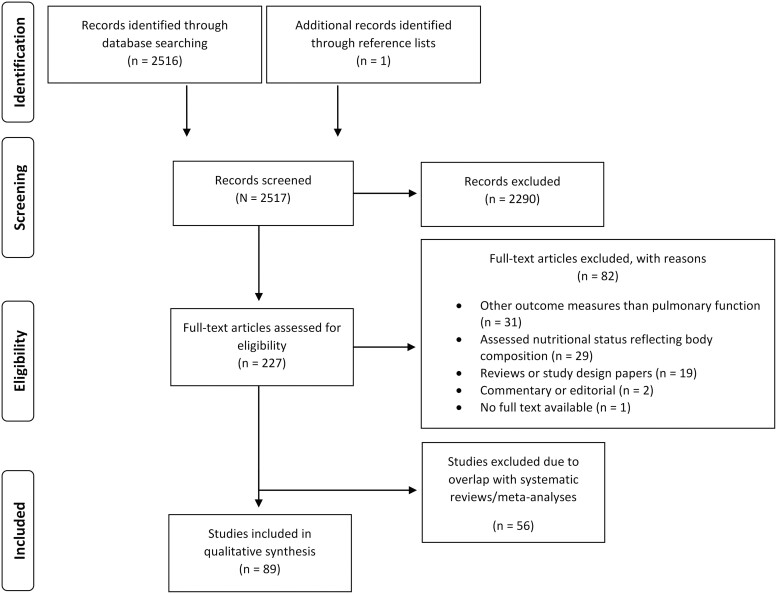
The PubMed database was searched by combining terms of pulmonary function or COPD with diet, nutrient status, or nutritional supplementation.
Original studies and systematic reviews and meta-analyses were included. Articles obtained were independently screened for relevance on the bases of title and abstract by 2 researchers. Eventually, 89 articles were included in the analysis.
The unhealthy Western-style diet is associated with an increased risk of COPD and an accelerated decline of pulmonary function. Intake of fruit, vegetables, dietary fibers, vitamins C and E, polyphenols, and β-carotene were individually associated with lower COPD risk, whereas consumption of processed meat was associated with higher COPD risk. Data on the effect of dietary quality on pulmonary function decline in patients with COPD are limited and inconsistent. Strong evidence for beneficial effects on pulmonary function decline was found only for vitamin D supplementation.
Considering the increasing burden of COPD, more attention should be given to dietary quality as a modifiable factor in disease development and progression in patients with COPD.
PROSPERO registration no. CRD42021240183.
慢性阻塞性肺疾病(COPD)是一种以持续性气流受限为特征的进行性肺部疾病。越来越多的证据表明,饮食质量对普通人群中 COPD 的发病风险和肺功能下降以及 COPD 患者的肺功能下降(第 1 秒用力呼气量、用力肺活量或两者之比的变化)有影响。
本系统评价旨在探讨饮食摄入和营养状况与 COPD 风险和发病以及 COPD 患者肺功能下降(第 1 秒用力呼气量、用力肺活量或两者之比的变化)之间的关系。
通过将肺功能或 COPD 与饮食、营养状况或营养补充剂的术语相结合,在 PubMed 数据库中进行搜索。
纳入原始研究和系统评价和荟萃分析。由 2 名研究人员根据标题和摘要独立筛选出相关文章。最终,有 89 篇文章纳入分析。
不健康的西方饮食与 COPD 风险增加和肺功能下降加速有关。水果、蔬菜、膳食纤维、维生素 C 和 E、多酚和β-胡萝卜素的摄入与较低的 COPD 风险相关,而加工肉类的消费与较高的 COPD 风险相关。关于饮食质量对 COPD 患者肺功能下降影响的数据有限且不一致。只有维生素 D 补充剂对肺功能下降有有益影响的证据确凿。
考虑到 COPD 的负担不断增加,应更加关注饮食质量作为 COPD 患者疾病发展和进展的可改变因素。
PROSPERO 注册号 CRD42021240183。