Internal Medicine Division, Rambam Health Care Campus, Haifa, Israel.
The Ruth and Bruce Rappaport Faculty of Medicine, Technion - Israel Institute of Technology, Haifa, Israel.
Eur Geriatr Med. 2022 Feb;13(1):253-265. doi: 10.1007/s41999-021-00557-6. Epub 2021 Sep 20.
The development of technologies for the prolongation of life has resulted in an increase in the number of older ventilated patients in internal medicine and chronic care wards. Our study aimed to determine the factors influencing the outcomes of older ventilated medical patients in a large tertiary medical center.
We performed a prospective observational cohort study including all newly ventilated medical patients aged 65 years and older over a period of 18 months. Data were acquired from computerized medical records and from an interview of the medical personnel initiating mechanical ventilation.
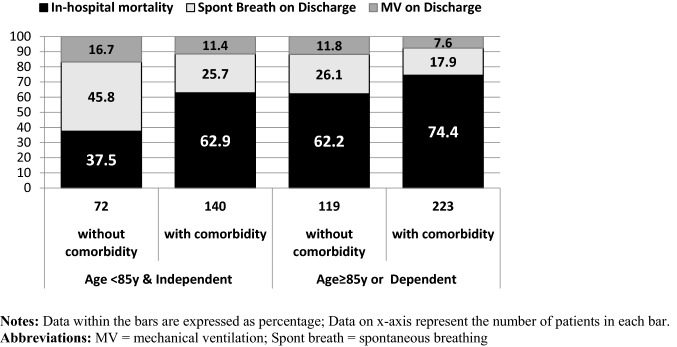
A total of 554 patients underwent mechanical ventilation for the first time during the study period. The average age was 79 years, and 80% resided at home. Following mechanical ventilation, 8% died in the emergency room, and the majority of patients (351; 63%) were hospitalized in internal medicine wards. In-hospital mortality was 64.1%, with 48% dying during the first week of hospitalization. Overall 6-months survival was 26%. We found that a combination of age 85 years and older, functional status prior to ventilation, and associated morbidity (diabetes with target organ injury and/or oncological solid organ disease) were the strongest negative predictors of survival after discharge from the hospital.
Mechanical ventilation at older age is associated with poor survival and it is possible to identify factors predicting survival. In the midst of the COVID-19 pandemic, the findings of this study may help in the decision-making process regarding mechanical ventilation for older people.
延长生命的技术的发展导致内科和慢性病病房中需要通气支持的老年患者数量增加。我们的研究旨在确定影响大型三级医疗中心老年通气内科患者预后的因素。
我们进行了一项前瞻性观察队列研究,纳入了在 18 个月期间首次接受通气支持的所有 65 岁及以上的新内科通气患者。数据来自计算机化的医疗记录和启动机械通气的医务人员的访谈。
在研究期间,共有 554 名患者首次接受机械通气。平均年龄为 79 岁,80%的患者居住在家庭中。通气后,8%的患者在急诊室死亡,大多数患者(351 例,63%)在内科病房住院。住院死亡率为 64.1%,其中 48%在住院第一周死亡。总体 6 个月生存率为 26%。我们发现,85 岁及以上的年龄、通气前的功能状态以及相关的合并症(伴有靶器官损伤的糖尿病和/或恶性实体器官疾病)是出院后生存的最强负预测因素。
老年患者接受机械通气与生存率较差相关,并且有可能确定预测生存率的因素。在 COVID-19 大流行期间,这项研究的结果可能有助于对老年人进行机械通气的决策过程。