Campbell Family Mental Health Institute, Centre for Addiction and Mental Health, Toronto, Canada.
Ontario Institute for Studies in Education, University of Toronto, Toronto, Canada.
Nat Hum Behav. 2021 Oct;5(10):1443-1457. doi: 10.1038/s41562-021-01191-9. Epub 2021 Sep 20.
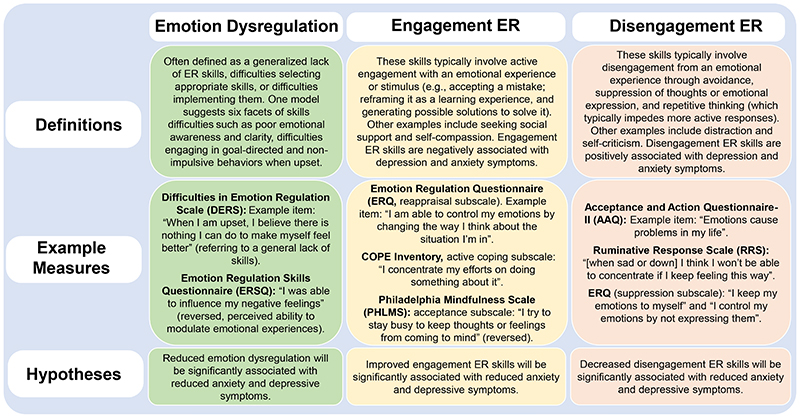
Difficulties in applying emotional regulation (ER) skills are associated with depression and anxiety symptoms, and are common targets of treatment. This meta-analysis examined whether improvements in ER skills were associated with psychological treatment outcomes for depression and/or anxiety in youth. A multivariate, random-effects meta-analysis was run using metafor in R. Inclusion criteria included studies that were randomized controlled trials (RCTs) of a psychological intervention for depression and/or anxiety in patients aged 14-24, were peer reviewed, were written in English, measured depression and/or anxiety symptoms as an outcome and measured ER as an outcome. Medline, Embase, APA PsycInfo, CINAHL and The Cochrane Library were searched up to 26 June 2020. Risk of bias (ROB) was assessed using the Cochrane Collaboration Risk of Bias 2.0 tool. The meta-analysis includes 385 effect sizes from 90 RCTs with total N = 11,652. Psychological treatments significantly reduced depression, anxiety, emotion dysregulation (k = 13, Hedges' g = 0.54, P < 0.001, 95% confidence interval (CI) = 0.30-0.78) and disengagement ER (k = 83, g = 0.24, 95% CI = 0.15-0.32, P < 0.001); engagement ER also increased (k = 82, g = 0.26, 95% CI = 0.15-0.32, P < 0.001). Improvements in depression and anxiety were positively associated with improved engagement ER skills, reduced emotion dysregulation and reduced disengagement ER skills. Sensitivity considered study selection and publication bias. Longer treatments, group formats and cognitive-behavioural orientations produced larger positive associations between improved ER skills and reduced symptoms. ER skill improvement is linked to depression and anxiety across a broad range of interventions for youth. Limitations of the current study include reliance on self-report measures, content overlap between variables and inability to test the directionality of associations.
应用情绪调节 (ER) 技能的困难与抑郁和焦虑症状有关,并且是治疗的常见目标。这项荟萃分析检查了 ER 技能的改善是否与青少年抑郁和/或焦虑的心理治疗结果相关。使用 R 中的 metafor 进行了多变量、随机效应荟萃分析。纳入标准包括针对 14-24 岁患者的抑郁和/或焦虑的心理干预的随机对照试验 (RCT)、同行评审、英文书写、将抑郁和/或焦虑症状作为结果测量、并将 ER 作为结果测量。检索了 Medline、Embase、APA PsycInfo、CINAHL 和 The Cochrane Library,检索时间截至 2020 年 6 月 26 日。使用 Cochrane 协作风险偏倚 2.0 工具评估偏倚风险 (ROB)。荟萃分析包括 90 项 RCT 的 385 个效应量,总 N = 11652。心理治疗显著降低了抑郁、焦虑、情绪失调 (k = 13,Hedges' g = 0.54,P < 0.001,95%置信区间 (CI) = 0.30-0.78) 和脱离 ER (k = 83,g = 0.24,95% CI = 0.15-0.32,P < 0.001);参与 ER 也增加了 (k = 82,g = 0.26,95% CI = 0.15-0.32,P < 0.001)。抑郁和焦虑的改善与参与 ER 技能的改善、情绪失调的减少和脱离 ER 技能的减少呈正相关。敏感性考虑了研究选择和发表偏倚。更长的治疗、小组格式和认知行为取向产生了 ER 技能改善与症状减轻之间更大的积极关联。ER 技能的改善与青少年广泛的干预措施中的抑郁和焦虑有关。本研究的局限性包括依赖自我报告的措施、变量之间的内容重叠以及无法测试关联的方向。