Wellcome Centre for Integrative Neuroimaging, FMRIB, Nuffield Department of Clinical Neurosciences, University of Oxford, Oxford, United Kingdom.
Magn Reson Med. 2022 Feb;87(2):574-588. doi: 10.1002/mrm.29018. Epub 2021 Sep 21.
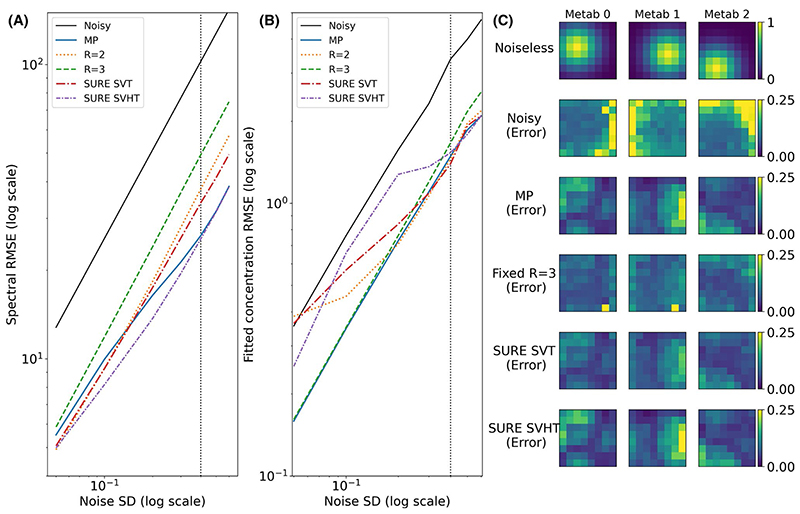
Low-rank denoising of MRSI data results in an apparent increase in spectral SNR. However, it is not clear if this translates to a lower uncertainty in metabolite concentrations after spectroscopic fitting. Estimation of the true uncertainty after denoising is desirable for downstream analysis in spectroscopy. In this work, the uncertainty reduction from low-rank denoising methods based on spatiotemporal separability and linear predictability in MRSI are assessed. A new method for estimating metabolite concentration uncertainty after denoising is proposed. Automatic rank threshold selection methods are also assessed in simulated low SNR regimes.
Assessment of denoising methods is conducted using Monte Carlo simulation of proton MRSI data and by reproducibility of repeated in vivo acquisitions in 5 subjects.
In simulated and in vivo data, spatiotemporal based denoising is shown to reduce the concentration uncertainty, but linear prediction denoising increases uncertainty. Uncertainty estimates provided by fitting algorithms after denoising consistently underestimate actual metabolite uncertainty. However, the proposed uncertainty estimation, based on an analytical expression for entry-wise variance after denoising, is more accurate. It is also shown automated rank threshold selection using Marchenko-Pastur distribution can bias the data in low SNR conditions. An alternative soft-thresholding function is proposed.
Low-rank denoising methods based on spatiotemporal separability do reduce uncertainty in MRS(I) data. However, thorough assessment is needed as assessment by SNR measured from residual baseline noise is insufficient given the presence of non-uniform variance. It is also important to select the right rank thresholding method in low SNR cases.
MRSI 数据的低秩去噪会导致谱 SNR 明显增加。然而,尚不清楚这是否会转化为光谱拟合后代谢物浓度的不确定性降低。去噪后真实不确定性的估计对于光谱学中的下游分析是可取的。在这项工作中,评估了基于 MRSI 中时空可分离性和线性可预测性的低秩去噪方法的不确定性降低。提出了一种用于估计去噪后代谢物浓度不确定性的新方法。还在模拟低 SNR 情况下评估了自动秩阈值选择方法。
使用质子 MRSI 数据的蒙特卡罗模拟和 5 个受试者中重复的体内采集的可重复性来评估去噪方法。
在模拟和体内数据中,基于时空的去噪被证明可以降低浓度不确定性,但线性预测去噪会增加不确定性。去噪后拟合算法提供的不确定性估计值始终低估了实际代谢物不确定性。然而,基于去噪后逐元素方差的解析表达式的提出的不确定性估计更为准确。还表明,使用 Marchenko-Pastur 分布的自动秩阈值选择可能会在低 SNR 条件下使数据产生偏差。提出了一种替代的软阈值函数。
基于时空可分离性的低秩去噪方法确实可以降低 MRS(I)数据的不确定性。然而,鉴于存在非均匀方差,仅从残留基线噪声测量的 SNR 进行评估是不够的,因此需要进行彻底的评估。在低 SNR 情况下,选择正确的秩阈值选择方法也很重要。