Oral Health Prev Dent. 2021 Sep 22;19:457-464. doi: 10.3290/j.ohpd.b2048359.
Social media is today a comprehensive source of data that can serve as a guide to professionals in issues related to public health. The purpose of this paper is to investigate the content of topical fluoride-related Twitter posts made over a 3-year period in order to improve our understanding of Twitter users' perceptions and treatment experiences.
A continuous cross-sectional sample of Tweets on the subject of 'approaches to the topical fluoride treatment of tooth decay' was collected from the Twitter social networking platform between 1 January 2017 and 1 January 2020 using a software application developed for this research that makes use of the Twitter advanced search API. The words and phrases used for the identification of related Tweets were determined through a screening of the topical fluoride keywords of previous studies, and a search was conducted in the English language. To better arrange the collected Tweets and to make the data more meaningful, firstly one of the natural language process techniques - Tokenization - was applied, after which the Tweets were converted into a set of meaningful words and regular expressions. The Tweets were then compared with each other, word-by-word, with the help of a word-based Levenshtein distance algorithm, after which two experts in the computational social science domain labelled each Tweet.
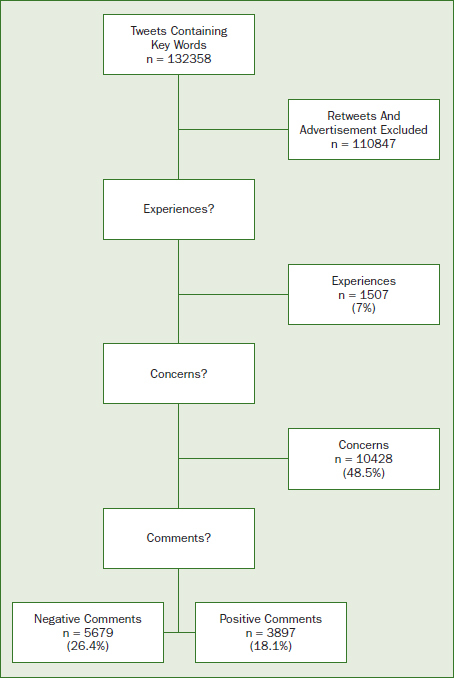
A total of 132,358 Tweeter posts referencing topical fluoride applications were collected, of which 110,847 were eliminated through the use of a word-based Levenshtein distance algorithm, and the remaining corpus of 21,511 posts was analysed and evaluated for specific content. Within the garnered data, 48.5% (n = 10,428) of the Tweeter posts concerned topical fluoride treatments, and 7% (n = 1,507) reported experiences with topical fluoride treatment. Negative Tweeter posts about topical fluoride treatment (5,679, 26.4%) vastly outnumbered those that were positive (3,897, 18.1%).
The current study achieved its main objectives of analysing topical fluoride application-related posts made on social media. From the garnered Twitter data, it can be understood that Twitter users regularly share their concerns and negative sentiments about the side effects of topical fluoride treatments on the platform. Future explorations of social media may aid public health and dental professionals in the development of strategies to educate the public and to raise awareness of the importance of topical fluoride applications.
社交媒体如今是一个全面的数据来源,可以为公共卫生相关专业人员提供指导。本文旨在调查三年内有关局部用氟化物的推特主题帖的内容,以增进我们对推特用户认知和治疗体验的了解。
利用为这项研究开发的软件应用程序,通过推特高级搜索 API 从推特社交网络平台上采集了 2017 年 1 月 1 日至 2020 年 1 月 1 日期间主题为“局部用氟化物治疗龋齿方法”的连续横断面样本。通过对之前研究的局部氟化物关键词进行筛选确定了用于识别相关推文的字词和短语,并进行了英语搜索。为了更好地整理收集到的推文并使数据更有意义,首先应用了自然语言处理技术之一——分词,然后将推文转换为一组有意义的单词和正则表达式。随后,使用基于单词的莱文斯坦距离算法逐字比较推文,然后由两位计算社会科学领域的专家对每条推文进行标注。
共收集了 132358 条提及局部用氟化物应用的推文,其中 110847 条通过基于单词的莱文斯坦距离算法被剔除,剩余的 21511 条推文的语料库进行了分析和评估。在所获得的数据中,48.5%(n=10428)的推文涉及局部氟化物治疗,7%(n=1507)报告了局部氟化物治疗的经验。有关局部氟化物治疗的负面推文(5679 条,占 26.4%)远远超过正面推文(3897 条,占 18.1%)。
本研究实现了分析社交媒体上局部用氟化物应用相关帖子的主要目标。从获得的推特数据中可以看出,推特用户经常在平台上分享他们对局部用氟化物治疗副作用的担忧和负面情绪。未来对社交媒体的探索可能有助于公共卫生和牙科专业人员制定策略,对公众进行教育并提高他们对局部用氟化物应用重要性的认识。