Department of Public Health Sciences, Pennsylvania State University College of Medicine, Hershey, PA, USA.
Department of Nutritional Sciences, Pennsylvania State University, University Park, PA, USA.
Nutr J. 2021 Sep 21;20(1):80. doi: 10.1186/s12937-021-00738-w.
Whether mushroom consumption, which is a rich source of potent antioxidants ergothioneine and glutathione, vitamins, and minerals (e.g., selenium & copper), is associated with a lower mortality risk is not well understood. This study aimed to examine the association between mushroom consumption and risk of mortality in a prospective cohort study and a meta-analysis of prospective cohort studies.
We followed 30,378 participants from the continuous National Health and Nutrition Examination Survey (NHANES) extant data (2003-2014). Dietary mushroom intake was assessed using up to two 24-h recalls. Mortality was evaluated in all participants linked to the National Death Index mortality data through December 31, 2015. We used Cox proportional hazards regression models to calculate multivariable-adjusted hazard ratios (HRs) and 95% confidence intervals (95% CIs). We also conducted a meta-analysis, including results from our present study and 4 other cohort studies.
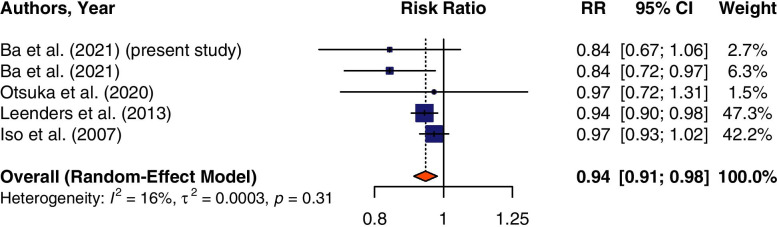
During a mean (SD) of 6.7 (3.4) years of follow-up, a total of 2855 death cases were documented among NHANES participants. In our analysis of continuous NHANES, we found a non-significant association between mushroom consumption and all-cause mortality (adjusted hazard ratio (HR) = 0.84; 95% CI: 0.67-1.06) after adjusting for demographic, major lifestyle factors, overall diet quality, and other dietary factors, including total energy. The meta-analysis of prospective cohort studies, including 601,893 individuals, showed that mushroom consumption was associated with a lower risk of all-cause mortality (pooled risk ratio: 0.94; 95% CI: 0.91, 0.98).
In a meta-analysis of prospective cohort studies, mushroom consumption was associated with a lower risk of all-cause mortality.
蘑菇是一种富含强效抗氧化剂麦角硫因和谷胱甘肽、维生素和矿物质(如硒和铜)的食物来源,其食用量与死亡率之间的关系尚不清楚。本研究旨在通过前瞻性队列研究和前瞻性队列研究的荟萃分析来检验蘑菇食用与死亡率风险之间的关系。
我们对连续的国家健康和营养调查(NHANES)现有数据(2003-2014 年)中的 30378 名参与者进行了随访。使用最多两次 24 小时回顾法评估膳食蘑菇摄入量。通过与国家死亡指数死亡数据的链接,对所有参与者进行了评估,截至 2015 年 12 月 31 日。我们使用 Cox 比例风险回归模型计算多变量调整后的风险比(HR)和 95%置信区间(95%CI)。我们还进行了荟萃分析,包括我们当前研究和其他 4 项队列研究的结果。
在平均(标准差)为 6.7(3.4)年的随访期间,NHANES 参与者中共有 2855 例死亡病例。在我们对连续 NHANES 的分析中,在调整了人口统计学、主要生活方式因素、总体饮食质量和其他饮食因素(包括总能量)后,发现蘑菇食用与全因死亡率之间没有显著关联(调整后的 HR=0.84;95%CI:0.67-1.06)。包括 601893 名个体的前瞻性队列研究荟萃分析表明,蘑菇食用与全因死亡率降低相关(汇总风险比:0.94;95%CI:0.91,0.98)。
在前瞻性队列研究的荟萃分析中,蘑菇食用与全因死亡率降低相关。