Xue Dabin, Liu Zhizhao, Wang Bing, Yang Jian
Department of Land Surveying and Geo-Informatics, The Hong Kong Polytechnic University, Hong Kong, China.
Department of Earth and Space Sciences, Southern University of Science and Technology, Shenzhen, China.
J Air Transp Manag. 2021 Aug;95:102106. doi: 10.1016/j.jairtraman.2021.102106. Epub 2021 Jul 1.
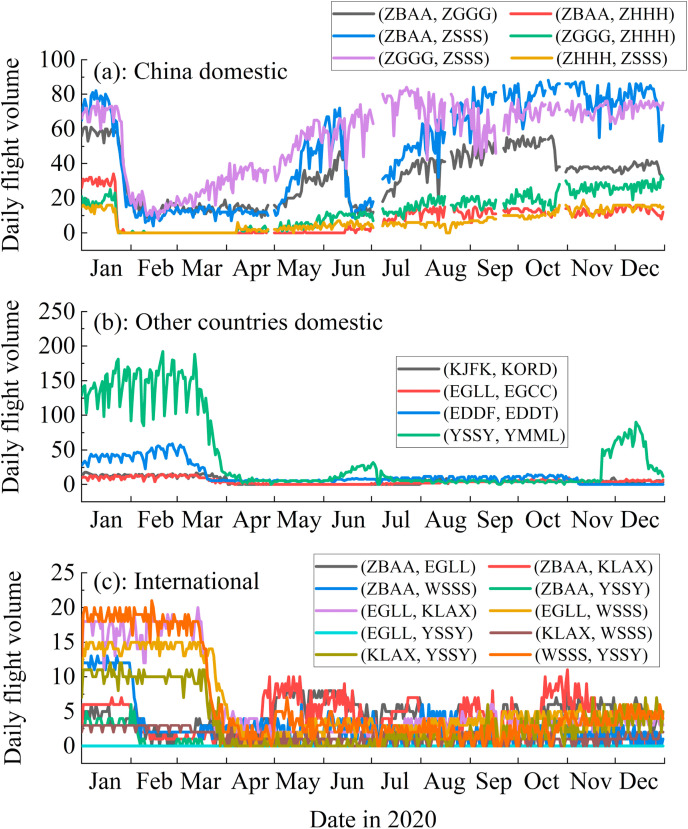
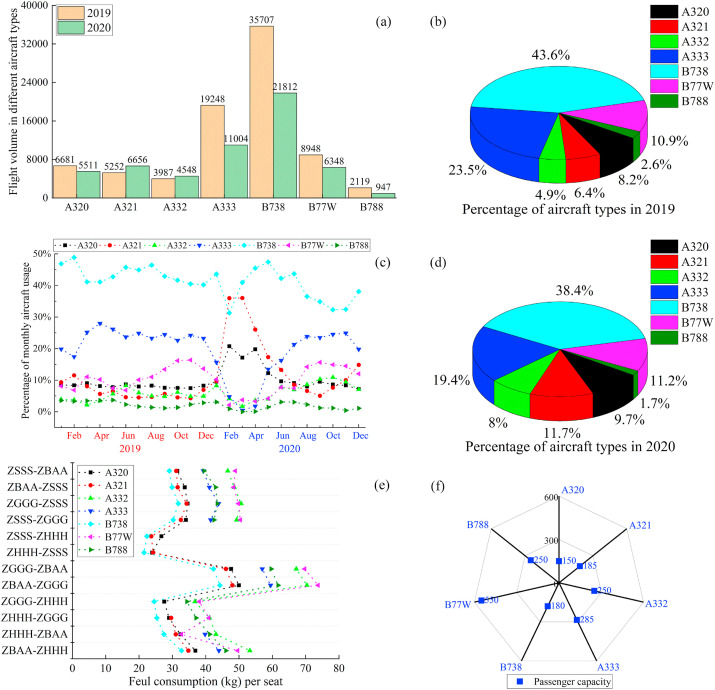
COVID-19 pandemic starting in early 2020 has greatly impacted human and industrial activities. Air transport in China shrank abruptly in February 2020, following a year-long gradual recovery. The airline companies reacted to this unprecedented event by dramatically reducing the flight volume and rearranging the aircraft types. As the first major economy that successfully controls the spread of COVID-19, China can provide a unique opportunity to quantify the medium-long impacts on the air transport industry. To quantify the corresponding changes and to elucidate the effects of COVID-19 in the wake of two major outbreaks centered in Wuhan and Beijing, we analyze twelve flight routes formed by four selected airports, using the Automatic Dependent Surveillance-Broadcast (ADS-B) data in 2019 and 2020. Our results show that the total flight volume in 2020 reduced to 67.8% of 2019 in China. The recovering time of flight volume was about 2-6 months, dependent on the severity. In order to unwind the severe challenge, airlines mainly relied on aircraft B738 and A321 between February and June in 2020 because the fuel consumption per seat of these two aircraft types is the lowest. Besides, fuel consumption and aircraft emissions are calculated according to the Base of Aircraft Data (BADA) and the International Civil Aviation Organization's Engine Emissions Databank (ICAO's EEDB). At the end of 2020, the ratios of daily fuel consumption and aircraft emissions of 2020 to 2019 rebounded to about 0.875, suggesting the domestic commercial flights were nearly fully recovered. Our results may provide practical guidance and meaningful expectation for commercial aircraft management for other countries.
始于2020年初的新冠疫情对人类活动和产业活动产生了巨大影响。在经历了长达一年的逐步复苏后,中国的航空运输在2020年2月突然萎缩。航空公司对这一前所未有的事件做出反应,大幅削减航班数量并重新安排机型。作为首个成功控制新冠疫情传播的主要经济体,中国能够提供一个独特的机会来量化中长期对航空运输业的影响。为了量化相应变化并阐明新冠疫情在以武汉和北京为中心的两次主要疫情爆发后的影响,我们使用2019年和2020年的自动相关监视广播(ADS-B)数据,分析了四个选定机场形成的十二条航线。我们的结果表明,2020年中国的航班总量降至2019年的67.8%。航班量的恢复时间约为2至6个月,具体取决于疫情严重程度。为了应对严峻挑战,航空公司在2020年2月至6月期间主要依赖B738和A321型飞机,因为这两种机型的每座燃油消耗最低。此外,根据飞机数据基准(BADA)和国际民航组织发动机排放数据库(ICAO的EEDB)计算燃油消耗和飞机排放。到2020年底,2020年每日燃油消耗和飞机排放与2019年的比率回升至约0.875,这表明国内商业航班几乎完全恢复。我们的结果可能为其他国家的商用飞机管理提供实际指导和有意义的参考。