Virtanen Jenni, Zalewski Andrzej, Kołodziej-Sobocińska Marta, Brzeziński Marcin, Smura Teemu, Sironen Tarja
Department of Veterinary Biosciences, Faculty of Veterinary Medicine, University of Helsinki, Helsinki 00790, Finland.
Polish Academy of Sciences, Mammal Research Institute, ul. Stoczek 1, Białowieża 17-230, Poland.
Virus Evol. 2021 Aug 28;7(2):veab075. doi: 10.1093/ve/veab075. eCollection 2021.
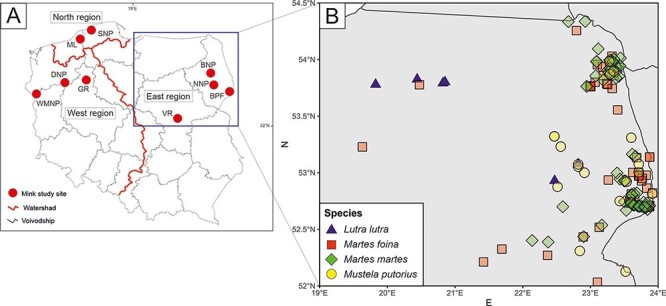
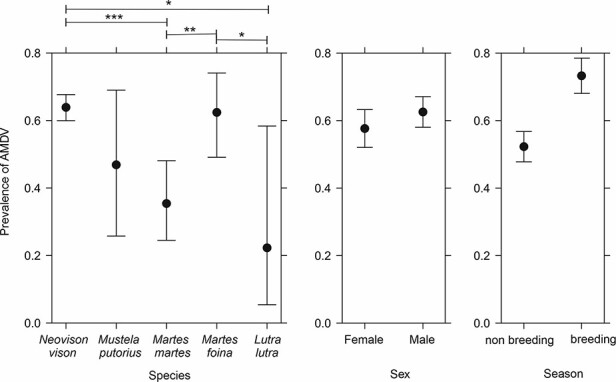
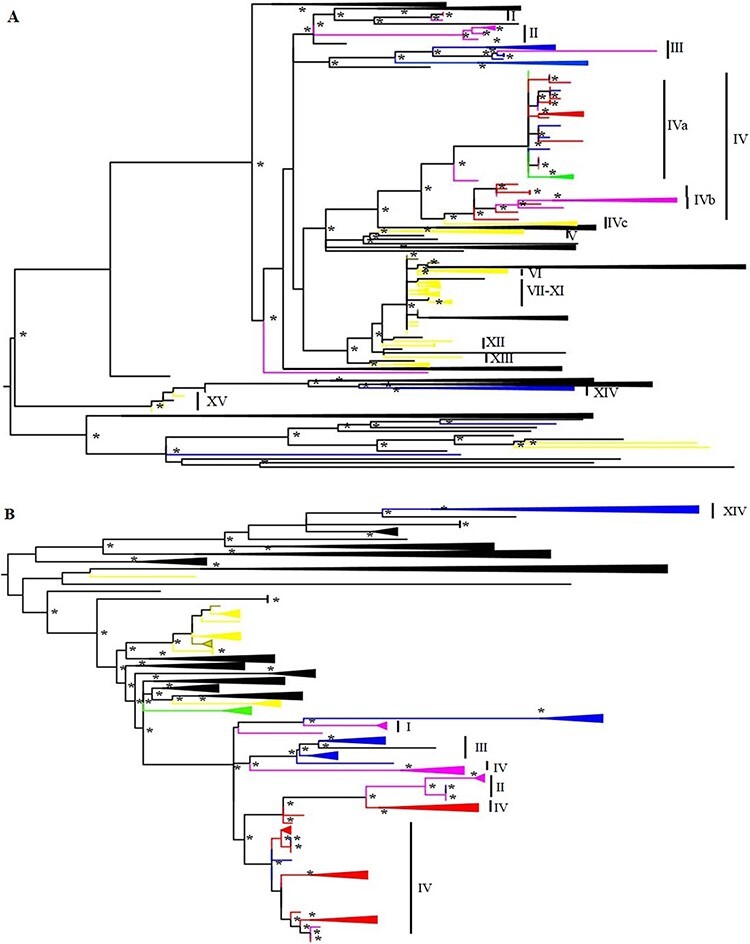
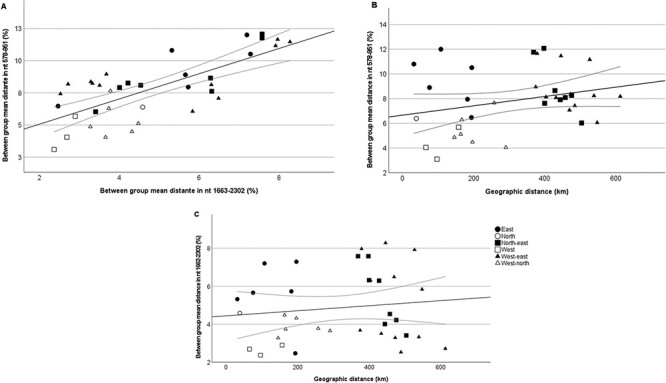
Aleutian mink disease virus (AMDV), which causes Aleutian disease, is widely spread both in farmed mink and wild mustelids. However, only limited data are available on the role of wild animals in AMDV transmission and spread. Our aim was to shed light on AMDV transmission among wild mustelids and estimate the effect of intense farming practices on the virus circulation by studying AMDV prevalence and genetic diversity among wild mustelids in Poland. We compared AMDV seroprevalence and proportion of PCR-positive individuals in American mink, polecats, otters, stone martens, and pine martens and used the phylogenetic analysis of the NS1 region to study transmission. In addition, we used a metagenomic approach to sequence complete AMDV genomes from tissue samples. In eastern Poland, AMDV seroprevalence in wild mustelids varied from 22 per cent in otters to 62 per cent and 64 per cent in stone martens and feral mink, respectively. All studied antibody-positive mink were also PCR positive, whereas only 10, 15, and 18 per cent of antibody-positive polecats, pine martens, and stone martens, respectively, were PCR positive, suggesting lower virus persistence among these animal species as compared to feral mink. In phylogenetic analysis, most sequences from feral mink formed region-specific clusters that have most likely emerged through multiple introductions of AMDV to feral mink population over decades. However, virus spread between regions was also observed. Virus sequences derived from farmed and wild animals formed separate subclusters in the phylogenetic tree, and no signs of recent virus transmission between farmed and wild animals were observed despite the frequent inflow of farmed mink escapees to wild populations. These results provide new information about the role of different mustelid species in AMDV transmission and about virus circulation among the wild mustelids. In addition, we pinpoint gaps of knowledge, where more studies are needed to achieve a comprehensive picture of AMDV transmission.
水貂阿留申病病毒(AMDV)可引发阿留申病,在养殖水貂和野生鼬科动物中广泛传播。然而,关于野生动物在AMDV传播和扩散中所起作用的数据有限。我们的目标是通过研究波兰野生鼬科动物中AMDV的流行情况和遗传多样性,来阐明野生鼬科动物之间的AMDV传播,并评估集约化养殖方式对病毒传播的影响。我们比较了美国水貂、鸡貂、水獭、石貂和松貂中AMDV的血清阳性率以及PCR阳性个体的比例,并利用NS1区域的系统发育分析来研究传播情况。此外,我们采用宏基因组学方法对组织样本中的完整AMDV基因组进行测序。在波兰东部,野生鼬科动物中AMDV的血清阳性率有所不同,水獭为22%,石貂和野生水貂分别为62%和64%。所有检测出抗体阳性的水貂PCR检测也呈阳性,而抗体阳性的鸡貂、松貂和石貂中,PCR阳性的比例分别仅为10%、15%和18%,这表明与野生水貂相比,这些动物物种中的病毒持续性较低。在系统发育分析中,大多数野生水貂的序列形成了区域特异性簇,很可能是几十年来AMDV多次传入野生水貂种群后形成的。然而,也观察到了病毒在不同区域之间的传播。来自养殖动物和野生动物的病毒序列在系统发育树中形成了单独的子簇,尽管养殖水貂经常逃入野生种群,但未观察到养殖动物和野生动物之间近期有病毒传播的迹象。这些结果提供了关于不同鼬科物种在AMDV传播中的作用以及野生鼬科动物之间病毒传播的新信息。此外,我们指出了知识空白之处,需要更多研究才能全面了解AMDV的传播情况。