Ryt-Hansen P, Hjulsager C K, Hagberg E E, Chriél M, Struve T, Pedersen A G, Larsen L E
National Veterinary Institute, Technical University of Denmark, Bülowsvej 27, DK-1870, Frederiksberg C, Denmark.
, Kemitorvet Bygning 204, Rum 255. 2800, Kongens Lyngby, Denmark.
Virol J. 2017 Jun 21;14(1):119. doi: 10.1186/s12985-017-0786-5.
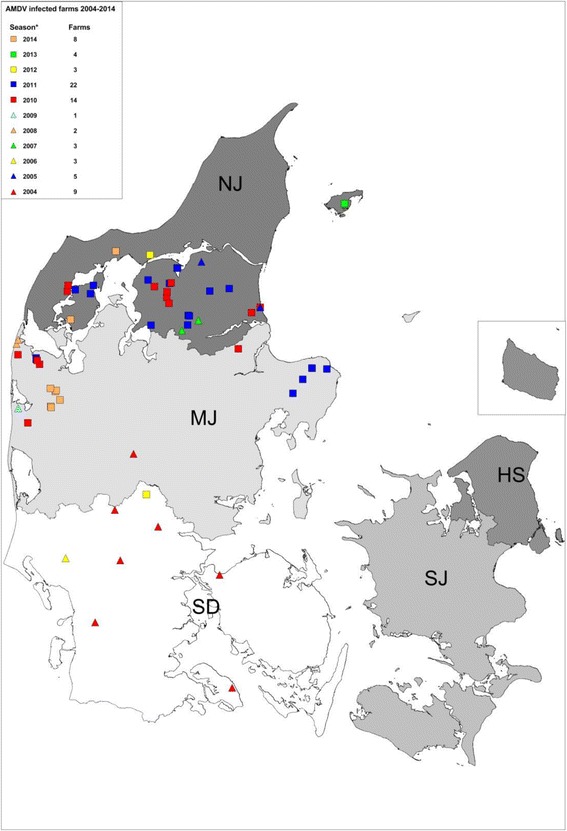
Aleutian Mink Disease (AMD) is an infectious disease of mink (Neovison vison) and globally a major cause of economic losses in mink farming. The disease is caused by Aleutian Mink Disease Virus (AMDV) that belongs to the genus Amdoparvovirus within the Parvoviridae family. Several strains have been described with varying virulence and the severity of infection also depends on the host's genotype and immune status. Clinical signs include respiratory distress in kits and unthriftiness and low quality of the pelts. The infection can also be subclinical. Systematic control of AMDV in Danish mink farms was voluntarily initiated in 1976. Over recent decades the disease was mainly restricted to the very northern part of the country (Northern Jutland), with only sporadic outbreaks outside this region. Most of the viruses from this region have remained very closely related at the nucleotide level for decades. However, in 2015, several outbreaks of AMDV occurred at mink farms throughout Denmark, and the sources of these outbreaks were not known.
Partial NS1 gene sequencing, phylogenetic analyses data were utilized along with epidemiological to determine the origin of the outbreaks.
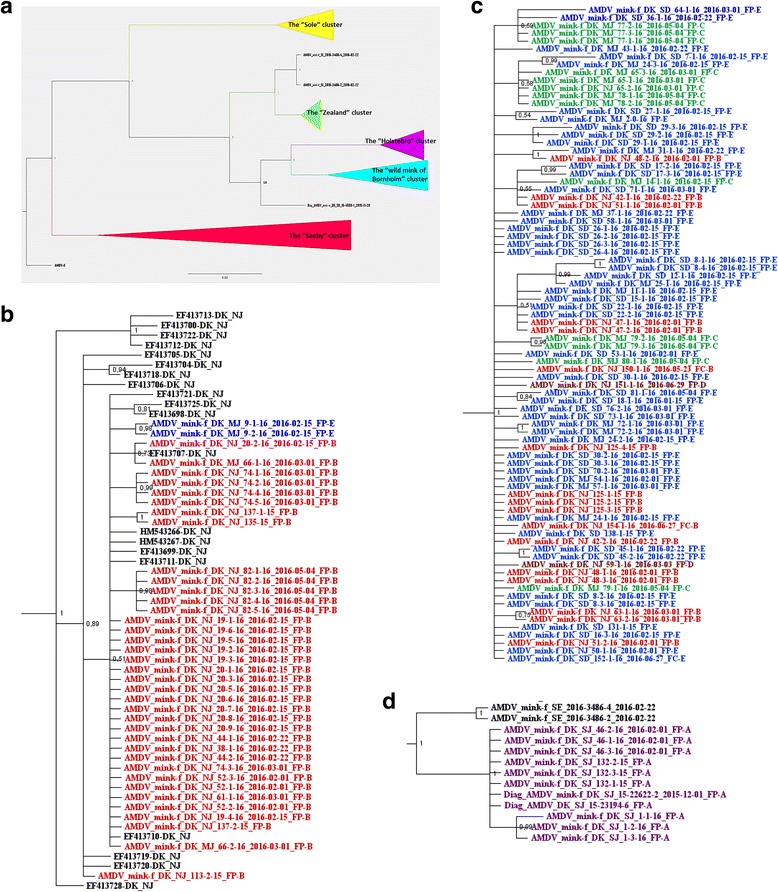
The phylogenetic analyses of partial NS1 gene sequences revealed that the outbreaks were caused by two different clusters of viruses that were clearly different from the strains found in Northern Jutland. These clusters had restricted geographical distribution, and the variation within the clusters was remarkably low. The outbreaks on Zealand were epidemiologically linked and a close sequence match was found to two virus sequences from Sweden. The other cluster of outbreaks restricted to Jutland and Funen were linked to three feed producers (FP) but secondary transmissions between farms in the same geographical area could not be excluded.
This study confirmed that partial NS1 sequencing can be used in outbreak tracking to determine major viral clusters of AMDV. Using this method, two new distinct AMDV clusters with low intra-cluster sequence diversity were identified, and epidemiological data helped to reveal possible ways of viral introduction into the affected herds.
阿留申水貂病(AMD)是水貂(Neovison vison)的一种传染病,在全球范围内是水貂养殖经济损失的主要原因。该疾病由阿留申水貂病病毒(AMDV)引起,AMDV属于细小病毒科中的阿留申细小病毒属。已描述了几种具有不同毒力的毒株,感染的严重程度还取决于宿主的基因型和免疫状态。临床症状包括幼崽呼吸窘迫、发育不良以及皮毛质量差。感染也可能是亚临床的。丹麦水貂养殖场对AMDV的系统控制于1976年自愿启动。在最近几十年中,该疾病主要局限于该国最北部地区(日德兰半岛北部),该地区以外仅有零星疫情爆发。几十年来,该地区的大多数病毒在核苷酸水平上仍保持非常密切的关系。然而,2015年,丹麦各地的水貂养殖场发生了几起AMDV疫情,且这些疫情的源头不明。
利用部分NS1基因测序、系统发育分析数据以及流行病学数据来确定疫情的源头。
部分NS1基因序列的系统发育分析表明,疫情是由两种不同的病毒簇引起的,这两种病毒簇与在日德兰半岛北部发现的毒株明显不同。这些病毒簇的地理分布有限,且簇内变异非常低。西兰岛的疫情在流行病学上有关联,并且发现与来自瑞典的两个病毒序列有密切的序列匹配。另一组局限于日德兰半岛和菲英岛的疫情与三家饲料生产商(FP)有关,但不能排除同一地理区域内养殖场之间的二次传播。
本研究证实,部分NS1测序可用于疫情追踪,以确定AMDV的主要病毒簇。使用该方法,鉴定出了两个新的、簇内序列多样性低的不同AMDV病毒簇,流行病学数据有助于揭示病毒引入受影响兽群的可能途径。