Li Siyu, Lyu Xiaotong, Zhao Lei, Chen Zhuangfei, Gong Anmin, Fu Yunfa
School of Information Engineering and Automation, Kunming University of Science and Technology, Kunming, China.
Brain Cognition and Brain-Computer Intelligence Integration Group, Kunming University of Science and Technology, Kunming, China.
Front Comput Neurosci. 2021 Sep 8;15:732763. doi: 10.3389/fncom.2021.732763. eCollection 2021.
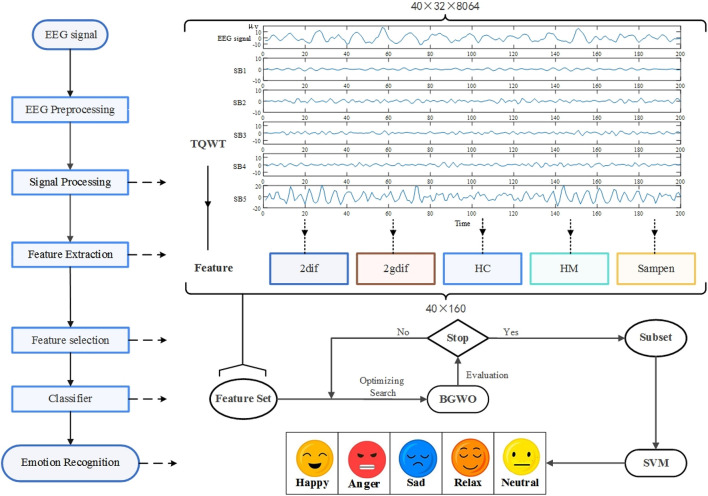
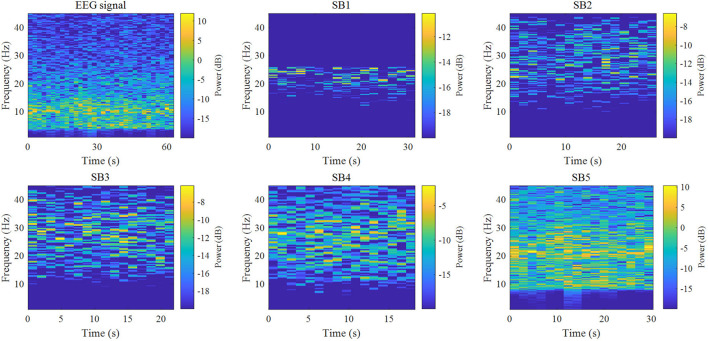
Emotional brain-computer interface based on electroencephalogram (EEG) is a hot issue in the field of human-computer interaction, and is also an important part of the field of emotional computing. Among them, the recognition of EEG induced by emotion is a key problem. Firstly, the preprocessed EEG is decomposed by tunable-Q wavelet transform. Secondly, the sample entropy, second-order differential mean, normalized second-order differential mean, and Hjorth parameter (mobility and complexity) of each sub-band are extracted. Then, the binary gray wolf optimization algorithm is used to optimize the feature matrix. Finally, support vector machine is used to train the classifier. The five types of emotion signal samples of 32 subjects in the database for emotion analysis using physiological signal dataset is identified by the proposed algorithm. After 6-fold cross-validation, the maximum recognition accuracy is 90.48%, the sensitivity is 70.25%, the specificity is 82.01%, and the Kappa coefficient is 0.603. The results show that the proposed method has good performance indicators in the recognition of multiple types of EEG emotion signals, and has a better performance improvement compared with the traditional methods.
基于脑电图(EEG)的情感脑机接口是人机交互领域的研究热点,也是情感计算领域的重要组成部分。其中,情感诱发脑电信号的识别是关键问题。首先,对预处理后的脑电信号进行可调Q小波变换分解。其次,提取各子带的样本熵、二阶差分均值、归一化二阶差分均值以及Hjorth参数(活动性和复杂性)。然后,采用二进制灰狼优化算法对特征矩阵进行优化。最后,使用支持向量机训练分类器。利用该算法对生理信号数据集用于情感分析的数据库中32名受试者的五种情感信号样本进行识别。经过6折交叉验证,最大识别准确率为90.48%,灵敏度为70.25%,特异性为82.01%,Kappa系数为0.603。结果表明,该方法在多种脑电情感信号识别中具有良好的性能指标,与传统方法相比有较好的性能提升。