Department of Psychological Medicine, King's College London, Weston Education Centre, London, SE5 9RJ, UK.
Behavioural Science Team, Emergency Response Department Science & Technology, Public Health England, Porton Down, Salisbury, SP4 0JG, UK.
Public Health. 2021 Oct;199:77-86. doi: 10.1016/j.puhe.2021.08.014. Epub 2021 Sep 1.
The COVID-19 pandemic caused countries across the globe to impose restrictions to slow the spread of the virus, with people instructed to stay at home and reduce contact with others. This reduction in social contact has the potential to negatively impact mental health and well-being. The restrictions are particularly concerning for people with existing chronic illnesses such as Parkinson's disease, who may be especially affected by concerns about the pandemic and associated reduction of social contact. The aim of this review was to synthesise published literature on the impact of the COVID-19 pandemic on the social and psychological well-being of people with Parkinson's disease.
The design of this study is a scoping review.
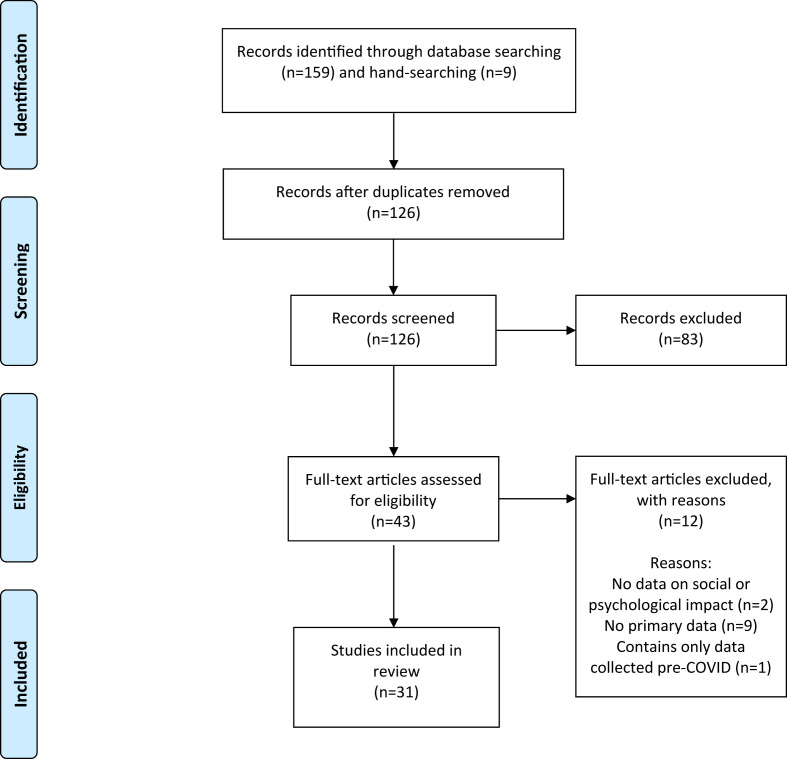
We searched five electronic databases for English language articles containing primary data on this topic.
Thirty-one relevant studies were found and included in the review. Six main themes were identified: impact of the pandemic on physical and mental health; COVID-19 concerns; access to health care; impact on daily and social activities; impact on physical activity and impact on caregivers. Levels of perceived risk of COVID-19 differed across studies, but most participants had adopted preventive measures such as staying at home and reducing social contacts. Participants in many studies reported a discontinuation of regular healthcare appointments and physiotherapy, as well as concerns about being able to obtain medication. Loss of daily activities and social support was noted by many participants. There was mixed evidence on the impact of the pandemic on physical exercise, with some studies finding no change in physical activity and others reporting a reduction; generally, participants with reduced physical activity had poorer mental health and greater worsening of symptoms. Caregivers of people with Parkinson's disease were more likely to be negatively affected by the pandemic if they cared for people with complex needs such as additional mental health problems.
The COVID-19 pandemic has had negative effects on the physical and mental health of people with Parkinson's disease, perhaps due to disruption of healthcare services, loss of usual activities and supports and reduction in physical activity. We make recommendations for policy, practice and future research.
COVID-19 大流行导致全球各国实施限制措施以减缓病毒传播,要求人们待在家中并减少与他人接触。这种社交接触的减少有可能对心理健康和幸福感产生负面影响。这些限制措施对患有帕金森病等现有慢性疾病的人特别令人担忧,他们可能会特别关注大流行及其相关社交接触减少所带来的担忧。本综述的目的是综合已发表的文献,了解 COVID-19 大流行对帕金森病患者的社交和心理健康的影响。
本研究的设计为范围综述。
我们在五个电子数据库中搜索了包含该主题原始数据的英文文章。
共发现 31 项相关研究并纳入综述。确定了六个主要主题:大流行对身心健康的影响;对 COVID-19 的担忧;获得医疗保健;对日常和社交活动的影响;对身体活动的影响以及对照顾者的影响。不同研究中对 COVID-19 的感知风险水平有所不同,但大多数参与者已采取预防措施,如待在家中并减少社交接触。许多研究的参与者报告说停止了定期医疗预约和物理治疗,并且担心无法获得药物。许多参与者注意到日常活动和社会支持的丧失。大流行对身体锻炼的影响证据不一,一些研究发现身体活动没有变化,而另一些研究则报告有所减少;通常,身体活动减少的参与者心理健康状况较差,症状恶化程度更大。如果照顾者照顾有其他心理健康问题等复杂需求的帕金森病患者,则更有可能受到大流行的负面影响。
COVID-19 大流行对帕金森病患者的身心健康产生了负面影响,这可能是由于医疗服务中断、丧失日常活动和支持以及身体活动减少所致。我们为政策、实践和未来研究提出了建议。