Liberini Virginia, Mariniello Annapaola, Righi Luisella, Capozza Martina, Delcuratolo Marco Donatello, Terreno Enzo, Farsad Mohsen, Volante Marco, Novello Silvia, Deandreis Désirée
Department of Medical Science, Division of Nuclear Medicine, University of Turin, 10126 Turin, Italy.
Nuclear Medicine Department, S. Croce e Carle Hospital, 12100 Cuneo, Italy.
Cancers (Basel). 2021 Sep 10;13(18):4543. doi: 10.3390/cancers13184543.
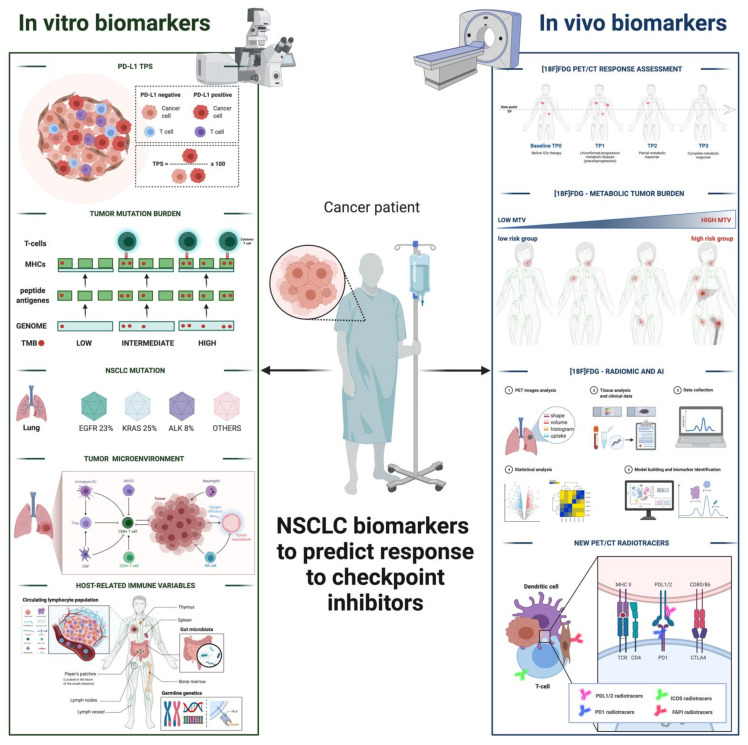
Lung cancer remains the leading cause of cancer-related death, and it is usually diagnosed in advanced stages (stage III or IV). Recently, the availability of targeted strategies and of immunotherapy with checkpoint inhibitors (ICI) has favorably changed patient prognosis. Treatment outcome is closely related to tumor biology and interaction with the tumor immune microenvironment (TME). While the response in molecular targeted therapies relies on the presence of specific genetic alterations in tumor cells, accurate ICI biomarkers of response are lacking, and clinical outcome likely depends on multiple factors that are both host and tumor-related. This paper is an overview of the ongoing research on predictive factors both from in vitro/ex vivo analysis (ranging from conventional pathology to molecular biology) and in vivo analysis, where molecular imaging is showing an exponential growth and use due to technological advancements and to the new bioinformatics approaches applied to image analyses that allow the recovery of specific features in specific tumor subclones.
肺癌仍然是癌症相关死亡的主要原因,并且通常在晚期(III期或IV期)被诊断出来。最近,靶向治疗策略和免疫检查点抑制剂(ICI)免疫疗法的出现,有利地改变了患者的预后。治疗结果与肿瘤生物学以及与肿瘤免疫微环境(TME)的相互作用密切相关。虽然分子靶向治疗的反应依赖于肿瘤细胞中特定基因改变的存在,但缺乏准确的ICI反应生物标志物,临床结果可能取决于宿主和肿瘤相关的多种因素。本文概述了正在进行的关于预测因素的研究,这些研究来自体外/离体分析(从传统病理学到分子生物学)和体内分析,由于技术进步以及应用于图像分析的新生物信息学方法(这些方法能够在特定肿瘤亚克隆中恢复特定特征),分子成像在体内分析中的应用正在呈指数级增长。