Paap Kenneth R, Mason Lauren, Anders-Jefferson Regina
Department of Psychology, San Francisco State University, 1600 Holloway Avenue, San Francisco, CA 94019, USA.
Department of Psychology, Tufts University, Medford, MA 02155, USA.
Brain Sci. 2021 Sep 15;11(9):1217. doi: 10.3390/brainsci11091217.
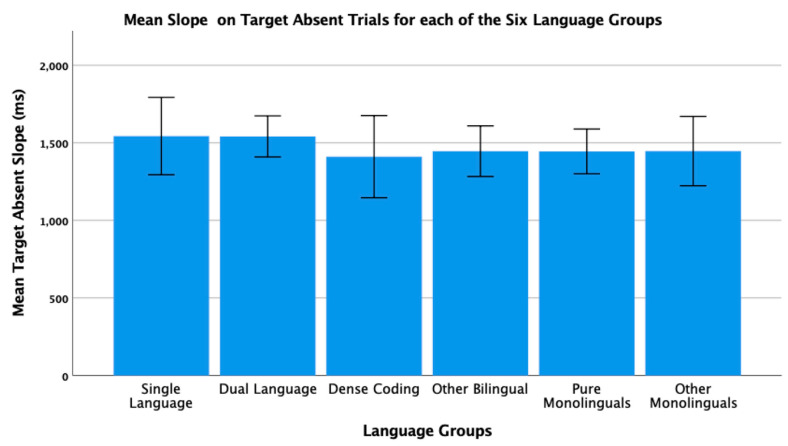
The adaptive control hypothesis developed by Green and Abutalebi is the most influential theory of bilingual language control. The focus of this article is on the predictions that other researchers have derived based on the three different modes of interactional context described by the hypothesis. Foremost, that dual-language contexts should enhance domain-general executive functions more than single-language contexts. Several recent and ambitious behavioral tests of these predictions are reviewed. Although there was some evidence that dual-language contexts are associated with smaller switch costs, the evidence is inconsistent and there were no similar advantages for inhibitory control. The hypothesis also predicts neuroanatomical adaptations to the three types of interactional context. A careful evaluation of the relevant fMRI and ERP studies that take into account whether behavioral differences align with neuroscience differences and resolves valence ambiguities led to the conclusion that the neuroscience evidence for the hypothesis is, at best, inconsistent. The study also includes new analyses of two large-sample studies that enable the identification of relatively pure cases of single-language bilinguals, dual-language bilinguals, and dense-code switchers. Across nine different measures of executive functioning, the predicted advantage of the dual-language context never materialized. The hypotheses derived from the adaptive control hypothesis do not accurately predict behavioral performance on tests of executive functioning and do not advance our understanding as to what dimensions of bilingualism may lead to enhancements in specific components of executive functioning.
格林(Green)和阿布拉泰比(Abutalebi)提出的适应性控制假说,是双语语言控制领域最具影响力的理论。本文重点关注的是,其他研究人员基于该假说所描述的三种不同互动情境模式得出的预测。首先,双语情境比单语情境更能增强通用执行功能。本文回顾了近期针对这些预测开展的几项宏大的行为测试。尽管有证据表明双语情境与较小的切换成本相关,但证据并不一致,且在抑制控制方面没有类似优势。该假说还预测了对三种互动情境类型的神经解剖学适应。对相关功能磁共振成像(fMRI)和事件相关电位(ERP)研究进行仔细评估,综合考虑行为差异是否与神经科学差异相符以及消除效价模糊性后,得出的结论是,支持该假说的神经科学证据充其量也是不一致的。该研究还对两项大样本研究进行了新的分析,从而能够识别出相对纯粹的单语双语者、双语双语者和密集代码切换者案例。在执行功能的九种不同测量方法中,双语情境的预期优势从未实现。从适应性控制假说衍生出的这些假说,并不能准确预测执行功能测试中的行为表现,也无助于我们理解双语的哪些维度可能会增强执行功能的特定组成部分。