Department of Surgery, Faculty of Veterinary Medicine and Animal Sciences, University of São Paulo, São Paulo 01001-010, Brazil.
Department of Veterinary Medicine, School of Animal Sciences and Food Engineering, University of Sao Paulo, Pirassununga 13635-900, Brazil.
Int J Mol Sci. 2021 Sep 18;22(18):10110. doi: 10.3390/ijms221810110.
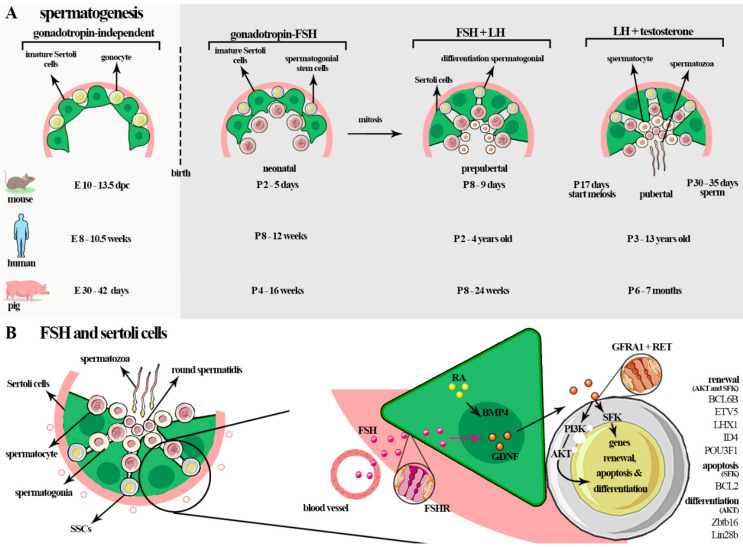
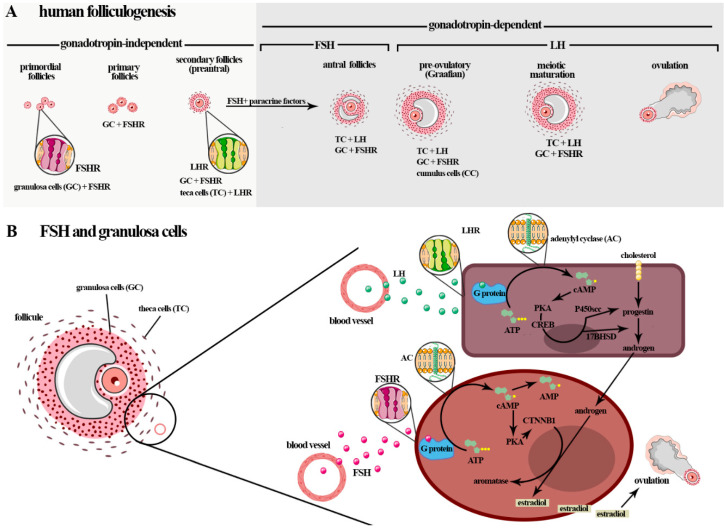
Follicle stimulating hormone (FSH) is produced by the pituitary gland in a coordinated hypothalamic-pituitary-gonadal (HPG) axis event, plays important roles in reproduction and germ cell development during different phases of reproductive development (fetal, neonatal, puberty, and adult life), and is consequently essential for fertility. FSH is a heterodimeric glycoprotein hormone of two dissociable subunits, α and β. The FSH β-subunit (FSHβ) function starts upon coupling to its specific receptor: follicle-stimulating hormone receptor (FSHR). FSHRs are localized mainly on the surface of target cells on the testis and ovary (granulosa and Sertoli cells) and have recently been found in testicular stem cells and extra-gonadal tissue. Several reproduction disorders are associated with absent or low FSH secretion, with mutation of the FSH β-subunit or the FSH receptor, and/or its signaling pathways. However, the influence of FSH on germ cells is still poorly understood; some studies have suggested that this hormone also plays a determinant role in the self-renewal of germinative cells and acts to increase undifferentiated spermatogonia proliferation. In addition, in vitro, together with other factors, it assists the process of differentiation of primordial germ cells (PGCLCs) into gametes (oocyte-like and SSCLCs). In this review, we describe relevant research on the influence of FSH on spermatogenesis and folliculogenesis, mainly in the germ cell of humans and other species. The possible roles of FSH in germ cell generation in vitro are also presented.
卵泡刺激素(FSH)由垂体在下丘脑-垂体-性腺(HPG)轴事件中协调产生,在生殖发育的不同阶段(胎儿期、新生儿期、青春期和成年期)发挥重要作用,并且对生育能力至关重要。FSH 是由两个可分离的亚基α和β组成的异二聚体糖蛋白激素。FSHβ亚基(FSHβ)的功能在与其特异性受体:卵泡刺激素受体(FSHR)结合后开始发挥。FSHRs 主要位于睾丸和卵巢(颗粒细胞和支持细胞)的靶细胞表面,最近在睾丸干细胞和性腺外组织中也发现了它们的存在。几种生殖障碍与 FSH 分泌缺失或减少有关,与 FSHβ亚基或 FSH 受体及其信号通路的突变有关。然而,FSH 对生殖细胞的影响仍知之甚少;一些研究表明,这种激素也在生殖细胞的自我更新中起着决定性作用,并促进未分化的精原细胞增殖。此外,在体外,它与其他因素一起,协助原始生殖细胞(PGCLCs)向配子(卵母细胞样和 SSCLCs)的分化过程。在这篇综述中,我们描述了 FSH 对精子发生和卵泡发生的影响的相关研究,主要是在人类和其他物种的生殖细胞中。还介绍了 FSH 在体外生殖细胞生成中的可能作用。