The Broad Institute of MIT & Harvard, Cambridge, MA, USA.
Department of Biological Engineering, Massachusetts Institute of Technology, Cambridge, MA, USA.
Nat Commun. 2021 Sep 29;12(1):5706. doi: 10.1038/s41467-021-25948-y.
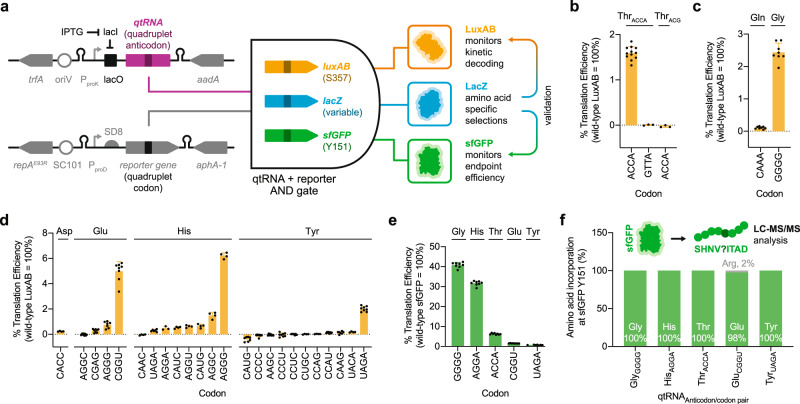
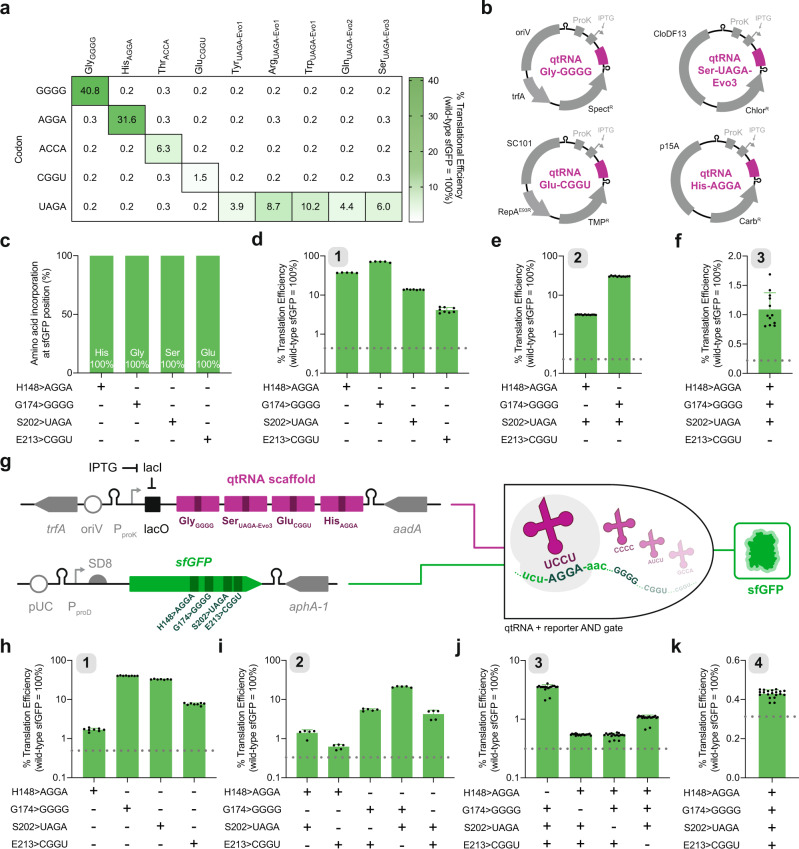
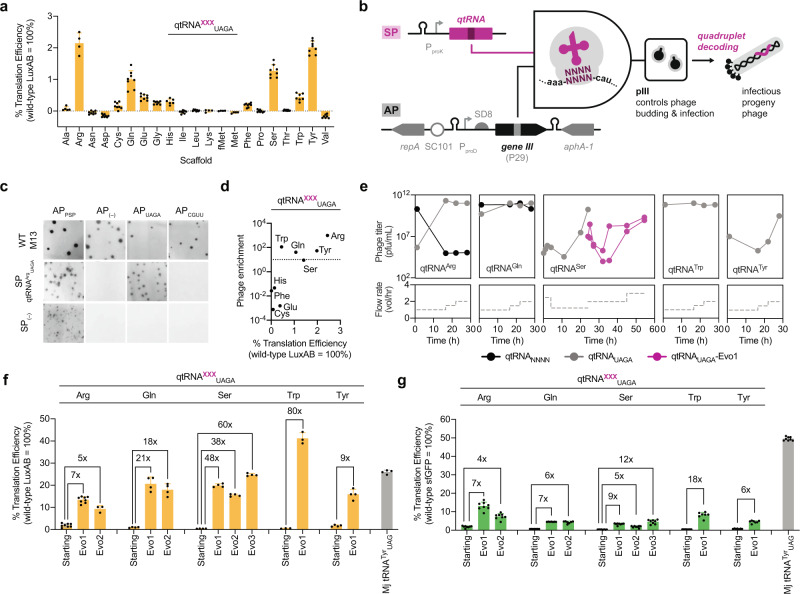
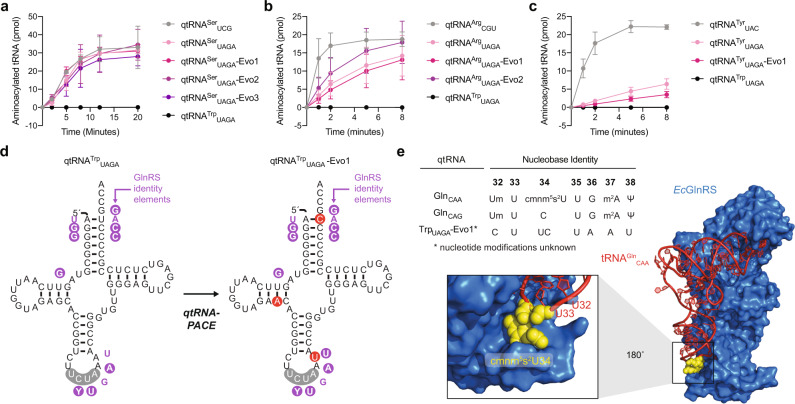
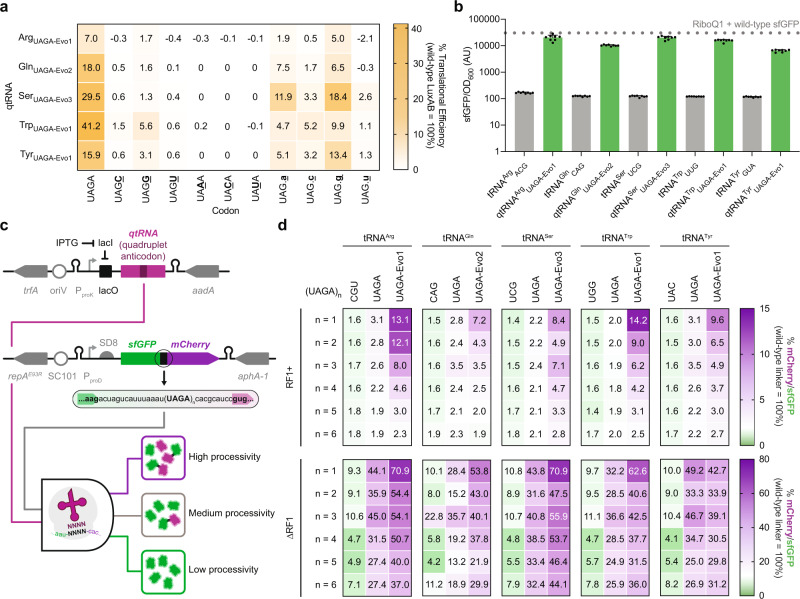
Genetic code expansion technologies supplement the natural codon repertoire with assignable variants in vivo, but are often limited by heterologous translational components and low suppression efficiencies. Here, we explore engineered Escherichia coli tRNAs supporting quadruplet codon translation by first developing a library-cross-library selection to nominate quadruplet codon-anticodon pairs. We extend our findings using a phage-assisted continuous evolution strategy for quadruplet-decoding tRNA evolution (qtRNA-PACE) that improved quadruplet codon translation efficiencies up to 80-fold. Evolved qtRNAs appear to maintain codon-anticodon base pairing, are typically aminoacylated by their cognate tRNA synthetases, and enable processive translation of adjacent quadruplet codons. Using these components, we showcase the multiplexed decoding of up to four unique quadruplet codons by their corresponding qtRNAs in a single reporter. Cumulatively, our findings highlight how E. coli tRNAs can be engineered, evolved, and combined to decode quadruplet codons, portending future developments towards an exclusively quadruplet codon translation system.
遗传密码扩展技术通过体内可分配的变体补充了自然密码子库,但通常受到异源翻译成分和低抑制效率的限制。在这里,我们通过首先开发库间库选择来提名四联体密码子-反密码子对,探索支持四联体密码子翻译的工程化大肠杆菌 tRNA。我们使用噬菌体辅助连续进化策略来扩展四联体解码 tRNA 进化 (qtRNA-PACE) 的发现,将四联体密码子翻译效率提高了 80 倍。进化的 qtRNA 似乎保持密码子-反密码子碱基配对,通常由其同源的 tRNA 合成酶氨酰化,并能够进行相邻四联体密码子的连续翻译。使用这些组件,我们展示了多达四个独特的四联体密码子可以通过它们相应的 qtRNA 在单个报告基因中进行多路解码。总之,我们的研究结果强调了如何对大肠杆菌 tRNA 进行工程设计、进化和组合以解码四联体密码子,预示着未来朝着完全使用四联体密码子翻译系统的发展。