The First School of Clinical Medicine, Southern Medical University, Guangzhou, Guangdong, 510515, China.
Department of Endocrinology, General Hospital of Central Theater Command, Wuhan, Hubei, 430070, China.
Lipids Health Dis. 2024 Jun 22;23(1):190. doi: 10.1186/s12944-024-02183-0.
The triglyceride-glucose (TyG) index is a risk marker for arterial stiffness; however, the extent to which the TyG index is associated with arterial stiffness via lipids and inflammation remains unknown. The first aim was to probe the relationship between the TyG index and arterial stiffness in two surveys. The second aim was to clarify whether lipids and inflammation mediate this relationship.
The sample size of 13,726 U.S. individuals from the National Examination Survey (NHANES) and 3,964 Chinese individuals from the China Health and Retirement Longitudinal Study (CHARLS 2015) were enrolled. Weighted multivariate logistic and linear regression models, as well as restricted cubic spline (RCS) and mediation analyses, were utilized to estimate complex relationships between the TyG index, arterial stiffness, lipids (non-high-density lipoprotein cholesterol [non-HDL-C]) and inflammation (C-reactive protein [CRP]) biomarkers.
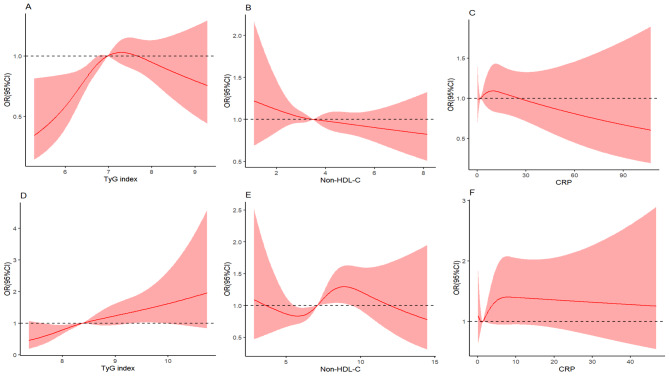
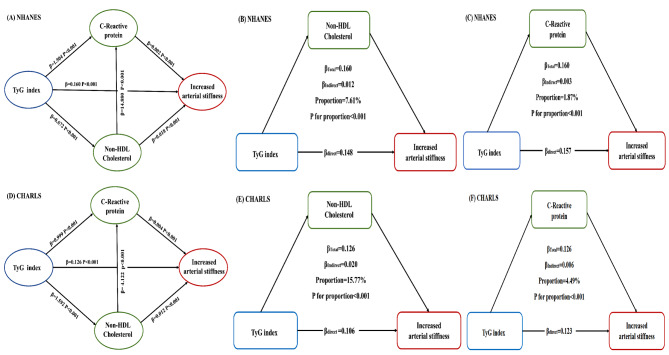
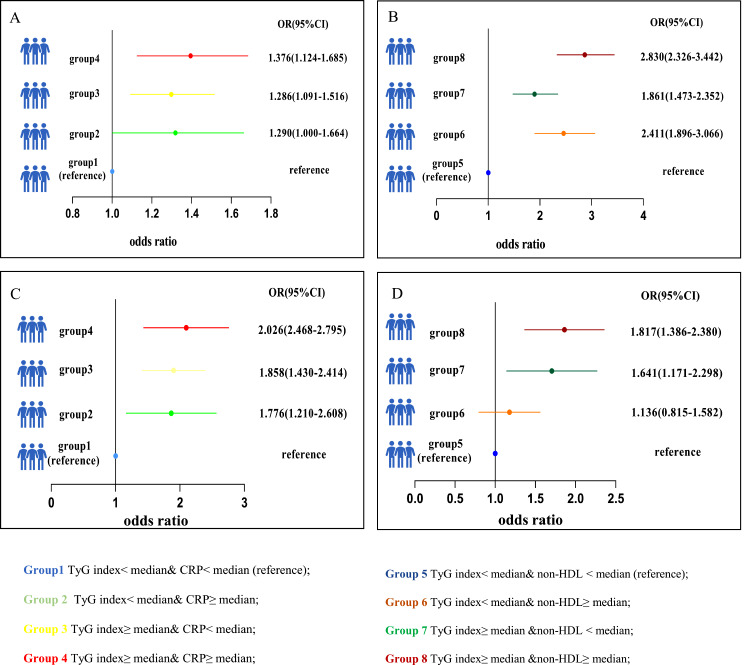
A total of 3,420 U.S. patients and 992 Chinese patients were diagnosed with increased arterial stiffness. Regression analyses demonstrated that higher quartiles of the TyG index were associated with a greater incidence of increased arterial stiffness (NHANES: OR = 2.610, 95% CI = 2.043-3.334, P < 0.001; CHARLS: OR = 1.579, 95% CI = 1.057-2.360, P < 0.001). Participants with a higher TyG index/higher CRP level or with a higher TyG index/higher non-HDL-C level had the highest incidence of increased arterial stiffness in the two surveys. The results were still consistent when the sensitivity analysis was implemented with stricter clinical cut-off values of non-HDL-C. Mediation analysis verified that lipids (mediated effect: β = 0.012, P < 0.001 in NHANES; β = 0.020, P < 0.001 in CHARLS) and inflammation (mediated effect: β = 0.003, P < 0.001 in NHANES; β = 0.006, P < 0.001 in CHARLS) partially mediated this relationship.
These results indicated a positive linear correlation between the TyG index, non-HDL-C level, CRP level and increased arterial stiffness in two surveys. Furthermore, lipids and inflammation could partly mediate the correlation of the TyG index with arterial stiffness in both surveys.
三酰甘油-葡萄糖(TyG)指数是动脉僵硬的风险标志物;然而,TyG 指数通过脂质和炎症与动脉僵硬的关联程度尚不清楚。第一个目的是在两项研究中探讨 TyG 指数与动脉僵硬之间的关系。第二个目的是阐明脂质和炎症是否介导这种关系。
共纳入美国国家体检调查(NHANES)的 13726 名个体和中国健康与退休纵向研究(CHARLS 2015)的 3964 名个体。采用加权多变量逻辑和线性回归模型以及限制性立方样条(RCS)和中介分析来估计 TyG 指数、动脉僵硬、脂质(非高密度脂蛋白胆固醇[非 HDL-C])和炎症(C 反应蛋白[CRP])生物标志物之间复杂的关系。
共 3420 名美国患者和 992 名中国患者被诊断为动脉僵硬增加。回归分析表明,TyG 指数较高的四分位数与动脉僵硬增加的发生率更高相关(NHANES:比值比[OR] = 2.610,95%置信区间[CI] = 2.043-3.334,P<0.001;CHARLS:OR = 1.579,95%CI = 1.057-2.360,P<0.001)。在两项研究中,TyG 指数较高/CRP 水平较高或 TyG 指数较高/非 HDL-C 水平较高的患者动脉僵硬增加的发生率最高。当使用更严格的非 HDL-C 临床截止值进行敏感性分析时,结果仍然一致。中介分析证实,脂质(中介效应:β=0.012,P<0.001 在 NHANES;β=0.020,P<0.001 在 CHARLS)和炎症(中介效应:β=0.003,P<0.001 在 NHANES;β=0.006,P<0.001 在 CHARLS)部分介导了这种关系。
这些结果表明,在两项研究中,TyG 指数、非 HDL-C 水平、CRP 水平与动脉僵硬之间呈正线性相关。此外,脂质和炎症可以部分介导 TyG 指数与两项研究中动脉僵硬的相关性。