Deri Yael, Clouston Sean A P, DeLorenzo Christine, Gardus John D, Bartlett Elizabeth A, Santiago-Michels Stephanie, Bangiyev Lev, Kreisl William C, Kotov Roman, Huang Chuan, Slifstein Mark, Parsey Ramin V, Luft Benjamin J
Department of Medicine, Renaissance School of Medicine at Stony Brook University, Stony Brook, NY, USA.
Program in Public Health and Department of Family, Population, and Preventive Medicine, Renaissance School of Medicine at Stony Brook University, Stony Brook, NY, USA.
Brain Behav Immun Health. 2021 Jun 30;16:100287. doi: 10.1016/j.bbih.2021.100287. eCollection 2021 Oct.
Neuroinflammation has long been theorized to arise from exposures to fine particulate matter and to be modulated when individuals experience chronic stress, both of which are also though to cause cognitive decline in part as a result of neuroinflammation.
Hypothesizing that neuroinflammation might be linked to experiences at the World Trade Center (WTC) events, this study explored associations between glial activation and neuropsychological measures including post-traumatic stress disorder (PTSD) symptom severity and WTC exposure duration.
Translocator protein 18-kDa (TSPO) is overexpressed by activated glial cells, predominantly microglia and astrocytes, making TSPO distribution a putative biomarker for neuroinflammation. Twenty WTC responders completed neuropsychological assessments and PET brain scan with [F]-FEPPA. Generalized linear modeling was used to test associations between PTSD, and WTC exposure duratiioni as the predictor and both global and regional [F]-FEPPA total distribution volumes as the outcomes.
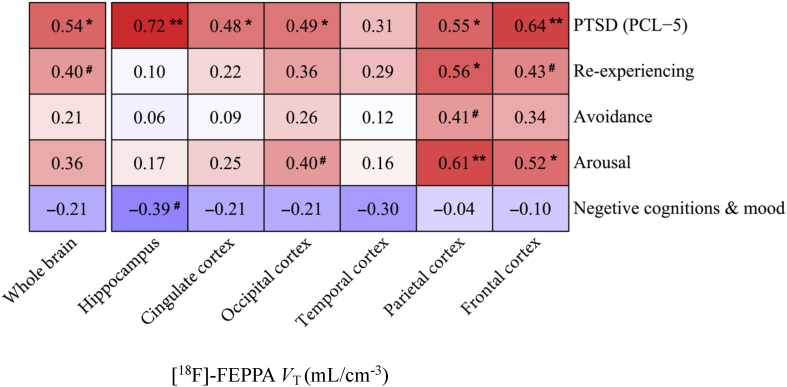
Responders were 56.0 ± 4.7 years-old, and 75% were police officers on 9/11/2001, and all had at least a high school education. Higher PTSD symptom severity was associated with global and regional elevations in [F]-FEPPA binding predominantly in the hippocampus ( = 0.72, = 0.001) and frontal cortex ( = 0.64, = 0.004). Longer exposure duration to WTC sites was associated with higher [F]-FEPPA binding in the parietal cortex.
Findings from this study of WTC responders at midlife suggest that glial activation is associated with PTSD symptoms, and WTC exposure duration. Future investigation is needed to understand the important role of neuroinflammation in highly exposed WTC responders.
长期以来,理论认为神经炎症源于接触细颗粒物,且当个体经历慢性应激时会受到调节,而这两者也都被认为部分是由于神经炎症导致认知能力下降。
鉴于假设神经炎症可能与世贸中心(WTC)事件中的经历有关,本研究探讨了胶质细胞激活与神经心理学指标之间的关联,包括创伤后应激障碍(PTSD)症状严重程度和WTC暴露持续时间。
转运蛋白18 kDa(TSPO)在激活的胶质细胞(主要是小胶质细胞和星形胶质细胞)中过度表达,使得TSPO分布成为神经炎症的一种假定生物标志物。20名WTC事件响应者完成了神经心理学评估和使用[F]-FEPPA的PET脑扫描。采用广义线性模型来测试以PTSD和WTC暴露持续时间为预测变量,以及以全脑和区域[F]-FEPPA总分布体积为结果变量之间的关联。
响应者的年龄为56.0±4.7岁,75%在2001年9月11日是警察,且所有人至少具有高中学历。较高的PTSD症状严重程度与[F]-FEPPA结合在全脑和区域的升高相关,主要在海马体(r = 0.72,p = 0.001)和额叶皮质(r = 0.64,p = 0.004)。在WTC场地更长的暴露持续时间与顶叶皮质中更高的[F]-FEPPA结合相关。
这项对中年WTC事件响应者的研究结果表明,胶质细胞激活与PTSD症状以及WTC暴露持续时间相关。需要进一步研究以了解神经炎症在高暴露的WTC事件响应者中的重要作用。