• 文献检索
  • 文档翻译
  • 深度研究
  • 学术资讯
  • Suppr Zotero 插件Zotero 插件
  • 邀请有礼
  • 套餐&价格
  • 历史记录
应用&插件
Suppr Zotero 插件Zotero 插件浏览器插件Mac 客户端Windows 客户端微信小程序
定价
高级版会员购买积分包购买API积分包
服务
文献检索文档翻译深度研究API 文档MCP 服务
关于我们
关于 Suppr公司介绍联系我们用户协议隐私条款
关注我们

Suppr 超能文献

核心技术专利:CN118964589B侵权必究
粤ICP备2023148730 号-1Suppr @ 2026

文献检索

告别复杂PubMed语法,用中文像聊天一样搜索,搜遍4000万医学文献。AI智能推荐,让科研检索更轻松。

立即免费搜索

文件翻译

保留排版,准确专业,支持PDF/Word/PPT等文件格式,支持 12+语言互译。

免费翻译文档

深度研究

AI帮你快速写综述,25分钟生成高质量综述,智能提取关键信息,辅助科研写作。

立即免费体验

空间转录组数据分析的进展。

Advances in spatial transcriptomic data analysis.

机构信息

Department of Medicine, Boston University School of Medicine, Boston, Massachusetts 02118, USA.

Bioinformatics Graduate Program, Boston University, Boston, Massachusetts 02215, USA.

出版信息

Genome Res. 2021 Oct;31(10):1706-1718. doi: 10.1101/gr.275224.121.

DOI:10.1101/gr.275224.121
PMID:34599004
原文链接:https://pmc.ncbi.nlm.nih.gov/articles/PMC8494229/
Abstract

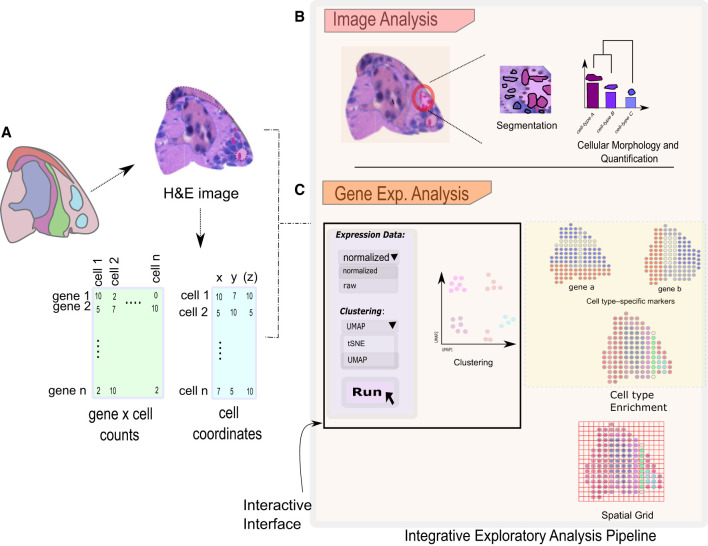
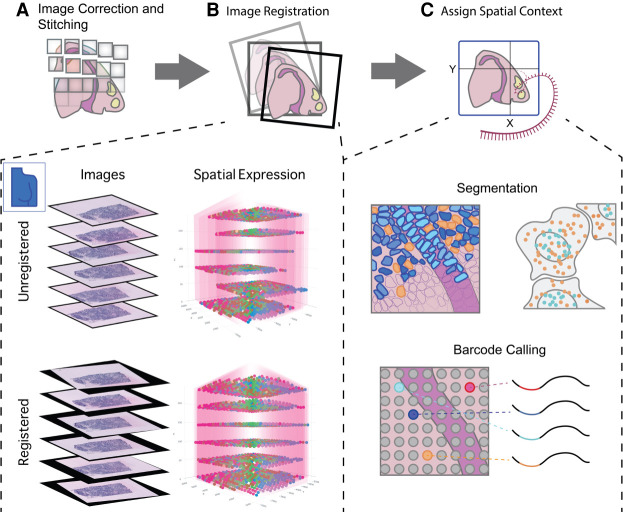
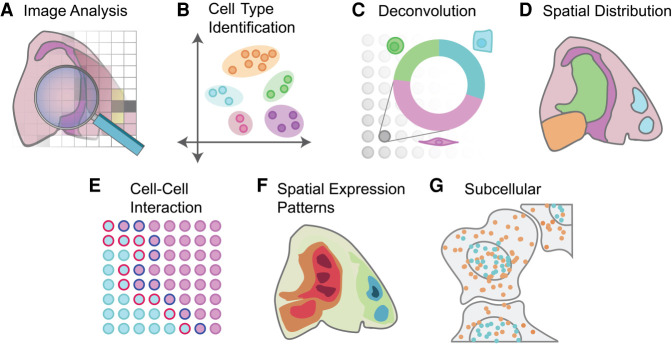
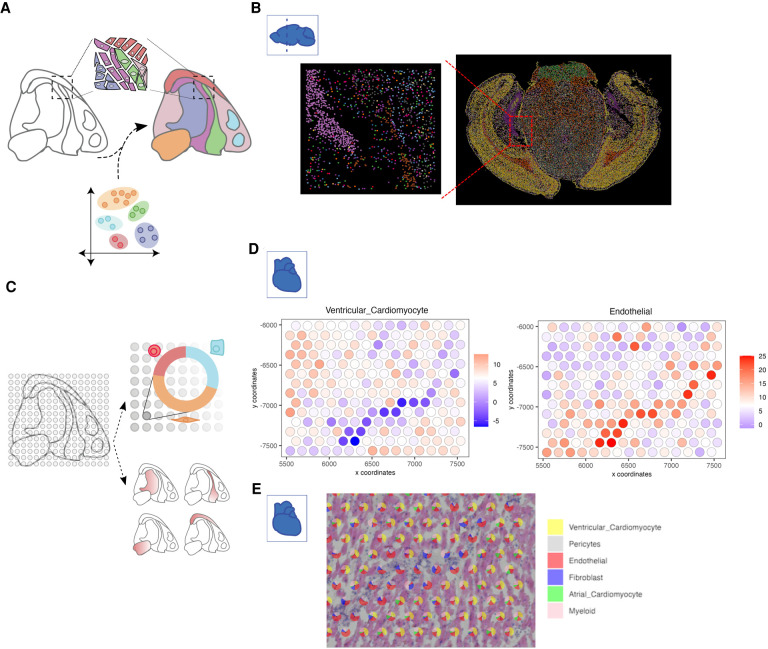
Spatial transcriptomics is a rapidly growing field that promises to comprehensively characterize tissue organization and architecture at the single-cell or subcellular resolution. Such information provides a solid foundation for mechanistic understanding of many biological processes in both health and disease that cannot be obtained by using traditional technologies. The development of computational methods plays important roles in extracting biological signals from raw data. Various approaches have been developed to overcome technology-specific limitations such as spatial resolution, gene coverage, sensitivity, and technical biases. Downstream analysis tools formulate spatial organization and cell-cell communications as quantifiable properties, and provide algorithms to derive such properties. Integrative pipelines further assemble multiple tools in one package, allowing biologists to conveniently analyze data from beginning to end. In this review, we summarize the state of the art of spatial transcriptomic data analysis methods and pipelines, and discuss how they operate on different technological platforms.

摘要

空间转录组学是一个快速发展的领域,有望全面描述单细胞或亚细胞分辨率下的组织组织和结构。这些信息为深入了解健康和疾病状态下的许多生物学过程提供了坚实的基础,而这些过程是传统技术无法获得的。计算方法的发展在从原始数据中提取生物信号方面发挥了重要作用。已经开发了各种方法来克服特定技术的限制,如空间分辨率、基因覆盖率、灵敏度和技术偏差。下游分析工具将空间组织和细胞间通讯表述为可量化的特性,并提供用于推导这些特性的算法。整合管道进一步将多个工具集成到一个包中,使生物学家能够方便地从头到尾分析数据。在这篇综述中,我们总结了空间转录组数据分析方法和管道的最新进展,并讨论了它们在不同技术平台上的工作原理。
https://cdn.ncbi.nlm.nih.gov/pmc/blobs/de76/8494229/1647d7e80e0b/1706f08.jpg
https://cdn.ncbi.nlm.nih.gov/pmc/blobs/de76/8494229/136b1944cf3a/1706f01.jpg
https://cdn.ncbi.nlm.nih.gov/pmc/blobs/de76/8494229/6d8273cdab1a/1706f02.jpg
https://cdn.ncbi.nlm.nih.gov/pmc/blobs/de76/8494229/4d7b3aaabba4/1706f03.jpg
https://cdn.ncbi.nlm.nih.gov/pmc/blobs/de76/8494229/9c3156f2a62c/1706f04.jpg
https://cdn.ncbi.nlm.nih.gov/pmc/blobs/de76/8494229/36c4b6ba574b/1706f05.jpg
https://cdn.ncbi.nlm.nih.gov/pmc/blobs/de76/8494229/48913d213008/1706f06.jpg
https://cdn.ncbi.nlm.nih.gov/pmc/blobs/de76/8494229/664fdeab3a17/1706f07.jpg
https://cdn.ncbi.nlm.nih.gov/pmc/blobs/de76/8494229/1647d7e80e0b/1706f08.jpg
https://cdn.ncbi.nlm.nih.gov/pmc/blobs/de76/8494229/136b1944cf3a/1706f01.jpg
https://cdn.ncbi.nlm.nih.gov/pmc/blobs/de76/8494229/6d8273cdab1a/1706f02.jpg
https://cdn.ncbi.nlm.nih.gov/pmc/blobs/de76/8494229/4d7b3aaabba4/1706f03.jpg
https://cdn.ncbi.nlm.nih.gov/pmc/blobs/de76/8494229/9c3156f2a62c/1706f04.jpg
https://cdn.ncbi.nlm.nih.gov/pmc/blobs/de76/8494229/36c4b6ba574b/1706f05.jpg
https://cdn.ncbi.nlm.nih.gov/pmc/blobs/de76/8494229/48913d213008/1706f06.jpg
https://cdn.ncbi.nlm.nih.gov/pmc/blobs/de76/8494229/664fdeab3a17/1706f07.jpg
https://cdn.ncbi.nlm.nih.gov/pmc/blobs/de76/8494229/1647d7e80e0b/1706f08.jpg

相似文献

1
Advances in spatial transcriptomic data analysis.空间转录组数据分析的进展。
Genome Res. 2021 Oct;31(10):1706-1718. doi: 10.1101/gr.275224.121.
2
Recent advances in spatially resolved transcriptomics: challenges and opportunities.近年来空间分辨转录组学的进展:挑战与机遇。
BMB Rep. 2022 Mar;55(3):113-124. doi: 10.5483/BMBRep.2022.55.3.014.
3
Advances in spatial transcriptomics and related data analysis strategies.空间转录组学及相关数据分析策略的进展。
J Transl Med. 2023 May 18;21(1):330. doi: 10.1186/s12967-023-04150-2.
4
Computational solutions for spatial transcriptomics.空间转录组学的计算解决方案。
Comput Struct Biotechnol J. 2022 Sep 1;20:4870-4884. doi: 10.1016/j.csbj.2022.08.043. eCollection 2022.
5
Spatial Transcriptomics: Emerging Technologies in Tissue Gene Expression Profiling.空间转录组学:组织基因表达分析的新兴技术。
Anal Chem. 2023 Oct 24;95(42):15450-15460. doi: 10.1021/acs.analchem.3c02029. Epub 2023 Oct 10.
6
Computational exploration of cellular communication in skin from emerging single-cell and spatial transcriptomic data.利用新兴的单细胞和空间转录组数据对皮肤中的细胞通讯进行计算探索。
Biochem Soc Trans. 2022 Feb 28;50(1):297-308. doi: 10.1042/BST20210863.
7
Mapping the transcriptome: Realizing the full potential of spatial data analysis.绘制转录组图谱:充分挖掘空间数据分析的潜力。
Cell. 2023 Dec 21;186(26):5677-5689. doi: 10.1016/j.cell.2023.11.003. Epub 2023 Dec 7.
8
STPDA: Leveraging spatial-temporal patterns for downstream analysis in spatial transcriptomic data.STPDA:利用时空模式进行空间转录组数据下游分析。
Comput Biol Chem. 2024 Oct;112:108127. doi: 10.1016/j.compbiolchem.2024.108127. Epub 2024 Jun 11.
9
Giotto: a toolbox for integrative analysis and visualization of spatial expression data.Giotto:一个用于空间表达数据综合分析和可视化的工具包。
Genome Biol. 2021 Mar 8;22(1):78. doi: 10.1186/s13059-021-02286-2.
10
Recent advances in high-throughput single-cell transcriptomics and spatial transcriptomics.高通量单细胞转录组学和空间转录组学的最新进展。
Lab Chip. 2022 Dec 6;22(24):4774-4791. doi: 10.1039/d2lc00633b.

引用本文的文献

1
stImage: a versatile framework for optimizing spatial transcriptomic analysis through customizable deep histology and location informed integration.stImage:一个通过可定制的深度组织学和位置信息整合来优化空间转录组分析的通用框架。
Brief Bioinform. 2025 Aug 31;26(5). doi: 10.1093/bib/bbaf429.
2
Spatial Multiplexing and Omics.空间复用与组学
Nat Rev Methods Primers. 2024;4(1). doi: 10.1038/s43586-024-00330-6. Epub 2024 Aug 1.
3
SPEX: A modular end-to-end platform for high-plex tissue spatial omics analysis.SPEX:用于高分辨率组织空间组学分析的模块化端到端平台。

本文引用的文献

1
Spatial Reconstruction of Oligo and Single Cells by De Novo Coalescent Embedding of Transcriptomic Networks.基于转录组网络从头合并嵌合对寡细胞和单细胞的空间重构。
Adv Sci (Weinh). 2023 Jul;10(20):e2206307. doi: 10.1002/advs.202206307. Epub 2023 Jun 15.
2
Sparcle: assigning transcripts to cells in multiplexed images.Sparcle:在多重图像中将转录本分配到细胞中。
Bioinform Adv. 2022 Jun 17;2(1):vbac048. doi: 10.1093/bioadv/vbac048. eCollection 2022.
3
SPICEMIX enables integrative single-cell spatial modeling of cell identity.
Gigascience. 2025 Jan 6;14. doi: 10.1093/gigascience/giaf090.
4
Spatial Transcriptomics Decodes Breast Cancer Microenvironment Heterogeneity: From Multidimensional Dynamic Profiling to Precision Therapy Blueprint Construction.空间转录组学解码乳腺癌微环境异质性:从多维动态分析到精准治疗蓝图构建
Biomolecules. 2025 Jul 24;15(8):1067. doi: 10.3390/biom15081067.
5
LSGI: interpretable spatial gradient analysis for spatial transcriptomics data.LSGI:用于空间转录组学数据的可解释空间梯度分析
Genome Biol. 2025 Aug 8;26(1):238. doi: 10.1186/s13059-025-03716-1.
6
SpaSEG: unsupervised deep learning for multi-task analysis of spatially resolved transcriptomics.SpaSEG:用于空间转录组学多任务分析的无监督深度学习
Genome Biol. 2025 Jul 29;26(1):230. doi: 10.1186/s13059-025-03697-1.
7
Spatial phenotyping of human bronchial airways in obstructive lung disease.阻塞性肺疾病中人类支气管气道的空间表型分析
Respir Res. 2025 Jul 2;26(1):232. doi: 10.1186/s12931-025-03315-5.
8
Spatial omics technology potentially promotes the progress of tumor immunotherapy.空间组学技术有可能推动肿瘤免疫治疗的进展。
Br J Cancer. 2025 Jun 2. doi: 10.1038/s41416-025-03075-5.
9
A Robust Kernel-Based Workflow for Niche Trajectory Analysis.一种用于生态位轨迹分析的基于稳健核的工作流程。
Small Methods. 2025 May;9(5):e2401199. doi: 10.1002/smtd.202401199. Epub 2024 Dec 29.
10
STCC enhances spatial domain detection through consensus clustering of spatial transcriptomics data.STCC通过空间转录组学数据的一致性聚类增强空间域检测。
Genome Res. 2025 Jun 2;35(6):1415-1428. doi: 10.1101/gr.280031.124.
SPICEMIX 能够实现细胞身份的综合单细胞空间建模。
Nat Genet. 2023 Jan;55(1):78-88. doi: 10.1038/s41588-022-01256-z. Epub 2023 Jan 9.
4
spatialLIBD: an R/Bioconductor package to visualize spatially-resolved transcriptomics data.spatialLIBD:一个用于可视化空间分辨转录组学数据的 R/Bioconductor 包。
BMC Genomics. 2022 Jun 10;23(1):434. doi: 10.1186/s12864-022-08601-w.
5
SpatialExperiment: infrastructure for spatially-resolved transcriptomics data in R using Bioconductor.SpatialExperiment:使用 Bioconductor 在 R 中进行空间分辨转录组学数据的基础架构。
Bioinformatics. 2022 May 26;38(11):3128-3131. doi: 10.1093/bioinformatics/btac299.
6
Squidpy: a scalable framework for spatial omics analysis.鱿鱼皮:一种用于空间组学分析的可扩展框架。
Nat Methods. 2022 Feb;19(2):171-178. doi: 10.1038/s41592-021-01358-2. Epub 2022 Jan 31.
7
Mapping the temporal and spatial dynamics of the human endometrium in vivo and in vitro.在体和体外描绘人类子宫内膜的时空动态。
Nat Genet. 2021 Dec;53(12):1698-1711. doi: 10.1038/s41588-021-00972-2. Epub 2021 Dec 2.
8
Whole-cell segmentation of tissue images with human-level performance using large-scale data annotation and deep learning.使用大规模数据标注和深度学习实现具有人类水平性能的组织图像全细胞分割。
Nat Biotechnol. 2022 Apr;40(4):555-565. doi: 10.1038/s41587-021-01094-0. Epub 2021 Nov 18.
9
Deep learning and alignment of spatially resolved single-cell transcriptomes with Tangram.基于 Tangram 的空间分辨单细胞转录组的深度学习和对齐。
Nat Methods. 2021 Nov;18(11):1352-1362. doi: 10.1038/s41592-021-01264-7. Epub 2021 Oct 28.
10
SpaGCN: Integrating gene expression, spatial location and histology to identify spatial domains and spatially variable genes by graph convolutional network.SpaGCN:通过图卷积网络整合基因表达、空间位置和组织学信息以识别空间域和空间可变基因
Nat Methods. 2021 Nov;18(11):1342-1351. doi: 10.1038/s41592-021-01255-8. Epub 2021 Oct 28.