Sbaraini Nicolau, Tomazett Mariana Vieira, Penteriche Augusto Bartz, Gonçales Relber Aguiar, Camargo Matheus da Silva, Bailão Alexandre Melo, Borges Clayton Luiz, Schrank Augusto, Soares Célia Maria de Almeida, Staats Charley Christian
Universidade Federal do Rio Grande do Sul, Centro de Biotecnologia, Programa de Pós-graduação em Biologia Celular e Molecular, Porto Alegre, RS, Brazil.
Rede Avançada em Biologia Computacional (RABICÓ), Petrópolis, RJ, Brazil.
Genet Mol Biol. 2021 Oct 1;44(3):e20210073. doi: 10.1590/1678-4685-GMB-2021-0073. eCollection 2021.
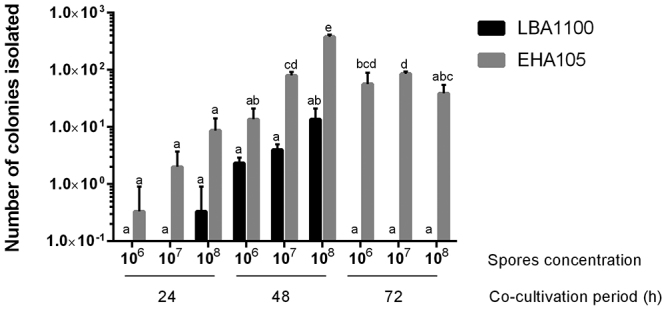
Filamentous fungi are the organisms of choice for most industrial biotechnology. Some species can produce a variety of secondary metabolites and enzymes of commercial interest, and the production of valuable molecules has been enhanced through different molecular tools. Methods for genetic manipulation and transformation have been essential for the optimization of these organisms. The genus Simplicillium has attracted increased attention given several potential biotechnological applications. The Simplicillium genus harbors several entomopathogenic species and some isolates have been explored for bioremediation of heavy metal contaminants. Furthermore, the myriad of secondary metabolites isolated from Simplicillium spp. render these organisms as ideal targets for deep exploration and further biotechnological mining possibilities. However, the lack of molecular tools hampered the exploration of this genus. Thus, an Agrobacterium tumefaciens-mediated transformation method was established for Simplicillium subtropicum, employing the far-red fluorescent protein TURBOFP635/Katushka, as a visual marker, and the selection marker SUR gene, that confers resistance to chlorimuron ethyl. Notably, one round of transformation using the established method yielded almost 400 chlorimuron resistant isolates. Furthermore, these transformants displayed mitotic stability for, at least, five generations. We anticipate that this method can be useful for deep molecular exploration and improvement of strains in the Simplicillium genus.
丝状真菌是大多数工业生物技术的首选生物。一些物种能够产生多种具有商业价值的次生代谢产物和酶,并且通过不同的分子工具提高了有价值分子的产量。基因操作和转化方法对于优化这些生物至关重要。鉴于几种潜在的生物技术应用,单顶孢属已引起越来越多的关注。单顶孢属包含几种昆虫病原物种,并且一些分离株已被用于重金属污染物的生物修复研究。此外,从单顶孢属物种中分离出的大量次生代谢产物使这些生物成为深入探索和进一步进行生物技术挖掘的理想目标。然而,缺乏分子工具阻碍了对该属的探索。因此,建立了一种根癌农杆菌介导的亚热带单顶孢转化方法,采用远红荧光蛋白TURBOFP635/Katushka作为视觉标记,以及赋予对氯嘧磺隆抗性的选择标记SUR基因。值得注意的是,使用该方法进行一轮转化产生了近400个对氯嘧磺隆抗性的分离株。此外,这些转化体至少在五代中表现出有丝分裂稳定性。我们预计该方法可用于单顶孢属菌株的深入分子探索和改良。