Department of Oral Biology, School of Dental Medicine at Rutgers, Newark, NJ, United States.
Department of Epidemiology, School of Public Health at Rutgers, Newark, NJ, United States.
Front Immunol. 2021 Sep 20;12:676669. doi: 10.3389/fimmu.2021.676669. eCollection 2021.
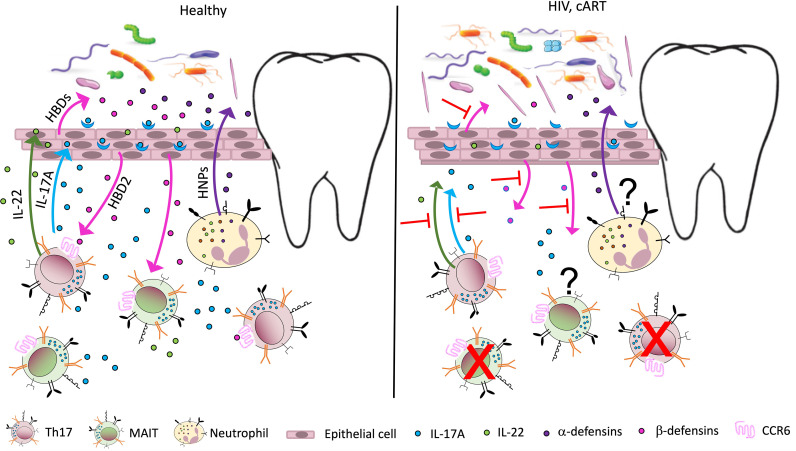
Even with sustained use of antiretroviral therapy (ART), HIV-infected individuals have an increased risk of systemic comorbid conditions and oral pathologies, including opportunistic infections, oral mucosal inflammation, and gingival and periodontal diseases. The immune-mediated mechanisms that drive this increased risk, in the context of sustained viral suppression, are unclear. HIV infection, even when controlled, alters microbial communities contributing to a chronic low-grade inflammatory state that underlies these non-HIV co-morbidities. The higher prevalence of dental caries, and mucosal and periodontal inflammation reported in HIV-infected individuals on ART is often associated with differentially abundant oral microbial communities, possibly leading to a heightened susceptibility to inflammation. This mini-review highlights current gaps in knowledge regarding the microbe-mediated oral mucosal immunity with HIV infection while discussing opportunities for future research investigations and implementation of novel approaches to elucidate these gaps. Interventions targeting both inflammation and microbial diversity are needed to mitigate oral inflammation-related comorbidities, particularly in HIV-infected individuals. More broadly, additional research is needed to bolster general models of microbiome-mediated chronic immune activation and aid the development of precise microbiota-targeted interventions to reverse or mitigate adverse outcomes.
即使持续使用抗逆转录病毒疗法 (ART),HIV 感染者也有更高的全身合并症和口腔病理学风险,包括机会性感染、口腔黏膜炎症以及牙龈和牙周疾病。在持续抑制病毒的情况下,驱动这种风险增加的免疫介导机制尚不清楚。HIV 感染即使得到控制,也会改变微生物群落,导致慢性低度炎症状态,从而导致这些非 HIV 合并症。在接受 ART 的 HIV 感染者中,龋齿、黏膜和牙周炎症的更高患病率通常与口腔微生物群落的丰度差异有关,这可能导致炎症易感性增加。这篇迷你综述强调了目前在 HIV 感染相关口腔黏膜免疫方面的知识差距,并讨论了未来研究调查和实施新方法以阐明这些差距的机会。需要针对炎症和微生物多样性进行干预,以减轻与口腔炎症相关的合并症,特别是在 HIV 感染者中。更广泛地说,需要更多的研究来支持微生物组介导的慢性免疫激活的一般模型,并帮助开发针对精确微生物组的干预措施,以逆转或减轻不良后果。