Division of Psychology and Behavioral Health, Center for Translational Research, Children's National Hospital, 111 Michigan Ave NW, Washington, DC, 20010, USA.
Department of Psychiatry & Behavioral Sciences, and Department of Pediatrics, The George Washington University School of Medicine and Health Sciences, Washington, DC, USA.
Res Child Adolesc Psychopathol. 2022 May;50(5):605-619. doi: 10.1007/s10802-021-00857-2. Epub 2021 Oct 7.
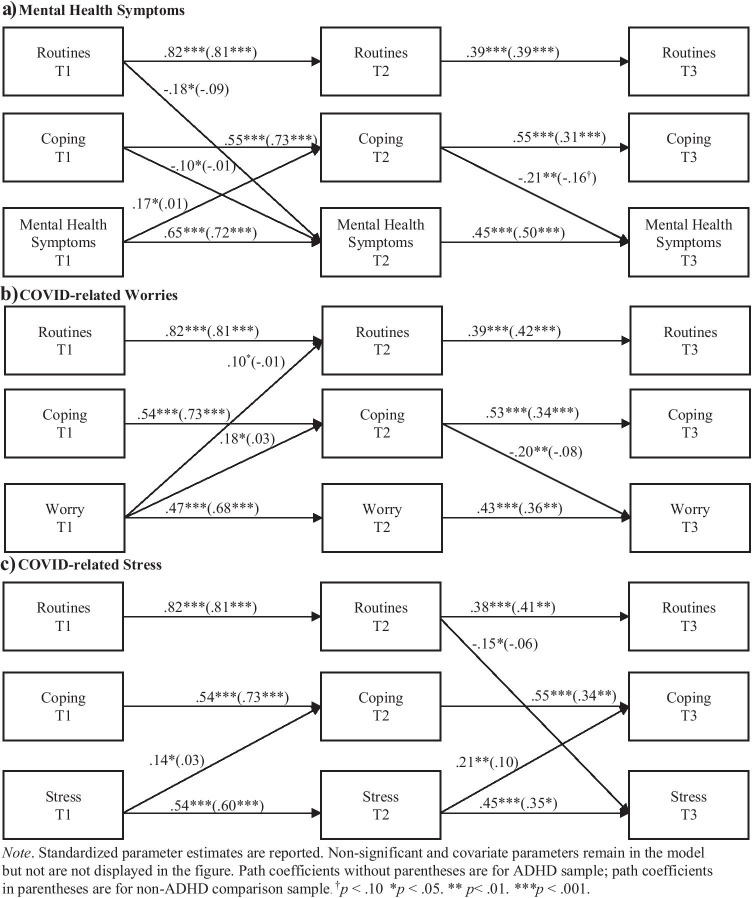
Understanding factors that foster resilience and buffer against the negative psychological impact of COVID-19 is critical to inform efforts to promote adjustment, reduce risk, and improve care, particularly for adolescents with neurodevelopmental disorders. This prospective longitudinal study addresses this gap by investigating the impact of the COVID-19 pandemic on adolescents' mental health and substance use, and by assessing specific positive coping strategies among adolescents with and without attention-deficit/hyperactivity disorder (ADHD). Using multi-group autoregressive cross-lagged path models, the present study explored the reciprocal influence of positive coping behaviors on multiple adjustment outcomes including mental health symptoms, substance use, stress, and worry. Participants included 238 adolescents (132 male participants; ages 15-17; 118 with ADHD). Parents provided ratings of adolescent routines, and adolescents provided ratings of coping behaviors and psychological adjustment in spring (May/June), summer (July/August), and fall (October/November) 2020. All models included the effects of adjustment at the prior timepoint as well as relevant covariates including adolescent race, ethnicity, sex, medication status, and family income. Adolescents with ADHD were at greater risk for experiencing increases in mental health symptoms and substance use throughout the pandemic, relative to adolescents without ADHD. The use of positive coping strategies and adolescent routines buffered against increases in substance use and mental health problems for adolescents with ADHD. These findings have important clinical and public policy relevance for parents, schools, and employers who may aim to prioritize keeping schedules as consistent as possible to promote healthy adjustment.
了解促进韧性和缓冲 COVID-19 负面影响的因素对于指导促进调整、降低风险和改善护理的努力至关重要,特别是对于患有神经发育障碍的青少年。这项前瞻性纵向研究通过调查 COVID-19 大流行对青少年心理健康和物质使用的影响,并评估注意力缺陷多动障碍(ADHD)青少年和无 ADHD 青少年的特定积极应对策略,解决了这一差距。本研究使用多组自回归交叉滞后路径模型,探讨了积极应对行为对包括心理健康症状、物质使用、压力和担忧在内的多种调整结果的相互影响。参与者包括 238 名青少年(132 名男性参与者;年龄 15-17 岁;118 名患有 ADHD)。父母对青少年日常活动进行评分,青少年在 2020 年春季(5 月/6 月)、夏季(7 月/8 月)和秋季(10 月/11 月)对应对行为和心理调整进行评分。所有模型都包括调整前的影响以及相关协变量,包括青少年的种族、民族、性别、用药状况和家庭收入。与无 ADHD 的青少年相比,ADHD 青少年在整个大流行期间经历心理健康症状和物质使用增加的风险更大。积极应对策略和青少年日常活动的使用缓冲了 ADHD 青少年物质使用和心理健康问题的增加。这些发现对于父母、学校和雇主具有重要的临床和公共政策意义,他们可能旨在优先保持尽可能一致的日程安排,以促进健康调整。