Vaccination Support Center, National Center for Global Health and Medicine, Tokyo, Japan.
Department of Health Policy and Management, Johns Hopkins Bloomberg School of Public Health, Baltimore, USA.
Hum Vaccin Immunother. 2022 Dec 31;18(1):1-3. doi: 10.1080/21645515.2021.1986333. Epub 2021 Oct 7.
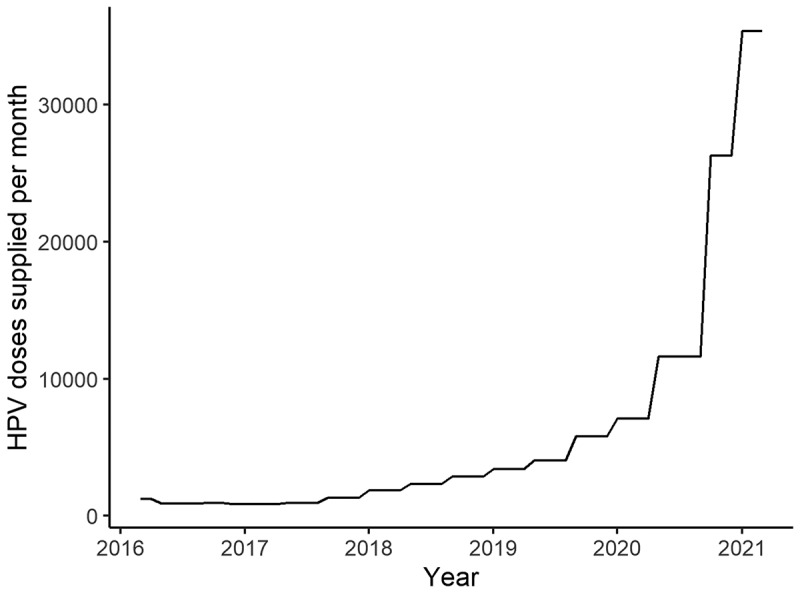
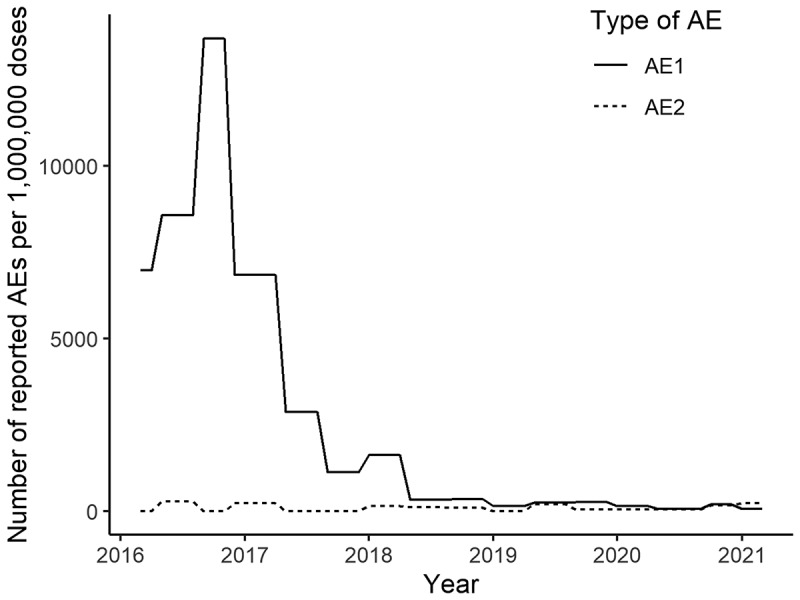
After the Japanese Ministry of Health, Labor and Welfare (MHLW) suspended its recommendation for the human papillomavirus (HPV) vaccine in June 2013, the rate of members of the new target population receiving of at least one of three doses of HPV vaccine declined, reaching 0.3% in 2016. Recently, however, the monthly number of vaccines delivered to healthcare facilities has significantly increased, from 878 doses over December 2016-April 2017 to 35,396 doses over January-March 2021. This may be due to governmental efforts to convey information about the HPV vaccination to the eligible population and their caregivers, as well as local educational programs, despite ongoing suspension of the recommendation. The incidence of reported adverse events per vaccine dose has not increased since 2016. While governmental recommendation of the HPV vaccination remains essential for optimal vaccine coverage, the recent increase in the number of doses delivered to healthcare facilities is promising.
日本厚生劳动省(MHLW)于 2013 年 6 月暂停推荐人乳头瘤病毒(HPV)疫苗后,新目标人群中至少接种三剂 HPV 疫苗的成员比例下降,2016 年降至 0.3%。然而,最近向医疗机构交付的疫苗数量每月显著增加,从 2016 年 12 月至 2017 年 4 月的 878 剂增加到 2021 年 1 月至 3 月的 35396 剂。这可能是由于政府努力向符合条件的人群及其照顾者传达 HPV 疫苗接种信息,以及开展地方教育计划,尽管推荐仍在继续暂停。自 2016 年以来,每剂疫苗报告的不良事件发生率没有增加。虽然政府推荐 HPV 疫苗接种对于最佳疫苗接种覆盖率仍然至关重要,但最近向医疗机构交付的疫苗剂量增加是有希望的。