Chitkara University Institute of Engineering and Technology, Chitkara University, Rajpura 140401, India.
Department of Computer Science and Engineering, Lovely Professional University, Phagwara 144411, India.
Sensors (Basel). 2021 Sep 23;21(19):6346. doi: 10.3390/s21196346.
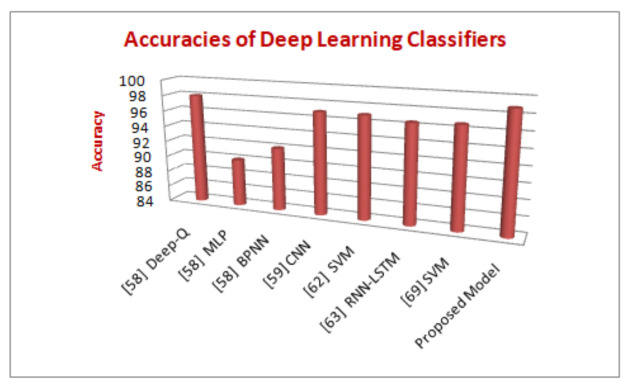
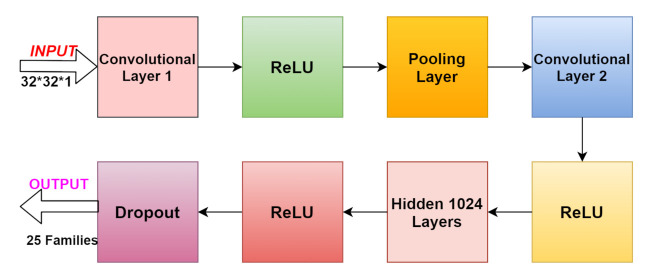
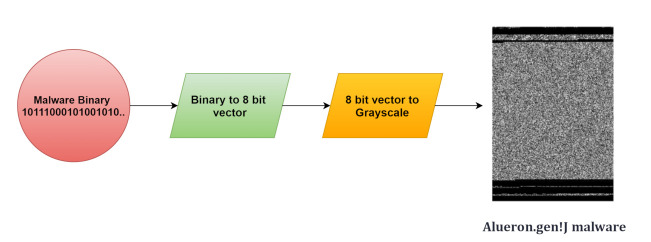
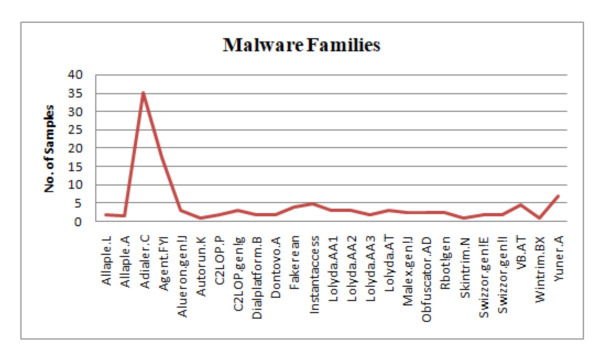
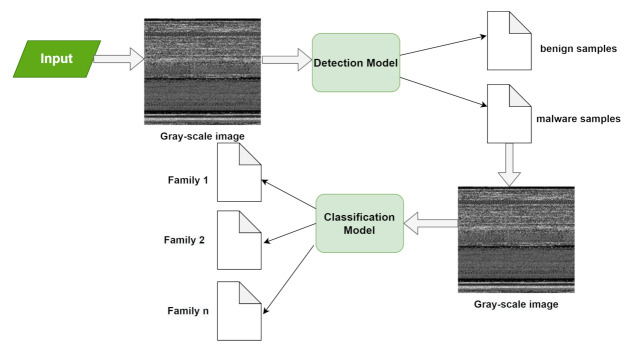
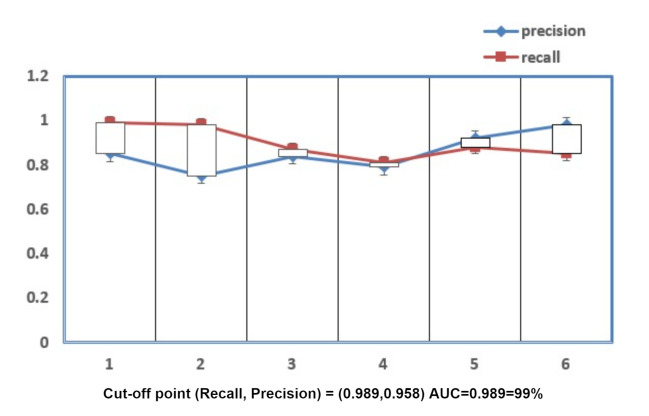
The role of 5G-IoT has become indispensable in smart applications and it plays a crucial part in e-health applications. E-health applications require intelligent schemes and architectures to overcome the security threats against the sensitive data of patients. The information in e-healthcare applications is stored in the cloud which is vulnerable to security attacks. However, with deep learning techniques, these attacks can be detected, which needs hybrid models. In this article, a new deep learning model (CNN-DMA) is proposed to detect malware attacks based on a classifier-Convolution Neural Network (CNN). The model uses three layers, i.e., Dense, Dropout, and Flatten. Batch sizes of 64, 20 epoch, and 25 classes are used to train the network. An input image of 32 × 32 × 1 is used for the initial convolutional layer. Results are retrieved on the Malimg dataset where 25 families of malware are fed as input and our model has detected is Alueron.gen!J malware. The proposed model CNN-DMA is 99% accurate and it is validated with state-of-the-art techniques.
5G-IoT 的角色在智能应用中变得不可或缺,它在电子健康应用中起着至关重要的作用。电子健康应用需要智能方案和架构来克服针对患者敏感数据的安全威胁。电子医疗保健应用中的信息存储在云端,容易受到安全攻击。然而,通过深度学习技术,可以检测到这些攻击,这需要混合模型。本文提出了一种新的深度学习模型(CNN-DMA),该模型基于分类器-卷积神经网络(CNN)来检测恶意软件攻击。该模型使用三个层,即密集层、Dropout 和 Flatten。网络训练使用 64 个批次大小、20 个时期和 25 个类别。初始卷积层使用 32×32×1 的输入图像。结果在 Malimg 数据集上检索,该数据集输入了 25 种恶意软件家族,我们的模型检测到了 Alueron.gen!J 恶意软件。所提出的模型 CNN-DMA 的准确率为 99%,并通过最先进的技术进行了验证。