Steidten Thomas, Baumbach Philipp, May Rico, Gabriel Brunhild, Herbsleb Marco, Markov Adrian, Granacher Urs, Kellmann Michael, Bloch Wilhelm, Gabriel Holger H W, Puta Christian
Department of Sports Medicine and Health Promotion, Friedrich-Schiller-University Jena, Jena, Germany.
Center for Interdisciplinary Prevention of Diseases Related to Professional Activities, Friedrich Schiller University, Jena, Germany.
Front Sports Act Living. 2021 Sep 28;3:689805. doi: 10.3389/fspor.2021.689805. eCollection 2021.
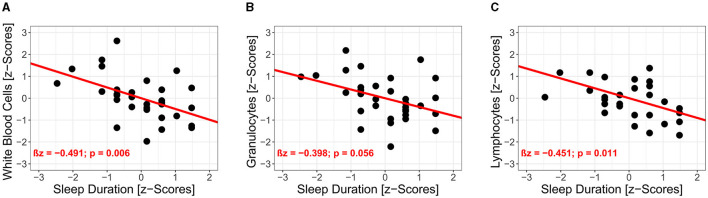
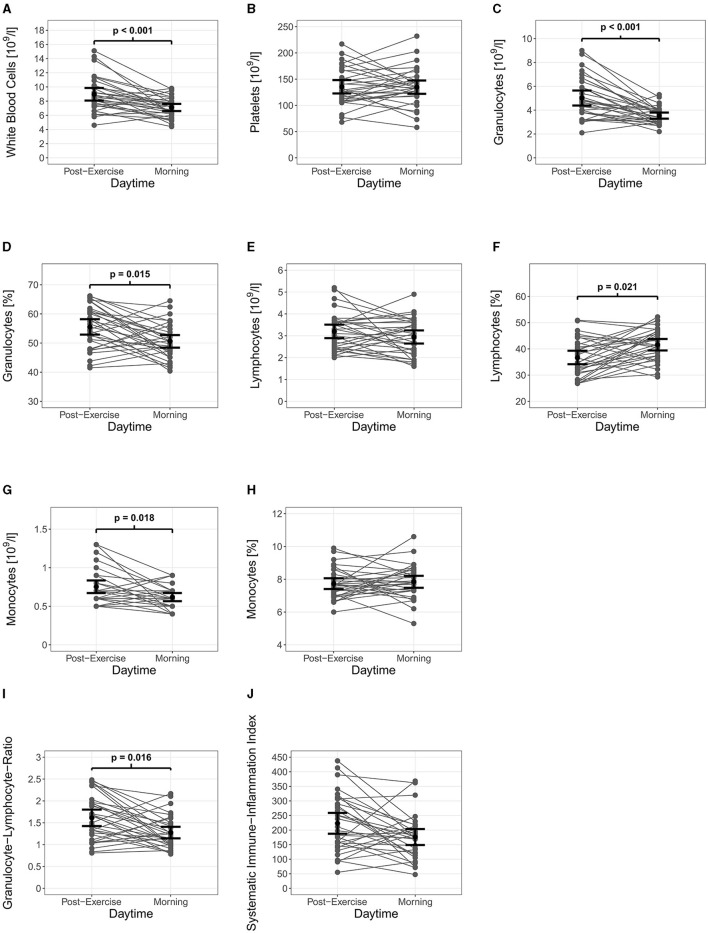
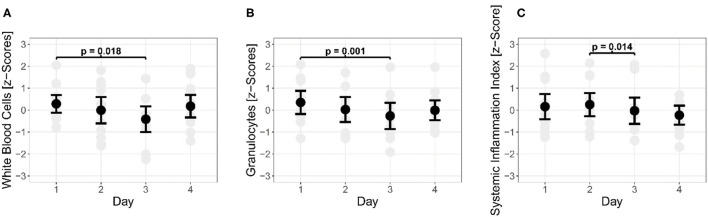
To ensure health maintenance of young athletes, immunological stress due to physical exercise has to be balanced for performance development and health maintenance. Sleep is an important influencing factor for immune regulation because of its regenerating effect. In an attempt to assess overnight immune regulation, this observational study aimed to examine associations between changes in capillary immunological blood markers and measures of sleep in adolescent athletes. Over a period of three nights, 12 male ( = 6) and female ( = 6) adolescent track and field athletes aged 16.4 ± 1.1 years were monitored for their sleep behavior (e.g., sleep duration, sleep depth) and immune regulation by using subjective (e.g., sleep) and objective (capillary blood markers) measurement tools. Over the 4 day (three nights), athletes followed their daily routines (school, homework, free time activities, and training). Training was performed for different disciplines (sprint, hurdles, and long-jump) following their daily training routines. Training included dynamic core stability training, coordination training, speed training, resistance training, and endurance training. Capillary blood samples were taken 30-45 min after the last training session (10:00-12:00 a.m. or 5:00-6:00 p.m.) and every morning between 7:00 and 10:00 a.m. Changes in capillary blood markers from post-training to the next morning and morning-to-morning fluctuations in capillary blood markers were analyzed over a three-night period using a generalized estimating equations (GEE) statistical approach. Associations of overnight changes with measures of sleep were analyzed using GEE. We found significant decreases in white blood cell count (WBC), granulocytes (GRAN), granulocytes% (GRAN%), monocytes (MID), and granulocyte-lymphocyte-ratio. In contrast, lymphocytes% (LYM%) increased significantly and systemic inflammation index showed no difference from post-training to the next morning. Furthermore, there was a significant decrease in WBC and GRAN between morning 1 and morning 3. At morning 4, values returned to baseline (morning 1), irrespective if athletes performed a training session or rested on day 3. Furthermore, sleep duration was significantly and negatively associated with changes in WBC (β = -0.491) and lymphocytes (β = -0.451). Our results indicate that overnight sleep duration is an important parameter of immunological overnight regulation for adolescent athletes.
为确保年轻运动员的健康维持,必须平衡体育锻炼引起的免疫应激,以促进成绩提升和维持健康。睡眠因其具有恢复作用,是免疫调节的一个重要影响因素。为了评估夜间免疫调节情况,这项观察性研究旨在探究青少年运动员毛细血管免疫血液标志物的变化与睡眠指标之间的关联。在三个晚上的时间里,对12名年龄在16.4±1.1岁的青少年田径运动员(男性6名,女性6名)的睡眠行为(如睡眠时间、睡眠深度)和免疫调节进行监测,采用主观(如睡眠情况)和客观(毛细血管血液标志物)测量工具。在这4天(三个晚上)里,运动员遵循他们的日常安排(上学、做作业、自由活动和训练)。训练按照日常训练计划针对不同项目(短跑、跨栏和跳远)进行。训练包括动态核心稳定性训练、协调性训练、速度训练、阻力训练和耐力训练。在最后一次训练 session 后30 - 45分钟(上午10:00 - 12:00或下午5:00 - 6:00)以及每天早上7:00至10:00采集毛细血管血样。使用广义估计方程(GEE)统计方法分析从训练后到第二天早上毛细血管血液标志物的变化以及毛细血管血液标志物在早晨之间的波动情况。使用GEE分析夜间变化与睡眠指标之间的关联。我们发现白细胞计数(WBC)、粒细胞(GRAN)、粒细胞百分比(GRAN%)、单核细胞(MID)和粒细胞 - 淋巴细胞比值显著下降。相比之下,淋巴细胞百分比(LYM%)显著增加,并且从训练后到第二天早上全身炎症指数没有差异。此外,在第一天早上和第三天早上之间WBC和GRAN显著下降。在第四天早上,数值恢复到基线(第一天早上),无论运动员在第三天是进行了训练 session 还是休息。此外,睡眠时间与WBC(β = -0.491)和淋巴细胞(β = -0.451)的变化显著负相关。我们的结果表明,夜间睡眠时间是青少年运动员夜间免疫调节的一个重要参数。