Zhong Ou, Ji Lin, Wang Jinyuan, Lei Xiaocan, Huang Hua
Clinical Anatomy and Reproductive Medicine Application Institute, Hengyang Medical School, University of South China, 421001, Hengyang, China.
Reproductive Hospital of Guangxi Zhuang Autonomous Region, 530021, Nanning, China.
Diabetol Metab Syndr. 2021 Oct 16;13(1):109. doi: 10.1186/s13098-021-00728-2.
The present study performed two distinct meta-analyses with common outcomes (sperm parameters); one was performed in obese individuals (and non-obese controls) and the other in diabetic individuals (and non-diabetic controls).
PubMed, Embase, The Cochrane library, Web of Science, Scopus databases were searched to collect clinical studies related to the effects of obesity and diabetes on male sperm from inception to on 1st February 2021. Statistical meta-analyses were performed using the RevMan 5.4 software. Stata16 software was used to detect publication bias. The methodological quality of the included studies was assessed with the Ottawa-Newcastle scale using a star-based system.
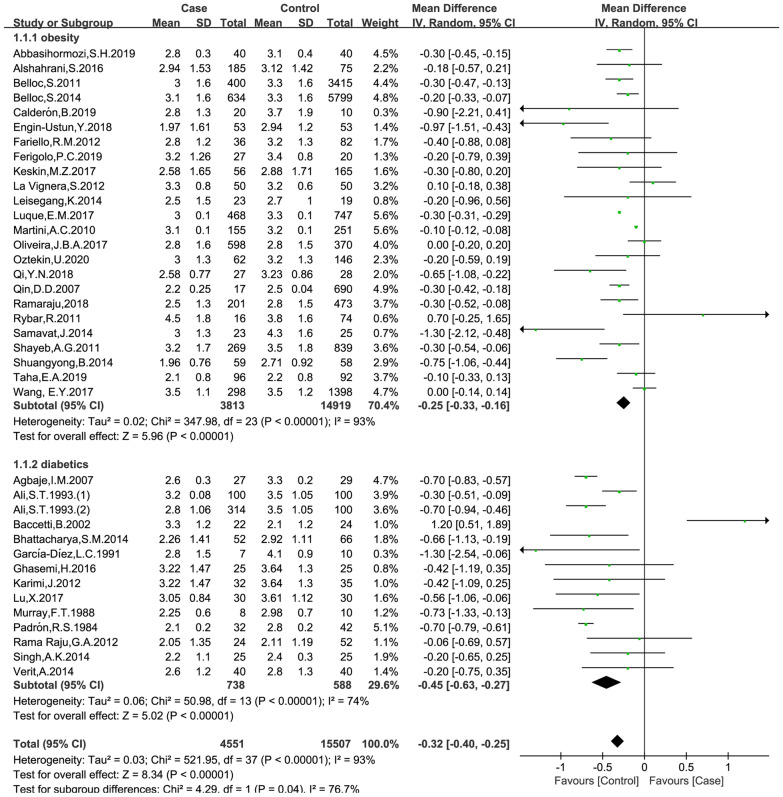
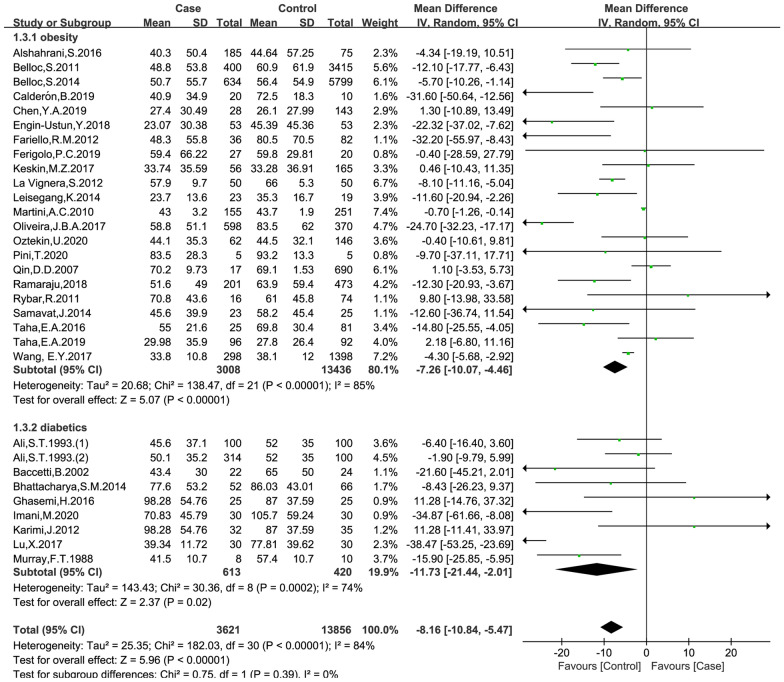
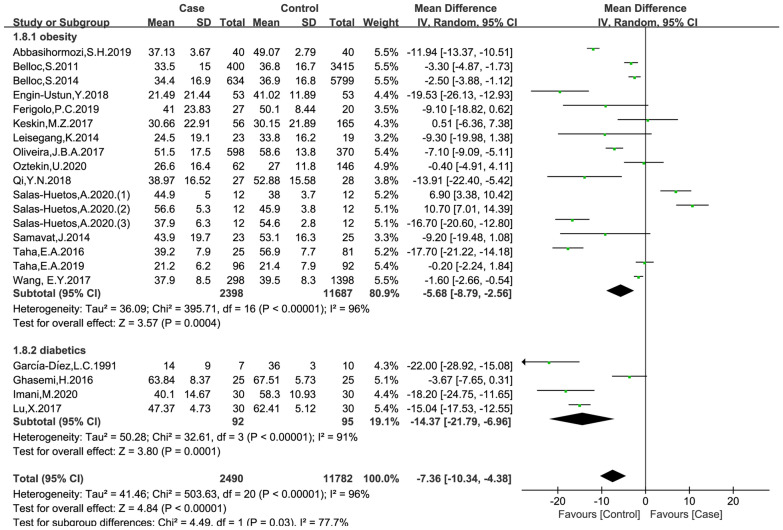
A total of 44 studies were finally included in the present study, which enrolled 20,367 obese patients and 1386 patients with diabetes. The meta-analysis results showed that both obesity and diabetes were associated with reduced semen volume (obese versus non-obese controls: mean difference (MD) = - 0.25, 95% CI = (- 0.33, - 0.16), p < 0.001; diabetes versus non-diabetic controls: MD = - 0.45, 95% CI = (- 0.63, - 0.27), p < 0.001), reduced sperm count (obese versus non-obese controls: MD = - 23.84, 95% CI = (- 30.36, - 17.33), p < 0.001; diabetes versus non-diabetic controls: MD = - 13.12, 95% CI = (- 18.43, - 7.82), p < 0.001), reduced sperm concentration (obese versus non-obese controls: MD = - 7.26, 95% CI = (- 10.07, - 4.46), p < 0.001; diabetes versus non-diabetic controls: MD = - 11.73, 95% CI = (- 21.44, - 2.01), p = 0.02), reduced progressive motility (obese versus non-obese controls: MD = - 5.68, 95% CI = (- 8.79, - 2.56), p < 0.001; diabetes versus non-diabetic controls: MD = - 14.37, 95% CI = (- 21.79, - 6.96), p = 0.001), and decreased testosterone levels (obese versus non-obese controls: MD = - 1.11, 95% CI = (- 1.92, - 0.30), p = 0.007; diabetes versus non-diabetic controls: MD = - 0.37, 95% CI = (- 0.63, - 0.12), p = 0.004).
Current evidence suggests that obesity and diabetes negatively affect sperm parameters in men and are associated with low testosterone levels. Due to the limitation of the number and quality of included studies, the above conclusions need to be verified by more high-quality studies.
本研究针对常见结局(精子参数)进行了两项不同的荟萃分析;一项在肥胖个体(及非肥胖对照)中进行,另一项在糖尿病个体(及非糖尿病对照)中进行。
检索了PubMed、Embase、Cochrane图书馆、Web of Science、Scopus数据库,以收集从研究起始至2021年2月1日期间有关肥胖和糖尿病对男性精子影响的临床研究。使用RevMan 5.4软件进行统计学荟萃分析。使用Stata16软件检测发表偏倚。采用基于星级系统的渥太华-纽卡斯尔量表评估纳入研究的方法学质量。
本研究最终纳入44项研究,其中纳入肥胖患者20367例,糖尿病患者1386例。荟萃分析结果显示,肥胖和糖尿病均与精液量减少相关(肥胖组与非肥胖对照组:平均差(MD)=-0.25,95%置信区间(CI)=(-0.33,-0.16),p<0.001;糖尿病组与非糖尿病对照组:MD=-0.45,95%CI=(-0.63,-0.27),p<0.001)、精子计数减少(肥胖组与非肥胖对照组:MD=-23.84,95%CI=(-30.36,-17.33),p<0.001;糖尿病组与非糖尿病对照组:MD=-13.12,95%CI=(-18.43,-7.82),p<0.001))、精子浓度降低(肥胖组与非肥胖对照组:MD=-7.26,95%CI=(-10.07,-4.46),p<0.001;糖尿病组与非糖尿病对照组:MD=-11.73,95%CI=(-21.44,-2.01),p=0.02)、前向运动能力降低(肥胖组与非肥胖对照组:MD=-5.68,95%CI=(-8.79,-2.56),p<0.001;糖尿病组与非糖尿病对照组:MD=-14.37,95%CI=(-21.79,-6.96),p=0.001)以及睾酮水平降低(肥胖组与非肥胖对照组:MD=-1.11,95%CI=(-1.92,-0.30),p=0.007;糖尿病组与非糖尿病对照组:MD=-0.37,95%CI=(-0.63,-0.12),p=0.004)。
目前的证据表明,肥胖和糖尿病对男性精子参数有负面影响,并与低睾酮水平相关。由于纳入研究的数量和质量有限,上述结论需要更多高质量研究加以验证。