Gröhn Cornelia, Norgren Elin, Eriksson Lars
Department of Social and Psychological Studies, Karlstad University, Karlstad, Sweden.
Schizophr Res Cogn. 2021 Oct 5;27:100219. doi: 10.1016/j.scog.2021.100219. eCollection 2022 Mar.
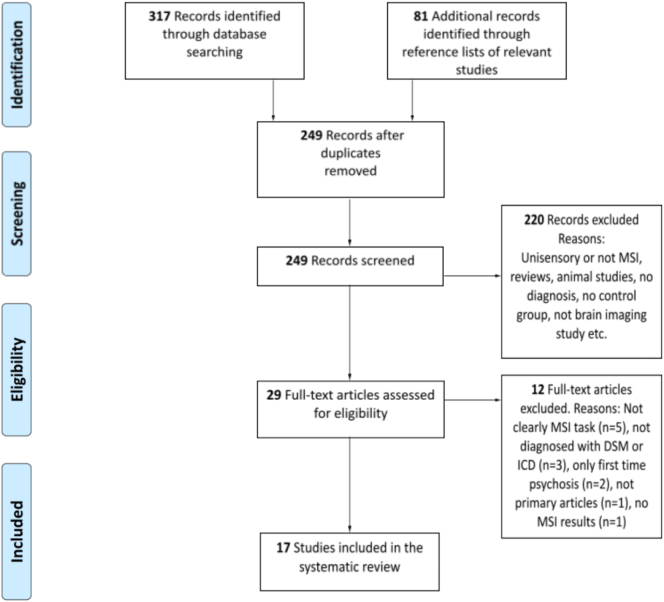
Multisensory integration (MSI), in which sensory signals from different modalities are unified, is necessary for our comprehensive perception of and effective adaptation to the objects and events around us. However, individuals with schizophrenia suffer from impairments in MSI, which could explain typical symptoms like hallucination and reality distortion. Because the neural correlates of aberrant MSI in schizophrenia help us understand the physiognomy of this psychiatric disorder, we performed a systematic review of the current research on this subject. The literature search concerned investigated MSI in diagnosed schizophrenia patients compared to healthy controls using brain imaging. Seventeen of 317 identified studies were finally included. To assess risk of bias, the Newcastle-Ottawa quality assessment was used, and the review was written according to the Preferred Reporting Items for Systematic Reviews and Meta-analysis (PRISMA). The results indicated that multisensory processes in schizophrenia are associated with aberrant, mainly reduced, neural activity in several brain regions, as measured by event-related potentials, oscillations, activity and connectivity. The conclusion is that a fronto-temporal region, comprising the frontal inferior gyrus, middle temporal gyrus and superior temporal gyrus/sulcus, along with the fusiform gyrus and dorsal visual stream in the occipital-parietal lobe are possible key regions of deficient MSI in schizophrenia.
多感官整合(MSI)是指来自不同感觉模态的感觉信号被统一起来的过程,它对于我们全面感知和有效适应周围的物体及事件而言是必不可少的。然而,精神分裂症患者存在多感官整合障碍,这可以解释幻觉和现实扭曲等典型症状。由于精神分裂症中异常多感官整合的神经关联有助于我们理解这种精神疾病的面相学,我们对该主题的当前研究进行了系统综述。文献检索涉及使用脑成像技术,将已确诊的精神分裂症患者与健康对照者的多感官整合情况进行对比研究。在317项已识别的研究中,最终纳入了17项。为评估偏倚风险,我们采用了纽卡斯尔-渥太华质量评估法,并根据系统综述和Meta分析的首选报告项目(PRISMA)撰写了本综述。结果表明,精神分裂症中的多感官过程与几个脑区的异常神经活动相关,主要是神经活动减少,这通过事件相关电位、振荡、活动和连接性来衡量。结论是,一个包括额下回、颞中回和颞上回/沟的额颞区域,以及枕顶叶的梭状回和背侧视觉通路,可能是精神分裂症中多感官整合缺陷的关键区域。