Postgraduate Program in Communication Disorders, Tuiuti University of Paraná, Curitiba, Brazil.
Department of Orthodontics, School of Health and Bioscience, Pontifícia Universidade Católica do Paraná, Street Imaculada Conceição, 1155, Prado Velho, Curitiba, Paraná, 80215-901, Brazil.
Int Arch Occup Environ Health. 2022 Jan;95(1):7-24. doi: 10.1007/s00420-021-01775-y. Epub 2021 Oct 21.
This systematic review aimed to evaluate the effectiveness of the use of personal protective equipment (PPE) in closed environments, similar to waiting or exam rooms of healthcare facilities, in the face of exposure to a bioaerosol.
Combinations of words were selected for six electronic databases and for the gray literature. To consider the eligibility of the studies to be included/excluded, the acronym "PECOS" was used: humans and/or experimental models that simulate aerosol (Population); aerosol exposure and the use of masks/respirators (exposition/intervention); controlled or not controlled (comparison); effectiveness of PPE and the receiver exposure (outcomes); and randomized clinical studies or not, observational or laboratory simulation studies (Studies design).
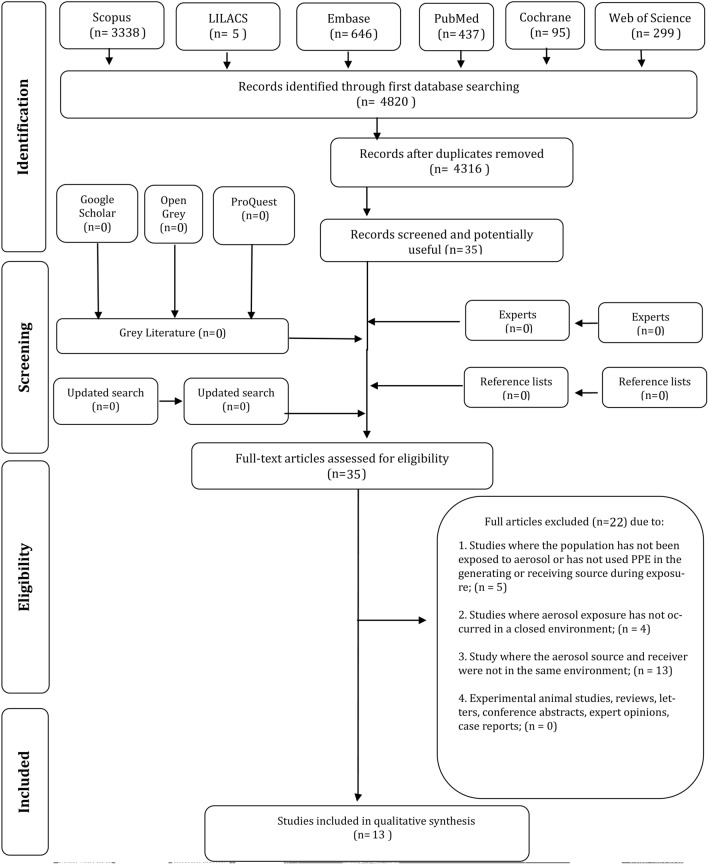
A total of 4820 references were retrieved by the search strategy. Thirty-five articles were selected for complete reading, of which 13 articles were included for qualitative synthesis. A surgical mask or N95 respirator reduced the risk of transmission, even over short distances. The use of masks, even those with less filtering power, when used by all individuals in the same environment is more effective in reducing risk than the use of respirators with high filtering power for only some of the individuals present.
The use of mask in closed environments is effective in reducing the risk of transmission and contagion of a contaminated bioaerosol, with greater effectiveness when these devices are used by the source and receiver, regardless of the equipment's filtering power. (PROSPERO 2020 CRD 42020183759).
本系统评价旨在评估在面临生物气溶胶暴露时,在类似于医疗保健设施的候诊室或检查室内使用个人防护设备(PPE)的效果。
选择了六个电子数据库和灰色文献的组合词。为了考虑纳入/排除研究的资格,使用了缩写“PECOS”:模拟气溶胶的人类和/或实验模型(人群);气溶胶暴露和口罩/呼吸器的使用(暴露/干预);是否控制(比较);PPE 的效果和接收者暴露(结果);以及随机临床研究或非随机临床研究、观察性研究或实验室模拟研究(研究设计)。
通过搜索策略共检索到 4820 篇参考文献。选择了 35 篇文章进行完整阅读,其中 13 篇文章被纳入定性综合分析。外科口罩或 N95 呼吸器可降低传播风险,即使在短距离内也是如此。在同一环境中,即使使用过滤效果较差的口罩,也比仅对部分在场人员使用过滤效果较高的呼吸器更能有效降低风险。
在封闭环境中使用口罩可有效降低受污染生物气溶胶传播和感染的风险,当源和接收者都使用这些设备时,无论设备的过滤效果如何,其效果都更大。(PROSPERO 2020 CRD 42020183759)。